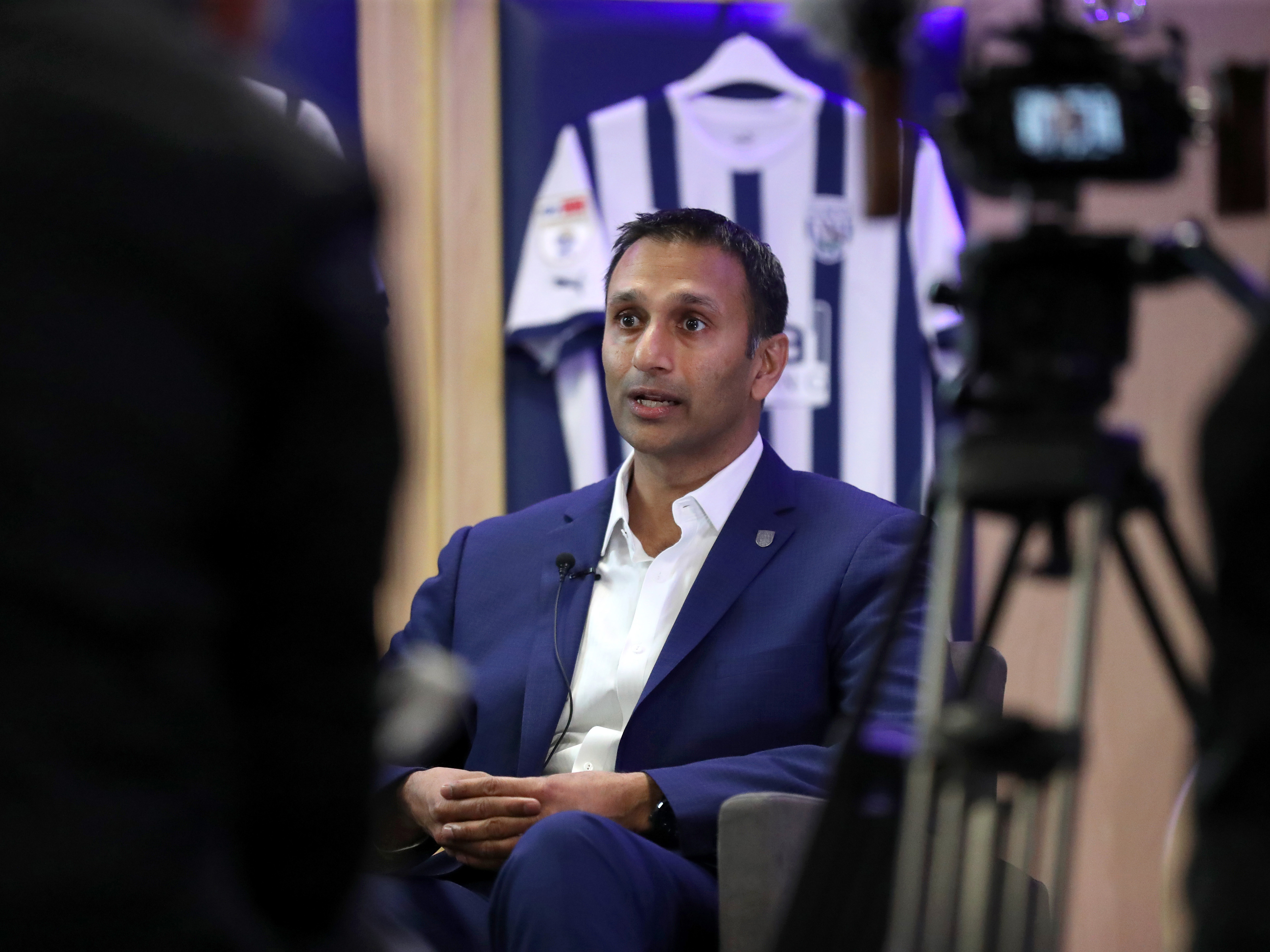
In August 2024, Shilen Patel went to a meeting. For a football chairman, this should barely qualify as an anecdote. Yet his arrival at the Albion Assembly earned a small place in the club’s records: he was the first owner and chairman to attend. Six months after buying into West Bromwich Albion, the businessman from Tampa was sitting with supporters who had questions. Ownership had acquired a face, and that face had to listen.
The meeting concerned the things that make a club a daily presence in people’s lives: ambition, money, communication, the experience of turning up. Such gatherings offer limited glamour. Nobody buys a football club for the minutes. But minutes can tell you something a photograph with a scarf cannot: whether the person holding the scarf is prepared to come back when the questions begin.
A family business in belonging
Patel’s interest in gathering people predates The Hawthorns. His grandfather moved from India to Zambia and helped establish a social and athletic club for an Indian community facing segregation. Families finding their feet stayed in his home. Decades later, Shilen would still meet people who remembered that hospitality through their own fathers and grandfathers. A building could be a place to begin again.
Born in Tampa, Patel grew up with that family history and with parents, Kiran and Pallavi, whose business success and philanthropy became prominent features of the city. His own childhood, as he described it, was comfortable and full of relatives and family friends. He was also a quiet, imaginative reader. The future chairman’s early audience was largely inside his head.
In 2022 he put one uncompleted ambition into a sentence: “My goal is to own a soccer team.” Two years later, that wish had a postcode in the Black Country. Between the grandfather’s club and the grandson’s purchase lies a recurring question: what do people need from a place they call theirs?
Tampa, with the world attached
His education gave him several vantage points. He completed his undergraduate business studies at Babson College in 2002, concentrating on entrepreneurship, then earned MBAs from Columbia University and London Business School through their joint EMBA-Global programme in 2013. The itinerary suits someone whose base remained Tampa while his business interests travelled considerably farther.
Patel’s working life included leading Visionary HealthWare before its sale in 2011 and serving as owner and chief executive of HealthAxis from 2011 to 2022. Those years matter here as experience of running organisations: building teams, living with decisions and handing over a business. His later investments reached across technology, real estate, finance, food and sport. The football chairman had spent years making choices without a terrace offering immediate feedback.
He also became an executive in the family office. In 2023, he acquired Fitlife Foods and became its chairman. These are different kinds of businesses, with different customers and different operating demands. Their variety helps explain why his public identity resists a single company name. HealthAxis belongs to his career; it does not contain the whole of it.
The route to The Hawthorns
- 2002Babson business degree
- 2013Columbia + London Business School MBAs
- 2014Minority investment in Bologna
- 2024West Bromwich Albion chairman
The cheque was only the admission price
On 28 February 2024, Bilkul Football WBA, ultimately owned by Shilen and his father, completed its acquisition of 87.8 per cent of West Bromwich Albion Group Limited. Shilen became chairman. He already held a minority stake in Bologna, acquired in 2014, so English football was a larger responsibility within an existing interest. This time, the decisions would carry his name.
At the takeover he chose the word custodian. He wanted Albion to become a consistent Premier League presence and accepted that the work would take time. The distinction matters because the asset came with generations of people who had no intention of treating their allegiance as a temporary investment. A shareholding can change hands on a Wednesday afternoon. A supporter’s claim is harder to put in a transaction document.
His first interview laid out a preference for collaboration, capable colleagues and clear responsibility. “My key values are trust and transparency,” he said. He wanted to establish a vision and a stable environment, then allow a team to carry out the work. He also acknowledged the amount he needed to learn. It was an owner’s introduction with rather more homework than coronation.
That promise gives supporters something concrete to judge. Delegating to a trusted team still leaves a chairman responsible for choosing it. Being open requires explaining the decisions that disappoint people as well as those that earn applause. Patel had set himself a standard that would become harder, and more useful, when the club struggled.
“My key values are trust and transparency.”
Shilen Patel, February 2024
Some changes need no trophy cabinet
In his summer 2024 letter, Patel announced that Albion’s women’s team had been incorporated into the club. Previously it had operated as a separate company, although the club financed it. He regarded that separation as something to correct. It was an organisational change with a plain human consequence: the women were formally part of the same club whose name they wore.
That letter also confirmed that the Wisdom Smart loan had been paid off and that the owners were continuing to fund a loss-making operation. The combination is a useful picture of his first months. Bringing teams together and dealing with old obligations happened alongside the football. Neither job could wait politely for promotion.
By June 2025, his attention included the Category 1 academy, the women’s Challenge Cup victory and alterations around The Hawthorns. He described paintwork, ticketing improvements, safe standing and the return of hawthorn trees to the ground. There was a pleasantly literal quality to that last project. Occasionally, making a football institution feel more itself involves planting the thing on the sign.

The scoreboard answers back
At his first anniversary, Patel picked the home play-off semi-final against Southampton as a favourite experience, despite the eventual disappointment. The anticipation and the crowd’s energy had shown him what the ground could feel like. He also described a less photogenic lesson: how many parties shape a club’s choices. Owners, leagues, other clubs, players and supporters all occupy the same complicated field.
He wanted a younger squad with room to develop, alongside a business capable of planning beyond the next month. Those were his stated aims in February 2025, rather than proof of a completed transformation. Football is particularly good at interrupting the moment when an executive might like to declare a strategy settled.
In April 2026, Albion received a two-point deduction for breaching the permitted loss threshold over the three-year period ending June 2025. The club disputed important aspects of the ruling, including the treatment of community development expenditure, and chose not to appeal. It said the deduction had not changed its final league position. The sanction remained a result the ownership had to face.
The June 2026 letter was consequently a different sort of communication. Patel apologised for the season’s failures and accepted responsibility. “Last season, we fell far short, and I take full responsibility for that.” He backed James Morrison, described changes in the executive structure and maintained his emphasis on developing players. Here was the public test of the language he had used on arrival: explaining a poor outcome while remaining answerable for what followed.
Two dates, one responsibility
Trust and transparency set out as leadership values.
An apology to supporters and acceptance of responsibility for the season.
A community is allowed to ask for more
Back in Florida, Patel had already taken on roles where relationships extended beyond a customer contract. In 2017 he co-founded and chaired the $3 million TiE Tampa Bay Angel Fund. Its purpose included financing Florida startups and helping local investors understand angel investment. In January 2021, he was appointed to a five-year term on the University of South Florida Board of Trustees. He is also a founding director of Central Bank.
Those commitments place him among the people who decide which local projects get attention, capital and patient support. They also make the move into football less abrupt than it first appears. A university, a community bank, an early-stage fund and a club all need people willing to remain involved after the announcement. Each produces its own version of a difficult meeting.
Patel’s present roles include chairman of Albion and chairman, president and co-founder of Bilkul Football Group. The titles establish his authority. His correspondence with supporters establishes something more demanding: a record against which his decisions can be measured. He has asked people to believe in a future while acknowledging that his organisation has fallen short in the present.
The distinction between an investor and a custodian becomes especially interesting here. An investor can describe a holding by its size, purchase date and expected return. A custodian has to account for how other people experience the place. That includes supporters who would never use the word stakeholder about themselves, because they have a simpler word available: fan. Their attachment creates both the opportunity Patel wanted and the scrutiny that comes with it. The two arrive together.
That leaves the story open in a useful place. The boy who invented worlds in his head now shares responsibility for an institution whose world was built long before he arrived. Its supporters have their own memories, expectations and opinions about the next chapter. Patel can fund the work, choose colleagues and explain the plan. He will also have to keep coming to the meetings.