At a job fair in a Waterloo bar called Chainsaw, Paul Donald had an idea to discuss: an app for keeping track of the things in your house. Appliances. Their manuals. The expensive objects whose model numbers become interesting only after something has gone wrong. It was a modest subject for a room full of people considering what to build next. Nobody has ever impressed a dinner party by announcing that the dishwasher paperwork is finally in order.
Ronuk Raval listened. A University of Waterloo student involved with the Velocity entrepreneurship community, he took Donald’s proposition back to his friends. One, Christophe Biocca, wanted to work on it. The three became Encircle’s co-founders. The company began in 2012, with a question that would prove more durable than its original consumer pitch: how do you put useful information within reach of the person who needs it?
Donald had already spent years in businesses built around moving information. Encircle would take him into property restoration, where the quality of a photograph can matter to someone’s invoice and the absence of one can keep an argument alive. The subject sounds administrative. The consequences arrive in actual homes, actual businesses and actual bank accounts.
The appliance manual was the opening act
There was a practical generosity to the first idea. A household owns an impressive quantity of things and an unimpressive system for remembering them. Receipts disappear into drawers. Instructions stay in boxes. A model number becomes a small archaeological expedition. Donald’s proposed inventory put photographs and product information together, with records stored online so they could survive the loss of the computer used to create them.
Carolyn Nolan, then director of operations at Waterloo’s Accelerator Centre, understood the appeal. A dishwasher fire in 2011 had displaced her family’s possessions. Among the things they missed was their filing cabinet, with the receipts and product records needed to reconstruct what they owned. Rebuilding that information meant searching for individual items. The seemingly dull cabinet had been doing rather important work.
The early Encircle app addressed that sort of problem, but Donald also saw a broader consumer product library: a place to keep information useful throughout ownership. The idea had occupied him for years. An inventory could help after a loss; a manual could help long before one. This was software aimed at the gap between possessing something and having the information necessary to deal with it.
What if the record of your belongings could survive the belongings?
A career spent getting information from here to there
Encircle was an experienced founder’s next undertaking. Donald had founded and led PeerDirect, which he sold to Progress Software in 1999. He subsequently worked at Research In Motion, the BlackBerry company, during a decade when mobile communication was becoming a daily business habit. His responsibilities included independent software vendor alliances and, later, the company’s CDMA business.
Those roles put him close to two problems that would recur at Encircle: getting different organizations to work together and making technology useful away from a desk. A phone’s value depends on the people and systems it connects. For Donald’s later customers, a field record would also need to travel beyond the person holding the device.
After BlackBerry, he became chief operating officer at PushLife, a mobile entertainment startup acquired by Google in 2011. His path had already crossed enterprise software, smartphones and consumer mobile services before it reached a homeowner photographing a refrigerator. The products changed. Information moving between people remained part of the work.
Waterloo supplied connections as well as technical talent. Mike Kirkup, who had worked with Donald at BlackBerry, later left his role directing Waterloo’s Velocity program to join Encircle. Kirkup already knew Donald and the other founders. His move reflected the close relationships around the young company, where a university entrepreneurship network and earlier professional ties met.
The photograph that has to persuade a stranger
Property claims gave Donald’s interest in shared information a sharper purpose. Homeowners, contractors and insurers could look at the same loss from different positions, with different incentives and different records. He saw how missing visual evidence left room for distrust. A written description might leave the reader wondering what the writer had seen, while a photograph could make the condition visible to everyone.
Encircle ran a pilot with Northbridge Insurance in the summer of 2015. The relationship later included Fairfax and its FairVentures innovation lab. It tested a practical proposition: people involved in a claim could share visual information without waiting for each step of a conventional paper process. The phone camera was already available. The harder work was organizing what it captured and getting it to the right people.
Donald also spent four months in the restoration field, an experience he discussed in a 2023 interview. That matters when considering the direction Encircle took. Its users were dealing with buildings and belongings, while software asked them to produce a readable account of the work. Understanding that job required more than understanding what a smartphone could technically do.
By 2022, a partnership with Crawford Contractor Connection brought Encircle Hydro into a managed repair network’s water-mitigation workflow. Hydro guided technicians through collecting moisture details and assembled the information into reports. Readings, equipment calculations and the progress of drying had to become understandable to a reviewer elsewhere. It was a specific, unglamorous test of whether a field application could serve both ends of a claim.
“If it wasn’t documented, it didn’t happen.”
Paul Donald, IAQ Radio, 2023
Donald’s formulation is stern enough to belong over an office photocopier. It describes a recurring difficulty in his chosen industry: completed work and demonstrable work have different routes through a payment process. Encircle organizes photos, videos, notes and other job details so that the contractor’s explanation can travel with the evidence.
- 01 / CapturePhotos, video, notes and readings from the property.
- 02 / OrganizeDetails connected to the job and its rooms.
- 03 / ExplainA report or scope someone elsewhere can review.
He keeps turning up for the shop talk
The public picture of Donald is populated by restorers. His conversations range from documentation and estimates to how a contractor builds a functioning operation. He is also an active mentor, coach and angel investor in the Kitchener technology community. The established executive who went looking for collaborators at a bar has remained involved in helping other businesses develop.
In a 2026 operator discussion, he brought together Brandon Reece, Lukas Szczurowski and Josh Bachman to talk about running restoration businesses through changing conditions. The discussion followed the business from incoming work to cash collected. Donald’s interest extended beyond the capture of a good photograph to whether the organization behind it could operate consistently as it grew.
There are lighter demonstrations of that same appetite for practical work. In one company gathering, Encircle colleagues built cardboard boats and paddled them on the Grand River. Donald publicly celebrated the team’s success. A software company can discuss collaboration indefinitely; a cardboard hull gives everyone a more immediate reason to agree on the details.
His public praise also returns to customers. In 2017, two LinkedIn articles celebrated work with Superior DKI and Paul Davis. Their titles focused on the satisfaction of being a CEO when customers succeed. Years before the latest AI announcements, he was putting individual restoration businesses in the foreground of his account of Encircle.
AI, with someone still checking the work
By 2026, the information Encircle collected had another job. Its AI tools could turn walkthrough videos into structured notes, describe contents from photos and capture readings from images of meters. Encircle Scope used field documentation to assemble a mitigation scope room by room. The work that previously supported a report could now help produce a draft.
Donald described the shift as “moving your experts from authors to editors.” That is a revealing choice of roles. An editor remains responsible for judgment. A generated document still needs scrutiny, and Encircle describes its outputs as editable. The proposition depends on the quality of what crews record before the software begins writing.
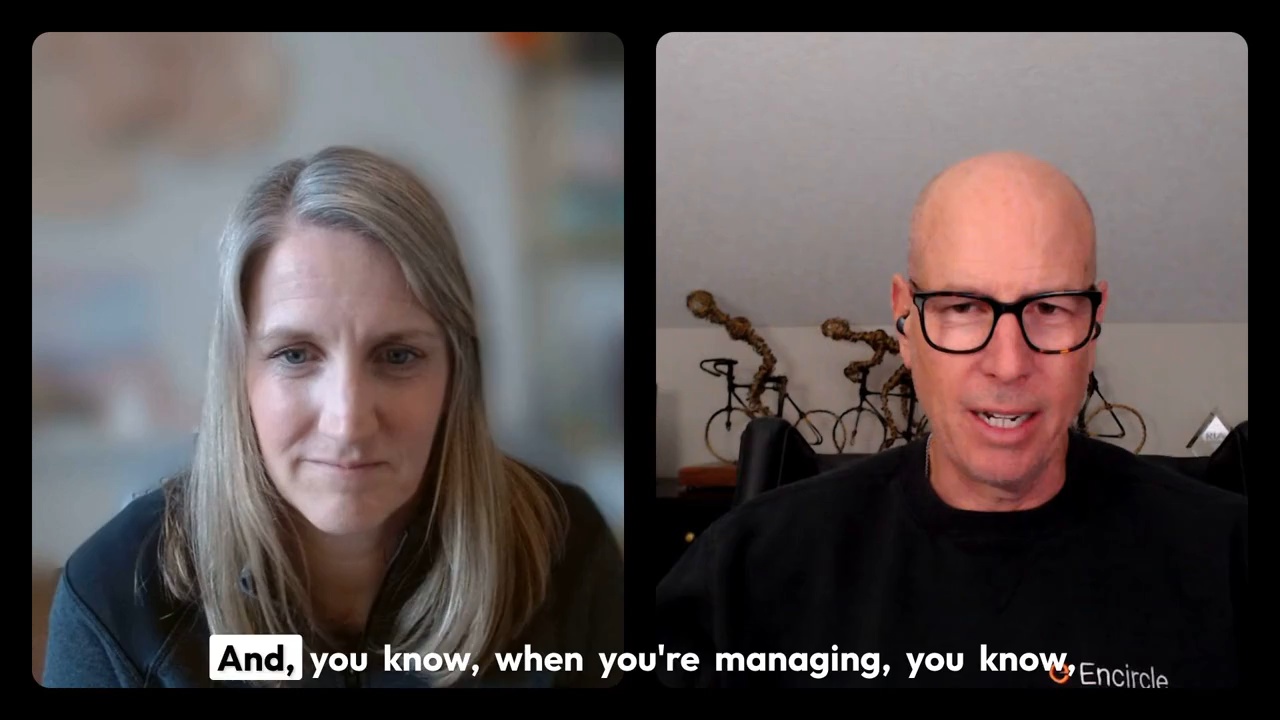
After the 2026 Restoration Industry Association gathering in Savannah, he discussed the questions contractors were asking about AI. He returned to the field data behind it. A contractor needs an account of a particular property, with enough detail to support the work proposed. The attraction of an instant answer does not remove the need to record the room.
His August 2026 conversation with Andy McCabe went into another piece of the same problem: mitigation billing. They examined class-based drying prices and what wider adoption would require. Documentation remained central, including the explanation of why work was necessary. Donald was still talking about how someone who had never visited the property could follow the contractor’s reasoning.
There is measurable business growth around that continuing argument. Encircle reported three-year revenue growth of 140% in the 2024 Canada’s Top Growing Companies ranking and 235% in 2025. Those are separate rolling periods, rather than annual growth rates. The distinction suits a story concerned with what a number actually says.
Three-year revenue growth reported for each year’s ranking. The measurement periods overlap.
United Policyholders offers another measure of the original idea’s usefulness. The nonprofit credits Donald and Encircle with creating and donating its home-inventory app for public use. Beneath the professional restoration tools, the household record still has a place. Someone needs to know what was there.
That gives Donald’s story an unusually tidy return to its beginning. The appliance manual, the inventory photograph, the drying record and the AI-assisted scope all ask information to remain useful after it changes hands. His ambitions have grown more technical. The demand underneath them is familiar: show the next person enough that they can understand.
- EncircleCompany website and product information
- Paul Donald on LinkedInHis public professional profile
- The founding conversation at ChainsawUniversity of Waterloo / 2022
- FNO: InsureTech, episode 235Listen / 49 minutes / October 2023
- The Mit List: Paul on AI in restorationWatch and read / May 2026
- The future of mitigation billingWatch on YouTube / Paul Donald with Andy McCabe / August 2026
- Software integration and field documentationIAQ Radio / December 2023
- The donated home-inventory appUnited Policyholders
- Encircle’s 2024 and 2025 growth recognitionCompany news / the later announcement