Consider the predicament of an insurance specialist. You understand a narrow corner of commerce, the peculiar risks other people overlook. You can find customers and judge which ones deserve coverage. But the money behind those policies belongs to somebody else. Your expertise has a landlord. If that landlord changes appetite, your plans can change with it.
- Accelerant connects specialist underwriters with insurance capital.
- Members get data tools, expert support and five-year capacity agreements.
- The exchange earns premium-linked fees and also retains some insurance risk.
Accelerant was built around this awkward dependency. Jeff Radke and Chris Lee-Smith launched the business in Europe in 2018. Radke brought a career in insurance, including leadership at PXRE and strategic work at Argo. The interesting question was how to make an independent underwriter’s knowledge easier for capital providers to understand, trust and finance.
The five-year difference
In insurance, “capacity” means the financial backing that allows an underwriter to write business. An MGA, or managing general agent, can have the expertise and authority to underwrite without supplying all the balance-sheet capital itself. Accelerant calls these specialists its Members. The company offers five-year capacity agreements, alongside a shared digital platform and hands-on support.
Five years is a business decision disguised as a contract term. It gives a specialist a longer horizon for hiring, product development and distribution relationships. That is the logic, anyway. Accelerant’s website supplies a vivid customer account from Will Johnson of ARU: “The five-year commitment changed our world so substantially that it nearly defies description.” Treat that as a customer testimonial, rather than a promise of what every member will achieve.
“The five-year commitment changed our world so substantially that it nearly defies description.”
Will Johnson / ARU, in an Accelerant testimonial
The member still needs to underwrite well. Accelerant looks for experienced teams, proven performance, digital data capture and transparency. Its stated appetite centers on small and midsized commercial clients, with limited coastal catastrophe exposure. The proposition has boundaries: a specialist seeking opaque reporting or a portfolio dominated by peak catastrophe risk would be a poor match.
First, make the risk legible
The other customer sits across the table: an insurer, reinsurer or institutional investor with capital to deploy. A collection of unfamiliar specialist books creates a problem of interpretation. What is being insured? How is it performing? Where are exposures accumulating? Before money can move confidently, those questions need consistent answers.
commercial risks
Monitor portfolios
Connect capacity
institutional investors
Accelerant’s technology ingests, validates and transforms member data. Dashboards track written premium, loss ratios, claims and retention. Automated monitoring helps surface changes in a portfolio. During the second quarter of 2026, the company introduced ARC, an AI agent designed to recognize, classify and structure data as it arrives. The useful work begins before a chart appears: making unlike inputs comparable.
That suggests a lesson other marketplace builders can copy. Standardize what buyers need to know before celebrating how many sellers have signed up. In Accelerant’s case, the proposition also includes underwriting, actuarial, claims and regulatory expertise. Its careers material emphasizes autonomy and teamwork; the operating model gives those aspirations a practical test, because software and insurance judgment must work together.
An exchange with a balance sheet
Accelerant is more involved than a directory that introduces two parties and disappears. Insurers joining the exchange pay a percentage-of-premium fee for sourcing, managing and monitoring business. The group also has MGA operations and owned insurance and reinsurance companies. Those entities provide capacity and retain some exposure to claims. Calling the whole thing a software subscription would miss a consequential part of the machinery.
The alternatives are familiar: negotiate directly with carriers, use brokers to reach capital, or assemble technology and services separately. Accelerant packages those relationships around a common data layer. Some organizations can be both alternatives and partners. Hadron, Incline and MS Transverse have participated as third-party insurers; the company also disclosed a facility involving six Lloyd’s syndicates.
By June 30, 2026, Accelerant reported 314 members and $4.6 billion in trailing twelve-month exchange written premium. Premium is the insurance business flowing through the system, not Accelerant’s revenue. Its 2025 total revenue was $912.9 million. Distinguishing the flow from the company’s own income is essential to understanding the business.
The bill, and the friction
Building this required actual capital. A 2022 equity round raised $193 million, led by Eldridge. The July 2025 IPO delivered $393.4 million in net proceeds to Accelerant. Its filing identifies $23.4 million in underwriting discounts and commissions and an estimated $9 million in offering expenses. Proceeds also funded a $175.3 million preference-share redemption and a $25 million termination fee to an Altamont affiliate.
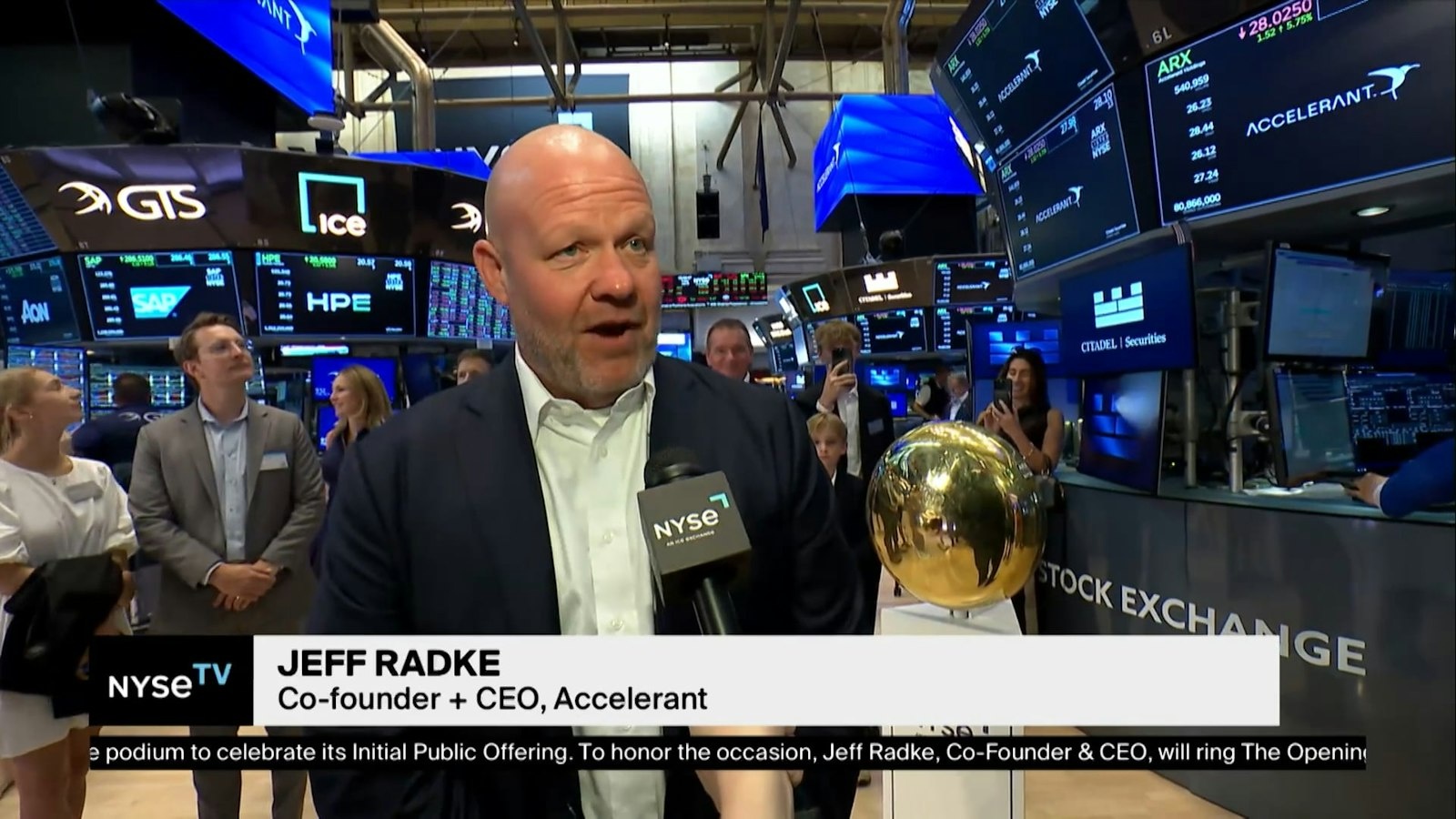
Expansion did encounter resistance. In September 2025, The Insurer reported that an initial proposed Lloyd’s syndicate launch had faced pushback and a revised plan was being prepared. Later disclosures described the six-syndicate facility. The sequence shows the importance of finding workable routes to capacity; it does not establish that one arrangement directly replaced the other.
A longer runway, again
In August 2026, Thoma Bravo agreed to acquire Accelerant for $20.25 per share in cash, at an enterprise value above $4 billion. Accelerant said private ownership would support further investment. Its September update reported no competing proposal during the go-shop period. Closing remained expected in the first half of 2027, subject to shareholder and regulatory approvals.
The argument ultimately rests on whether better information keeps expertise and capital working together. That requires reliable data, disciplined underwriting and partners willing to stay. For a specialist deciding whether to join, the practical questions are wonderfully unglamorous: Does the risk appetite fit? What does the agreement commit? Can both sides see enough to make the next decision?