A restoration contractor can dry the wall, save the floor and still lose money because somebody forgot to photograph the baseboard. That is the oddly specific economic territory Encircle occupies. The Kitchener, Ontario company makes mobile and web software for the people who arrive after water, fire or mold has damaged a property. Its app gathers the photos, video, notes, moisture readings, floor plans, signatures and contents lists that explain what happened - and what the repair should cost.
It sounds like a filing cabinet. In practice, it is closer to an evidence pipeline. A technician records the loss room by room. The office sees the job in real time. An estimator uses the same material to write a scope. An adjuster receives a coherent report instead of a camera roll and a plea. Encircle's pitch is not that paperwork becomes delightful. It is that documentation done once, at the source, should keep paying for itself downstream.
01The first thing that failed was memory
The enemy was not a rival startup. It was the handoff. Restoration crews worked across paper, generic photo apps, sketch tools, drying logs and estimating software. Notes went missing. Photos arrived without room labels. Technicians postponed documentation until they reached the office, when the details had already softened. One Encircle partner remembered crews using as many as five apps on a job. The result was extra administrative time and a weaker claim file.
That weakness has a price. Insurance restoration is full of legitimate work that must still be justified: why equipment remained for another day, where moisture persisted, which contents were packed, what damage existed before the crew arrived. If the proof is incomplete, an estimate can be compressed or bounced back. The contractor does the work, then pays again in delay, rework or an unbilled line item.
“There’s a direct correlation between how much restorers get paid, how quickly they get paid, and their documentation.”Gregg Sargent / Restoration Made Simple
Encircle's founders - Paul Donald, Ronuk Raval and Christophe Biocca - started the company in 2012. The early idea was home inventory, a broad consumer problem. The sharper business emerged in property claims, where information is not merely useful but contested. That shift mattered. A generic inventory app stores things. Restoration software has to preserve a story under pressure, function in a basement without reliable Wi-Fi and produce something an insurer can audit.
02What they actually built
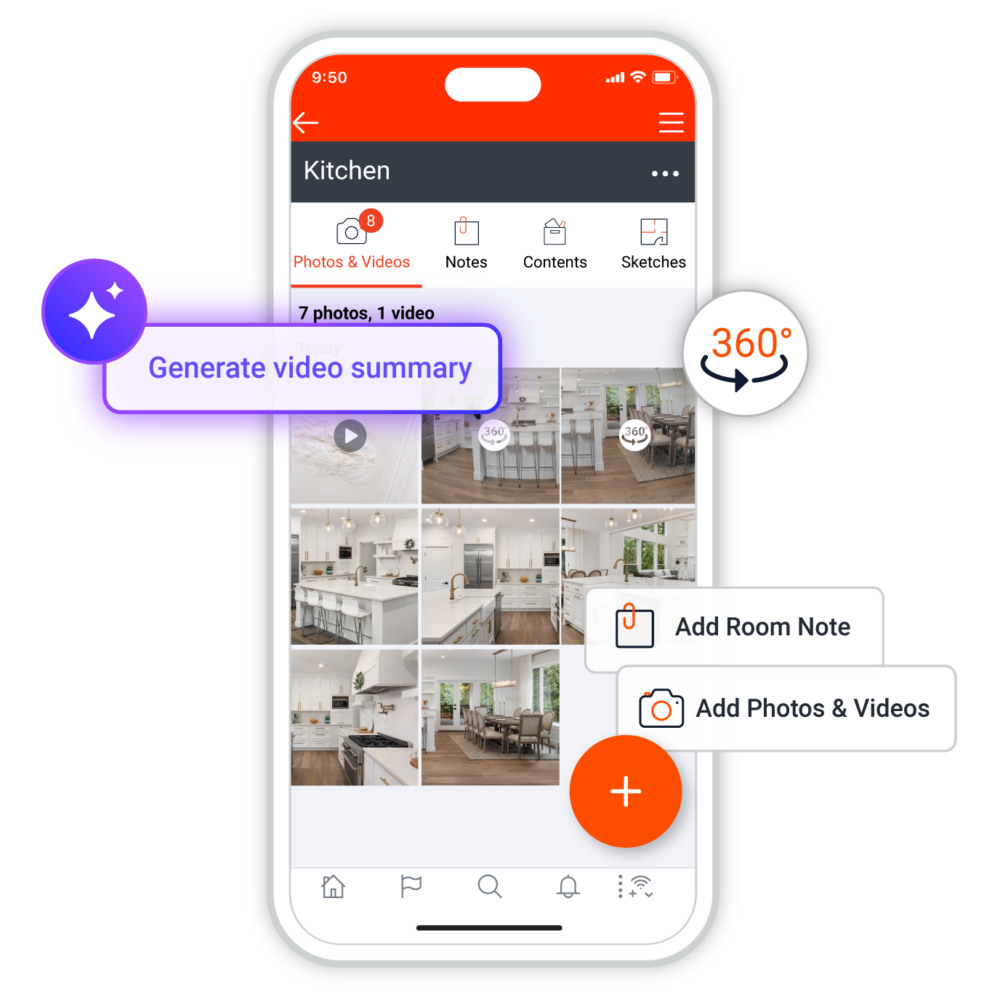
The core app organizes evidence by job, structure and room. Crews can capture conventional and 360-degree photos, video walkthroughs, notes, custom forms and e-signatures. Offline mode and automatic syncing address the unromantic reality that disaster zones make poor coworking spaces. Reports assemble the captured material for property owners, adjusters, carriers and office staff.
Around that spine, Encircle added specialist workflows. Hydro records moisture and psychrometric readings, builds drying logs and maps affected areas. Contents catalogs personal property, boxes and movement during a packout; its newer QR tools let a worker scan a box into a truck, vault or other location. Floor Plan turns phone or tablet capture into a 2D plan, with an optional path into Xactimate. Payments collects deposits and deductibles in the field. The Edge, acquired in November 2025, produces rough-order-of-magnitude budgets using production rates and historical cost ratios.
The newest layer is Encircle AI. The company says its system combines computer vision, spatial calculations, language models, restoration logic and IICRC standards. Scope reads the existing job evidence and drafts a mitigation scope for an estimator to review. Other features summarize video walkthroughs, read meter displays from photos, clean up notes and describe inventory items. Encircle frames the change vividly: a 12-hour scoping task becomes roughly 10 minutes of review, while the draft may arrive 90 to 95 percent complete. Those are vendor claims, not laws of physics. The useful idea is still sound - the AI begins with the job file rather than an empty chat box.
03What it costs - and what customers say it saves
Encircle sells subscriptions to restoration businesses, generally sized by annual job volume rather than seats. One public campaign page advertises a starting price of US$270 a month for up to 200 jobs a year with unlimited users. Floor plans, an Xactimate sketch and products such as Scope or Edge can add fees. The company offers a 14-day trial without a credit card. Buyers should treat the advertised starting figure as a doorway, not a final invoice.
The return is easier to understand than the packaging. Encircle says streamlined handoffs can save about four hours per job. In published customer stories, Ultra Clean Service Corp reported 20 percent higher job profitability and estimates ready within 12 hours. Restoration 1 of Washington said better documentation helped it double revenue and reach $5 million. A separate customer cut contents paperwork time by 60 percent. These are individual outcomes, selected by the vendor, and they should not be averaged into a promise.
The copyable lesson is upstream.
- Find the costly decision downstream.
- Own the messy data created upstream.
- Make capture easy enough for frontline workers.
- Reuse the same record in reports, estimates and payment.
The more revealing case is a change of mind. Ultra Clean owner Deborah Zupke described herself as uncomfortable with technology and observed that restorers chose field work for a reason. A consulting partner recommended Encircle; Floor Plan helped win her over because it saved time, supported faster estimates and made a small operation present itself with the organization of a larger firm. No grand digital-transformation speech was required. The tool removed a task she disliked and improved a conversation she had to have.
04The moat is the crew using it on Tuesday
Encircle competes across several overlapping markets. CompanyCam handles job-site photos across trades. DocuSketch and Matterport lean into 360 capture and property models. magicplan focuses on floor plans. Xactimate is deeply embedded in insurance estimating. Restoration suites such as DASH, MICA, Albiware and iRestore cover wider operational territory. Some are competitors; some remain systems Encircle must complement because carriers or third-party administrators require them.
Encircle's difference is breadth inside a narrow profession. A single app can capture a 360 image, record a moisture reading, inventory a sofa, generate a floor plan and package the evidence. The room and timestamp structure reduces manual labeling. Integrations and camera partnerships with Verisk, Ricoh, Insta360 and Tramex extend rather than replace the field record. In July 2026, Insta360 X-series support became available to customers without an extra subscription charge.
The company has institutional evidence of traction, too. It won the Restoration Industry Association's Contractor's Choice product award in 2022 and 2023. In 2025, it ranked No. 154 on The Globe and Mail's list of Canada's Top Growing Companies with reported three-year growth of 235 percent - its sixth consecutive appearance. The Canadian government committed C$2.1 million in 2022 to improve real-time claim monitoring, expand exports and support 20 skilled jobs. Encircle has also completed a SOC 2 Type 2 examination, a relevant credential for software holding property and claim data.
05What breaks the model
This approach is not universal. A plumber who needs a few timestamped photos may find restoration-specific workflows excessive. A tiny shop with low claim volume may prefer a cheaper point tool. A contractor locked into a carrier's TPA process may still have to enter data elsewhere. Firms seeking a complete CRM, scheduling and accounting system will need Encircle alongside other software, not instead of it.
AI also magnifies the oldest constraint. A scope cannot recover a wall the technician never photographed or a reading nobody took. Encircle can guide capture, organize evidence and flag omissions, but it cannot make indifferent field habits disappear. Its economics work best when claim volume is high enough to reward consistency, managers enforce a standard workflow, estimators review machine drafts and the outputs fit carrier expectations. Without those conditions, the evidence pipeline becomes an expensive camera roll.
The defensible advantage is not “we have AI.” It is: the crew already captured the truth.
That is the piece other founders can steal. Begin with the awkward moment when reality becomes data. Speak the industry's language. Make the frontline employee's job shorter, not merely the executive's dashboard prettier. Then travel with the record toward progressively more valuable work. Encircle moved from inventory and documentation into floor plans, drying, contents, scoping, estimating and payments. Each step asks the same job file to do another job.
There is something pleasingly modest about the whole machine. A wet baseboard gets a photo. The photo keeps its room, time and author. The scope remembers it. The invoice can defend it. Software rarely gets to stop water damage. Encircle is betting it can stop the work from evaporating afterward.
Continue the field trip