Shelley Reinstein began Autumn Communications around her kitchen table. By April 2026, she was describing a team of nearly 200 people spread across multiple divisions. The furniture had become a founding anecdote. The problem it represented had grown considerably: how do you keep people working together when there are enough of them to fill an entirely different kind of room?
A kitchen table is a useful headquarters for a young agency. Departments have trouble keeping their distance when there is nowhere to put the distance. Later, success supplies offices, titles and specialists. It also supplies opportunities for an idea to get lost between them. Reinstein has built her business around a practical response to that problem: bring more of the work into the same company, then give the people doing it a reason to collaborate.
Her public account of the journey is unusually collective. When recognition arrives, she talks about the team, clients and managing partner Ashley Carone. Even the kitchen-table recollection leads quickly to other people. “Growth isn’t linear,” she wrote while announcing her selection as an EY Greater Los Angeles award finalist. That short sentence is a sensible place to begin. The story is fuller than a rising headcount.
Before the table, a social network
Reinstein studied marketing and communications at Michigan State University from 1999 to 2003. She worked in marketing at Myspace between 2006 and 2009, before founding Autumn in 2009. Her career therefore includes a social platform as well as an agency. That sequence is worth holding onto when looking at a business that now combines press relations with work involving creators, events and online shopping.
There is no need to turn the Myspace job into a prophecy. A previous employer cannot explain every later decision. It does, however, make this a career that crossed the boundary between a platform and the businesses trying to reach people through one. Reinstein’s subsequent service list makes room for both a story and the ways that story travels.
By 2021, Autumn had offices in New York and Los Angeles, a dedicated influencer marketing division and 60 new employees added that year. A larger New York headquarters was part of accommodating that expansion. The agency was serving consumer businesses across food, fashion, entertainment and technology. The assignments were varied; the recurring task was helping a client become intelligible and interesting to somebody outside its own office.
A publicist can arrange an introduction. A creator can make a product familiar. An event can give people something to experience together. These activities involve different skills and different kinds of trust. Building them into an agency gives a founder more ways to answer a brief, along with more people whose judgment she must learn to rely on.
- 2006-09Marketing at Myspace
- 2009Autumn begins
- 2021Dedicated influencer division
- 2024Affiliate and Talent & Creator teams
- 2026Strategy, Insights & AI division
More people at the brief
In 2024, Autumn’s offering widened again. A dedicated affiliate and performance marketing team and a Talent & Creator team joined its public relations and experiential capabilities. The agency was also developing corporate communications work that put client founders forward through speaking engagements, social media and award opportunities. Its customers could ask for help with the person behind a business as well as the product on the shelf.
That last detail suits a founder whose own visibility has accumulated alongside her company’s. In 2022, Reinstein was listed among the speakers for USC Annenberg’s Lead On! women in communication leadership forum. The program combined workshops and networking with leaders from agencies and corporate communications. Running a firm and explaining the work to the next generation were appearing on the same calendar.
Her argument for bringing services together is straightforward. Brands want coordinated help earning attention, selling products and reaching communities. In her description of Autumn’s model, disciplines share a strategy rather than simply occupying the same roof. “Fewer handoffs. Faster execution. Clearer reporting.” Those are modest-sounding promises with substantial consequences for the client who otherwise has to carry an idea between several suppliers.
The word integrated is easy to put on a website. The harder question is what happens when two teams want different things from the same campaign. A producer needs an executable event. A publicist needs a credible angle. A performance specialist needs a measurable next step. Reinstein’s proposition asks them to resolve those questions together, before the client becomes the company’s unpaid traffic controller.
“Fewer handoffs. Faster execution. Clearer reporting.”
Shelley Reinstein, on integrated agencies
A coffee blend leaves the moodboard
The Pinterest and Chamberlain Coffee collaboration offers a compact example of that approach. Autumn helped broker a product collaboration inspired by the “fisherman aesthetic” in Pinterest Predicts, with a Cannes Lions debut. A trend that existed as inspiration became something a coffee brand could make and people could buy. The assignment crossed the borders between platform storytelling, a creator-led business and a physical product.
It is an appealingly literal answer to a familiar communications question. What does an audience do with an idea once it has seen it? Here, the idea could leave the screen. A moodboard had acquired a shopping basket. The work belonged to the agency’s team; its significance for Reinstein is the kind of company she had assembled to take on that assignment.
An earlier relationship shows the same pattern over a longer period. Amazon initially came to Autumn for earned media support. By the 2026 account of the agency’s work, that relationship extended across public relations, creator and talent partnerships, and experiential work, supported by a dedicated 20-person team. The scope had expanded as the relationship continued.
That is a different growth story from winning a new logo every month. An existing client has another problem, then another. Each extension gives an agency more responsibility, and more chances to disappoint. The commercial opportunity depends on keeping enough confidence in the relationship for the next assignment to arrive.
The numbers behind the guest list
Reinstein’s December 2025 recap put some scale around that widening brief. Autumn had welcomed more than 60 new clients and made 46 hires, reaching 168 people. More than half of clients were working with multiple Autumn teams, up from about a third the previous year. She also reported more than $20 million in tracked revenue generated by its affiliate team.
The affiliate figure describes sales attributed to that work. It belongs in a different column from the agency’s own revenue. The distinction matters because public relations increasingly shares a brief with commerce, and because an impressive number is most useful when a reader knows what it measures. A placement and a purchase can both matter without becoming interchangeable.
Autumn’s Free Rein launch case describes the arithmetic at a smaller scale. The initial affiliate goal included a $6 return on ad spend and an incremental contribution of 5 percent of total ecommerce revenue. The agency reports a $16.60 average return in its first full month and more than 5 percent of ecommerce revenue. These are agency-reported campaign results, with a stated goal to compare them against.
The lesson for a founder is less glamorous than the event photograph. Someone has to decide how a campaign will be judged, keep the accounts straight and explain the result. Reinstein’s company has made room for that work beside the people who create the occasion. Attention remains part of the business. So does the spreadsheet.
Affiliate revenue here means attributed sales, separate from Autumn’s own revenue.
The people who come back
There is another set of numbers in Autumn’s record, concerning the people delivering the work. Forty-six percent of staff earned promotions in 2023. Its 2022 account described weekly leadership coaching and workshops with Language and Culture Worldwide, alongside an employee-established inclusion committee. Those details show a company building routines for internal development as it added new client capabilities.
The workplace recognition in 2025 supplied more specific examples. Seven former employees had returned. Junior staff were encouraged to pitch ideas in weekly brainstorms and share successes at agency meetings. Reinstein was described as accessible, involved in client work and active in mentoring. Each practice addresses a different part of the same problem: people need a way to contribute before they have a senior title.
A returning employee is an interesting vote of confidence because it follows a comparison. The person has seen another workplace and chosen this one again. It would be foolish to make seven decisions explain an entire company, but they deserve attention alongside a client count. Agencies sell other people’s time, taste and judgment. Keeping those people is part of keeping the product.
Reinstein’s own response to Autumn’s workplace recognition emphasized building somewhere people could feel supported and challenged. That aspiration is specific to an employer. The test continues after the announcement, in the next review, promotion and difficult brief. A company can grow a service list quickly. Giving people the room to get good at those services takes longer.
A partnership in the picture
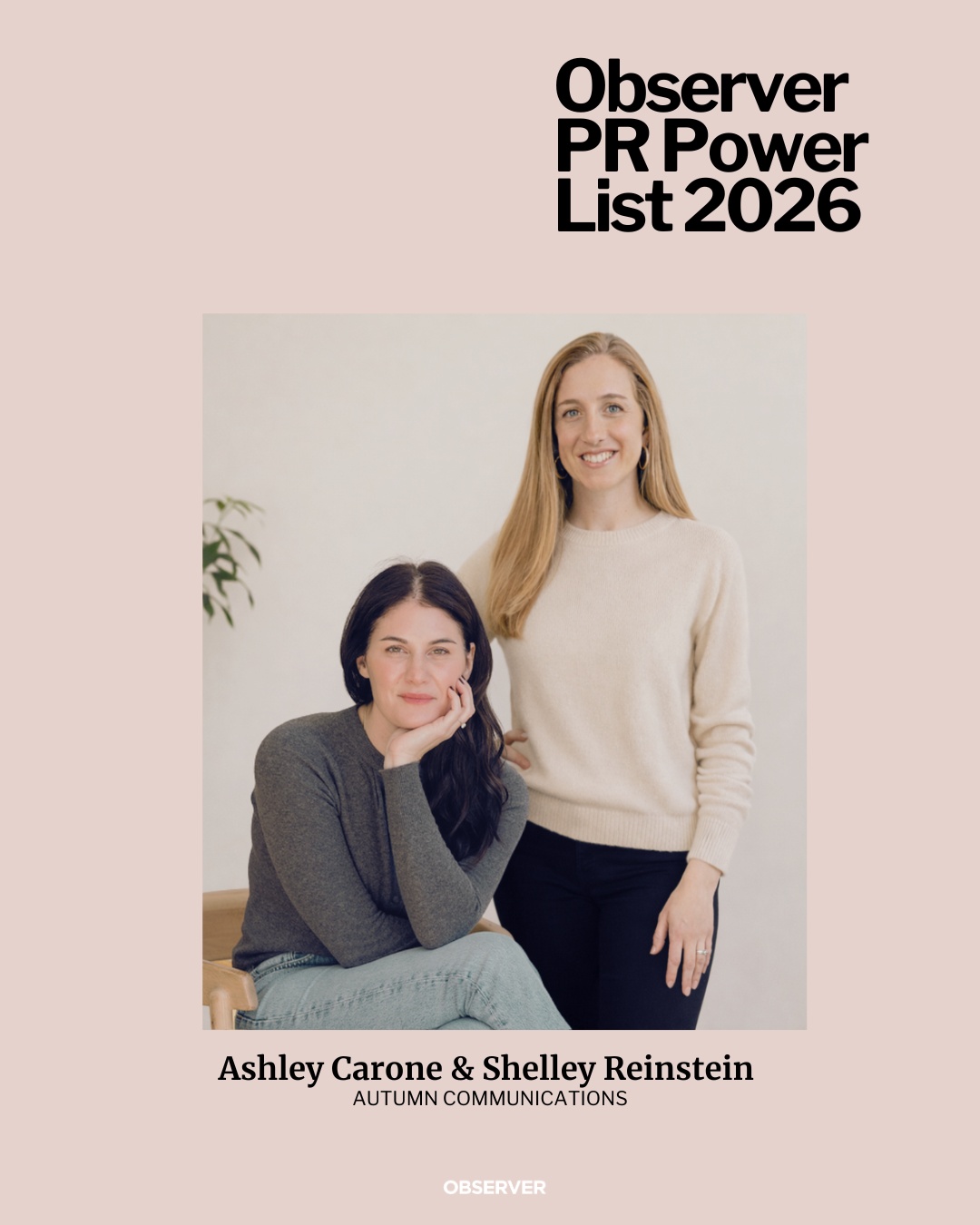
When Autumn entered the 2026 PR Power List, Reinstein recalled following it since her early years in the industry. Her response centered on Carone’s contribution and on building the company together. The photograph of the two leaders makes a useful companion to the statement. A founder story can become rather crowded once it admits everyone who helped make the company work.
Her description of Carone emphasized leadership and steady drive. Their current public roles divide the titles between founder and CEO, and managing partner. The agency’s own team page also lists people and operations leadership, industry specialists and functional leaders. As the company has grown, the visible cast has grown with it.
By 2026, Reinstein was included in Inc.’s Female Founders list, which recognized her for growing Autumn’s team beyond 160 employees to meet client demand. Her April EY finalist selection added another personal milestone. These recognitions give dates to the journey; they also point back toward the company and the people whose work made the nominations plausible.
A separate part of her year-end account concerned volunteering with animal rescue organization Wags & Walks. It is a small, concrete detail beside the business results: the agency’s calendar had room for something beyond a client assignment. It also keeps the public portrait from becoming entirely a list of accounts and awards.
The next chair
Autumn’s 2026 expansion includes a Strategy, Insights & AI division, covering AI visibility monitoring, optimization for language models and cultural intelligence. Its industry profile describes more than 170 employees and more than 120 active brands. The new capabilities continue the same sequence: a change in how people encounter information creates another job for the communications agency.
For Reinstein, adding a discipline means adding expertise, management and another set of decisions about what a client actually needs. The service menu can keep lengthening. The more consequential question is whether the people behind it can still share a brief without forcing the customer to stitch the pieces together.
Her kitchen-table beginning remains a useful image because it puts collaboration at a human scale. Everyone can hear the conversation. Everyone knows whose turn it is to speak. A company approaching 200 people cannot reproduce that arrangement literally. Reinstein’s next chapter depends on preserving enough of its usefulness as the chairs multiply.