The front row has a small design flaw. There is only one of it. A concert can sell thousands of tickets, install enormous screens and send a bass line through the building, yet the singer remains a distant figure for much of the room. Seungjoon (Steve) Lee has spent years working on that shortage of proximity. His answer requires a camera, a headset and, rather unexpectedly, a trip to the movies.
Lee is the CEO and co-founder of AMAZE, the Los Angeles company previously known as AmazeVR. Its concerts combine filmed artists with constructed three-dimensional environments. Fans can watch through headset apps or attend cinema screenings where the hardware is supplied. The particular pleasure being sold is easy to understand: the performer appears close, and the view does not depend on how quickly someone else bought a ticket.
In September 2026, Lee put his occupation plainly: “We’re running a music concert business.” It is a useful sentence from someone who entered the field with a much larger theory about the future of displays. Eleven years after founding the company, he can describe the problem without requiring the listener to acquire a new vocabulary.
A global ambition, a very local first victory
Lee studied at KAIST and worked in software engineering and management consulting before joining Kakao. He arrived in 2012, when the company had roughly 100 employees, and led its strategy team. His work included the Kakao-Daum merger and planning around new businesses. The experience gave him a view of how a young technology company becomes part of ordinary life.
It also gave him colleagues for the next attempt. In 2015, Lee joined JB Lee, Jeremy Nam and Steven Koo to found what became AMAZE in the United States. Their ambition crossed two borders at once: from mobile to VR, and from a business rooted in Korea toward an international audience. The company established a Los Angeles office in 2017 and consolidated its American headquarters there in 2019.
The venture followed an earlier, unsuccessful startup Lee had tried with friends while working at Bain. They worked on weekends. He later acknowledged the limits of that arrangement. Kakao became a place to learn before he tried again. In 2019, asked to identify his first real victory at AmazeVR, he chose hiring the first employee in America. Before pop stars and cinema tours, somebody had to agree to come to work.
That answer gives the career a human scale. A global service sounds splendid in a presentation. Making the first hire in an unfamiliar country is a smaller, less photogenic task, and a necessary one. Lee's recollection locates the excitement in the moment an ambitious plan began becoming a workplace.
“I think hiring the right people is the key. For that, the founder should be there.”
Steve Lee, 2019
The headset needed a reason
The original conviction was that a new personal display could follow the smartphone. That left a difficult creative question: what would people want to experience inside it? AMAZE explored several kinds of content before focusing on concerts around 2019. Choosing a medium had preceded choosing the thing worth watching.
There is a pleasing inconvenience in this sequence. Engineers can build a convincing virtual room, but a room does not automatically provide a reason to visit. Music supplied a reason that arrived with its own audience. Fans already wanted the artist. The company's work was to arrange a meeting that a conventional camera angle or distant seat could not offer.
Megan Thee Stallion gave that work a theatrical destination. An agreement announced in 2021 led to Enter Thee Hottieverse, the VR concert that toured AMC cinemas in 15 American cities in 2022. The company reported a 75 percent attendance rate. A performance made with one artist could travel through a network of screens and headsets.
The production also required the company to work across unfamiliar professional boundaries. A music performance has timing, movement and a visual identity. A headset experience needs a view that holds together when the viewer looks around. Cinema exhibition adds another job: delivering the same show reliably to people who have bought tickets for a particular time. Lee's business had become a chain of connected tasks.
Pop stars, meet the production schedule
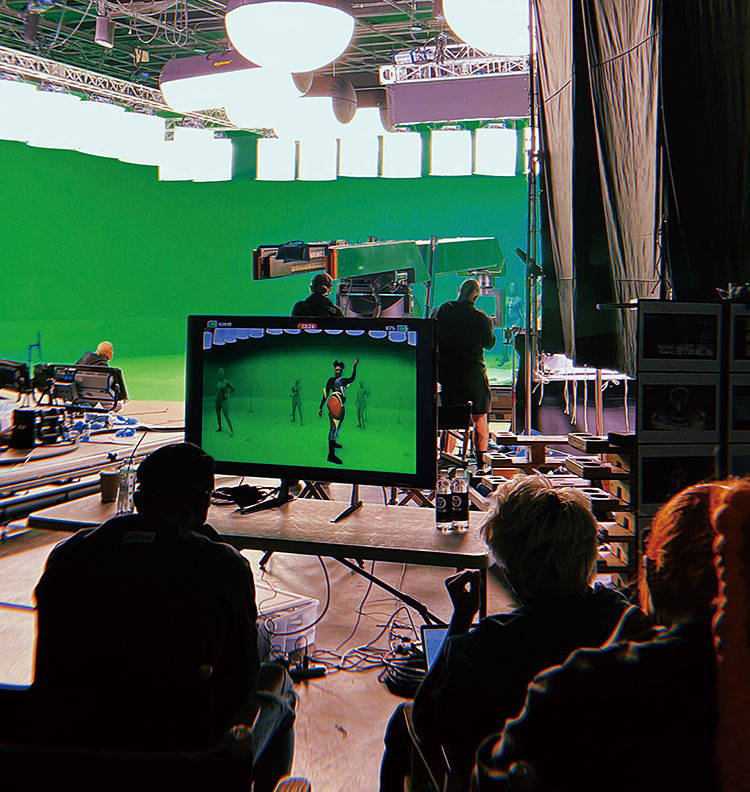
The company's technical method brings filmed people into digital settings. Live-action performance capture supplies the artist; computer graphics supply environments that need not obey the dimensions of a stage. Unreal Engine and AI-assisted production tools help join those elements. The unusual picture depends on some very practical work behind the picture.
By July 2023, Lee said modular production and AI had reduced a concert's creation time from five or six months to about six weeks. Tasks included separating details such as hair and clothing from green-screen footage. Those details sound modest beside the promise of virtual reality. They are also where an illusion can announce its seams.
Approximate durations, shown proportionally. A shorter production cycle made a continuing concert catalogue more practical.
A shorter cycle changes what a company can promise. A single successful show proves that a format can work once. A catalogue needs repeated arrivals. In July 2023, AmazeVR launched its concert app. In their joint launch message, Ernest Lee and Steve Lee thanked teams in the United States and Korea after more than three years of development.
The app added a second destination for the work. A theatrical release could introduce someone to the format; a home library could let an existing headset owner return to it. Distribution began to look like a set of options rather than a single doorway. The artist, the show and the audience could meet in different places.
A cinema already knows how to gather fans
For Lee, cinemas solve a conspicuously practical problem: many people do not own a VR headset. They do know how to book a movie. Providing the equipment at the venue removes a purchase from the evening's preparations. The building also comes with sound systems and the familiar expectation that everyone has arrived to pay attention.
AMAZE's current visitor guidance makes the arrangement wonderfully concrete. Headsets wait at seats. Guests bring tickets and arrive on time. The future of entertainment still has a showtime. For all the elaborate technology involved, an audience member can begin with the same decision that sends them to any other cinema screening: whether this is something they want to see.
K-pop became an important test of that arrangement. In 2022, AmazeVR formed Studio A with SM Entertainment. The following year, aespa's LYNK-POP brought the group's performances to a VR cinema setting. Lee explained that the members performed close to the cameras because fans valued close views. Proximity was part of the directing.
The choice joined the technology to a specific appetite. A fan may care about an expression, a gesture or the chance to follow a favorite member. Making an environment larger is only one creative option. Bringing a performer nearer can be the more consequential decision. It gives a spatial format a use that can be felt immediately.
Book a screening.
Headset supplied.
Fans gather in one room.
Open the concert app.
Use a compatible headset.
Return to the performance.
The catalogue crosses the Pacific
In February 2024, the AmazeVR Concerts app arrived on Apple Vision Pro at launch. Apple included it in its announcement of apps for the device. The available performances included Zara Larsson, T-Pain and UPSAHL, with Avenged Sevenfold's Looking Inside following that month. The catalogue was already moving among different musical audiences.
Avenged Sevenfold described its concert as a distinct experience alongside live shows and music videos. That description helps explain the format's place. A recorded immersive show can have its own staging and its own occasion for viewing. Its value rests on the performance it offers, including choices that a touring stage cannot easily reproduce.
TOMORROW X TOGETHER's HYPERFOCUS brought another route through theaters in 2024. By December, HYBE Japan announced its arrival in the home app after cinema screenings in Korea, the United States and Japan. Japanese screenings had covered five cities. Here was the release pattern becoming tangible: a particular group, a theatrical run, then another way to watch.
By September 2026, Lee's conference biography reported screenings in more than 70 cities across 18 countries, over one million tickets sold and more than 3,300 headsets supplied to partner theaters. These are company figures. They give a geographic shape to the international ambition that took Lee and his co-founders out of Kakao in 2015.
Company-reported figures, September 2026.
A smaller sentence for a bigger ambition
Lee still thinks spatial experiences can extend beyond music. In March 2026, he described ambitions for dedicated venues designed around an artist's world, with the visit beginning before the headset goes on. These remain plans. They show a founder thinking about the entire outing as well as the imagery inside the device.
His recent language also puts the audience ahead of a fashionable industry label. In September, he questioned the usefulness of the word “metaverse” and returned to the concertgoer's view of a distant stage. The ambition can survive a change in terminology if the experience continues to earn a ticket purchase.
There is a long journey between predicting the next display and getting equipment ready at a cinema seat. Lee has worked along that distance for more than a decade. The result brings together the engineer's concern for how a picture is made and the operator's concern for how people reach it. Somewhere between those concerns sits a fan who simply wants a better look.
The front row remains scarce in an arena. In Lee's version of the evening, the seat can travel.
Follow the performance
Conversations, concert films and the people making them.