A hospital can own shares in a technology company and still discover that its most useful product is the one that survives elsewhere. Sensyne Health makes that possibility unusually concrete. It raised £60 million on London’s AIM market in 2018, brought NHS trusts into its commercial model and sold drugmakers research built around anonymised patient records. Four years later, it needed rescuing. Its pregnancy-diabetes software continued under Huma; the restructured company became Arcturis.
That split is the key to understanding Sensyne. It was trying to build a business around two related activities: helping clinicians monitor patients, and helping researchers learn from healthcare data. Both had credible customers. Neither made the company immune to the awkward interval between spending money and collecting it.
The story is still moving. In August 2026, Sky News reported that Arcturis had agreed a £140 million merger with fellow Oxford data business Akrivia. Completion was expected in the autumn. For now, that is a proposed next chapter, not a finished turnaround.
A hospital at the shareholders’ table
Founder Paul Drayson brought an unusual résumé: healthcare entrepreneur and former UK science minister. Sensyne’s holding company was incorporated in June 2018, but its Oxford relationships predated the flotation. A strategic agreement with the University of Oxford and Oxford University Hospitals had been established in 2017 under the predecessor business.
That gave the venture more than an academic postcode. It had a route to software developed around clinical problems, including hospital observation systems and remote monitoring. Support-HF, licensed in 2018, followed years of work on managing heart failure at home. The underlying ambition was to carry university and NHS research into products that other organisations could use.
The financial proposition was equally distinctive. Participating trusts could receive shares, research support and royalties. If commercial research prospered, the health service would participate in the proceeds. An NHS partnership was therefore doing several jobs at once: supplying clinical knowledge, governing research access and creating a financial relationship.
- 01 / NHS partnersGovern access to anonymised patient data
- 02 / SensyneAnalyse approved research questions
- 03 / DrugmakersPay for research and analytical services
Simplified historical model. Terms varied by agreement.
What Bayer bought for £5 million
The July 2019 Bayer agreement put a price on the idea. The initial cardiovascular research collaboration was worth £5 million over two years. Partner NHS trusts were allocated 4% of the resulting revenue, alongside their existing shareholdings.
Sensyne described itself as a “docking station” between the health service and commercial researchers. Under that agreement, the NHS remained the data controller; Sensyne said patient data would not be sold or transferred to third parties. Research programmes required approval from the relevant trusts. The commercial offering was analysis conducted within those arrangements.
For a pharmaceutical team, the attraction was a better account of how illness and treatment unfolded outside a trial. Sensyne’s wider research work included disease characterisation and clinical-development questions. Roche and Alexion also became collaborators. The company occupied the space between the hospitals recording care and the drugmakers trying to extract useful evidence from it.
Its differentiation rested on those clinical relationships and the depth of the records, as well as its algorithms. A general-purpose analytics tool could process information; Sensyne was offering the arrangements and expertise needed to make particular healthcare information usable. That distinction also meant the business had substantial work to do before an analysis could begin.
The app with a job to do
GDm-Health made the clinical side easier to picture. Commercially launched in October 2018, it connected women managing diabetes during pregnancy with their care teams. Patients submitted blood-glucose readings; clinicians reviewed them through a web portal and could send guidance or respond to requests for contact.
Lucy Mackillop, Sensyne’s chief medical officer, explained in a 2021 interview that the idea grew from her maternity work: testing whether technology could support a different, cost-effective care pathway. The useful unit here was a reading that reached someone able to act on it. A colourful graph on a patient’s phone was only part of the service.
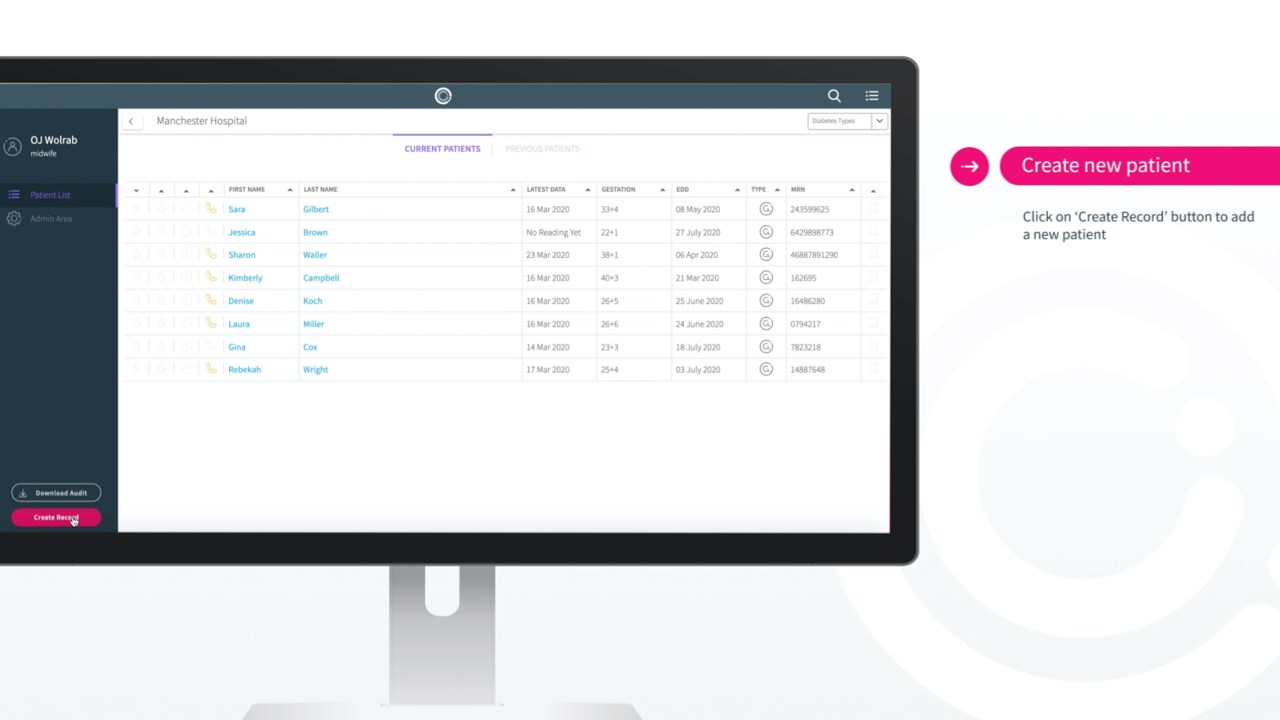
Oxford researchers subsequently documented the licence’s acquisition by Huma in 2022. Huma’s current product page reports use across 64 NHS trusts and 137,000 patients since August 2018. Those are figures for the continuing product, spanning different owners. They should not be mistaken for the scale of today’s Arcturis business.
For a prospective user, the practical condition remains straightforward: the care team needs to use the service too. The current app listing directs patients to their clinicians and explains that full functionality depends on the clinical dashboard. Downloading an app alone does not establish a remote-monitoring service.
Research by subscription, expertise by the project
Sensyne also tried to make research access more repeatable. SENSIGHT, launched in September 2021, offered tools for examining cohorts, disease progression and patient characteristics. Its Microsoft marketplace listing advertised £25,000 per commercial user per year. That is a historical asking price, not a current Arcturis tariff.
The December 2021 Exscientia contract shows how the platform met actual buying behaviour. It combined four SENSIGHT subscriptions with professional services. The announced payment split was 40% subscriptions and 60% project fees, with Sensyne creating bespoke datasets for questions about biomarkers and drug targets.
That mix matters. Software access could be sold by the seat, but a specific research question still called for specialised work. The company was carrying a service business inside its platform proposition. Buyers were paying for useful answers, and the route to those answers was not always something a subscription could standardise.
The balance sheet interrupts
Revenue increased, but the cost base was much larger. For the year ended April 2021, Sensyne reported £9.1 million in revenue against £33.9 million in operating expenses. The annual financial review described investment in platforms, data expansion and the United States. It also acknowledged slower-than-expected US uptake of GDm-Health amid the pandemic and competition.
Same scale; figures rounded. Operating expenses are an accounting measure, not cash burn. This comparison does not calculate net loss.
There had already been a governance failure. In November 2021, the London Stock Exchange censured Sensyne over breaches of AIM rules concerning executive bonuses and its dealings with its nominated adviser. A £580,000 fine was reduced to £406,000 for early settlement. The underlying events dated to 2018 and 2019.
The immediate threat to survival was financing. By January 2022, Sensyne was warning that it could not keep trading without new funding. A sale process had begun the previous November. In April, its lenders agreed amended financing providing for up to £26.35 million in loan notes, including the original £6.35 million notes.
“unlikely to be able to continue to trade”
Sensyne’s board, April 2022, on the position without additional capital
The failure visible in those disclosures was commercial and financial. They do not establish that the algorithms stopped working. Research relationships and clinical use could persist while the business funding them ran short of money. That is the uncomfortable lesson for anyone who treats adoption as a substitute for a sustainable cost base.
Alex Snow’s shorter list
New leadership arrived with the rescue. Drayson stepped down, and Alex Snow became chief executive in April 2022. The board ended the formal sale process after agreeing the amended financing. Its subsequent circular identified the healthcare product division and digital applications as non-core to the future company.
The company re-registered as private in July and became Arcturis Data in October. By December, Sky News reported that the restructuring had involved closing or selling divisions and reducing the workforce to about 40. A further £12.5 million equity raise, backed by Hambro Perks and Lansdowne Partners, supported the refocused operation.
The evidence points to financial necessity as the immediate reason for the change of direction. The new strategy concentrated on real-world patient data for drug development. That also changed how to read the old product catalogue: a listing carrying the Sensyne name does not prove that Arcturis still sells that product.
The less glamorous work that remains
Arcturis now describes a business built around curated UK healthcare data and evidence for pharmaceutical and biotechnology research. Its technical work includes extracting clinical information from free text with ArcTEX and suggesting mappings to standard medical concepts with ArcMAP. Those tasks address a basic obstacle: information recorded during care is not automatically ready for research.
Its market position is consequently more specific than the old clinical-AI umbrella. It offers clinical context, data preparation and research expertise to organisations developing therapies. Buyers can also commission other evidence providers or analyse data internally. The relevant comparison is whether a provider can answer the particular question with suitable information and methods.
There is something concrete to copy in the software legacy. The Polaris Foundation maintains the open-source backend originally developed at Sensyne from 2017 to 2022. It describes more than 20 microservices supporting clinical monitoring products. The patient-facing applications remain proprietary; opening the underlying platform did not turn every product into free software.
For founders and healthcare partners, the broader lessons are editorial judgments drawn from this history: start with a clinical task, specify who pays, and distinguish an equity stake from dependable income. The model depends on usable data, agreed research permissions, staff who can interpret results and customers with budgets. Remove any of those conditions and an impressive record count becomes much less informative.
Sensyne’s afterlife offers two different measures of value: a monitoring product still used in maternity care, and a research business seeking another expansion through the proposed Akrivia deal. The next test is whether that expansion can support the economics that the original ambition outran.