A medical record can remember something that a database forgets. A physician writes down a symptom. An image captures an abnormality. A laboratory test arrives months later. Each item survives, but the connection between them takes work to reconstruct. Multiply that problem across years of care and millions of people, and you begin to see the business nference is building.
- The raw material: de-identified records from long-term health system partners.
- The product: software for finding cohorts, following patient journeys and testing research questions.
- The wager: better-connected evidence makes AI more useful to medical research.
The Cambridge company works in the space between recording care and learning from it. Its software brings together clinical narratives, scans, molecular information and physiological signals. The customer might be a pharmaceutical researcher designing a study, or a hospital scientist looking for an overlooked pattern. The patient is the reason for the work, though usually not the person buying the software.
The first bottleneck had a front door
Murali Aravamudan and Venky Soundararajan conceived nference in 2013. Their backgrounds made an unusual pairing: Aravamudan had built telecom and media technology businesses; Soundararajan trained in biological engineering at MIT and genetics at Harvard Medical School. They saw neural networks as a way to connect biomedical information that people could no longer read at sufficient scale.
But the early obstacle was institutional. In a 2022 interview, Soundararajan described “finding the right enterprise partners” as the most arduous part of the initial journey. A clever system could not appoint itself custodian of a hospital’s accumulated experience. It needed a partner with clinical knowledge, usable records and reasons to participate.


Mayo Clinic became that anchor. The organizations launched drug-development venture Qrativ in 2017. In January 2020, Mayo selected nference as its first Clinical Data Analytics Platform partner, including an exclusive role providing analytic services to the biopharmaceutical industry. That agreement made the ambition concrete: combine software with the expertise and records of an institution that actually treats patients.
The hospital keeps the keys
The arrangement helps explain nference’s emphasis on federation. Rather than treating every hospital as a shipment of records to collect, its model brings analytics infrastructure into partner environments. Data must be de-identified, harmonized and curated before researchers can use it. Privacy and institutional control shape the architecture from the beginning.
Across partner-controlled environments
Rush’s September 2026 announcement makes the principle particularly clear. The partners plan a secure, Rush-hosted platform with a multimodal scope encompassing nearly five million unique patients. That is the proposed reach of an agreement, rather than a claim that five million people have already benefited from an algorithm.
Duke Health and Banner Health announced their own collaborations in 2023. By the Rush announcement, the named network also included Vanderbilt University Medical Center, Emory Healthcare and Mercy Health. The important expansion is the number of institutions willing to build this infrastructure together. Their records do not become interchangeable simply because the network gets bigger.
“Clinical data is extraordinarily rich, but the signals that matter are fragmented.”Venky Soundararajan · Rush partnership announcement, 2026
Ask a better question of the chart
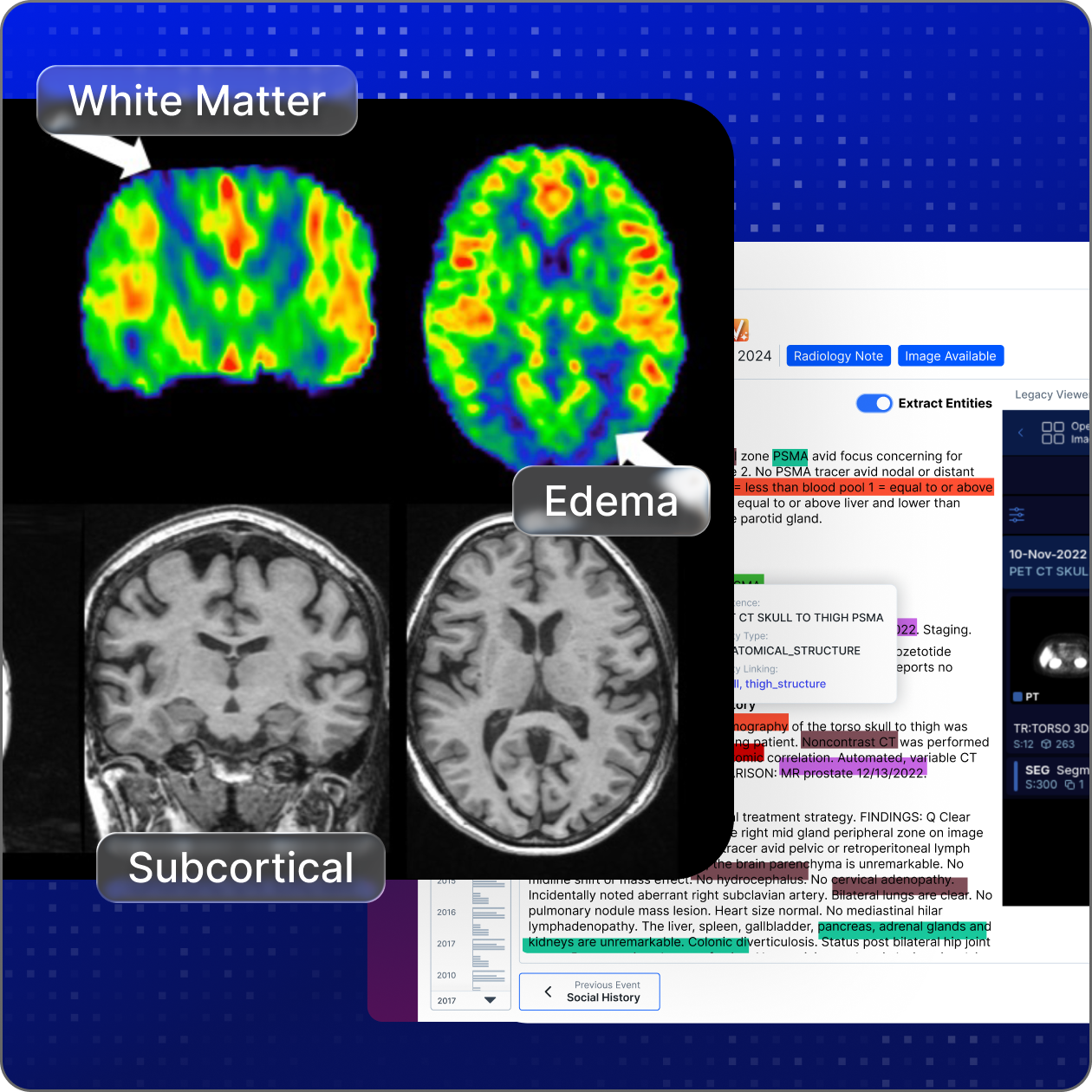
nSights is the researcher-facing expression of that work. It supports cohort design, patient journey analysis and investigation across structured and unstructured records. A researcher can combine criteria found in conventional fields with details buried in notes, then examine the evidence behind a patient’s timeline. The appeal is clinical context: what happened before, during and after a treatment.
Nucleus addresses a related problem inside pharmaceutical organizations. It connects and harmonizes their proprietary clinical data, including trial information, imaging and genomic data, within their own environment. Together, the products place nference in enterprise research software and real-world evidence, where customers need usable data as well as analytical tools.
The April 2025 collaboration with BeiGene provides a specific example: studying real-world treatment patterns and outcomes in B-cell cancers, with a planned review of more than 700 patient charts. nference’s product pages also display organizations including GSK, Bristol Myers Squibb, Moderna and Takeda. Those relationships point toward a professional research market, rather than a consumer symptom checker.
The expensive part comes before the query
Making these records usable requires money before it produces an elegant screen. nference announced a $60 million Series B in January 2020 and a separate $60 million Series C that December. The latter was led by Matrix Capital Management, alongside Matrix Partners, Mayo Clinic Ventures and NTTVC. These are financing amounts, not operating costs or software prices.
Capital raised to develop the business. Not a customer price tag.
The commercial bargain is revealing. nference says it deploys its Federated Clinical Analytics Platform at its own cost and handles customer acquisition and sales. Health systems can generate revenue through collaborations, product licensing and development sponsorships. The company is effectively tying infrastructure investment to a market for research. For hospitals, participation offers tools and potential revenue; for nference, it creates the foundation for enterprise offerings.
More records still require judgment
This is a competitive market. Flatiron Health offers oncology-focused real-world data and evidence; Tempus connects clinical, molecular and imaging information. nference’s pitch emphasizes longitudinal depth across multiple specialties and hospital-based federation. Buyers still have to ask whether the available patients, variables and follow-up fit their particular question.
Its venture history shows another route from infrastructure to products. Mayo and nference launched Anumana in 2021 to develop AI-enabled diagnostics, initially focused on ECGs. nference also founded digital pathology company Pramana that year; Evident announced an acquisition agreement in 2025, and Pramana is now part of Evident.
The useful lesson is to solve access, incentives and data preparation alongside the model. The limit follows from the same logic: absent clinical detail cannot be recovered by enthusiasm, and observational records do not automatically establish causation. A large network needs careful study design. Medicine has already written an extraordinary amount down. nference’s opportunity depends on how reliably researchers can learn from it.