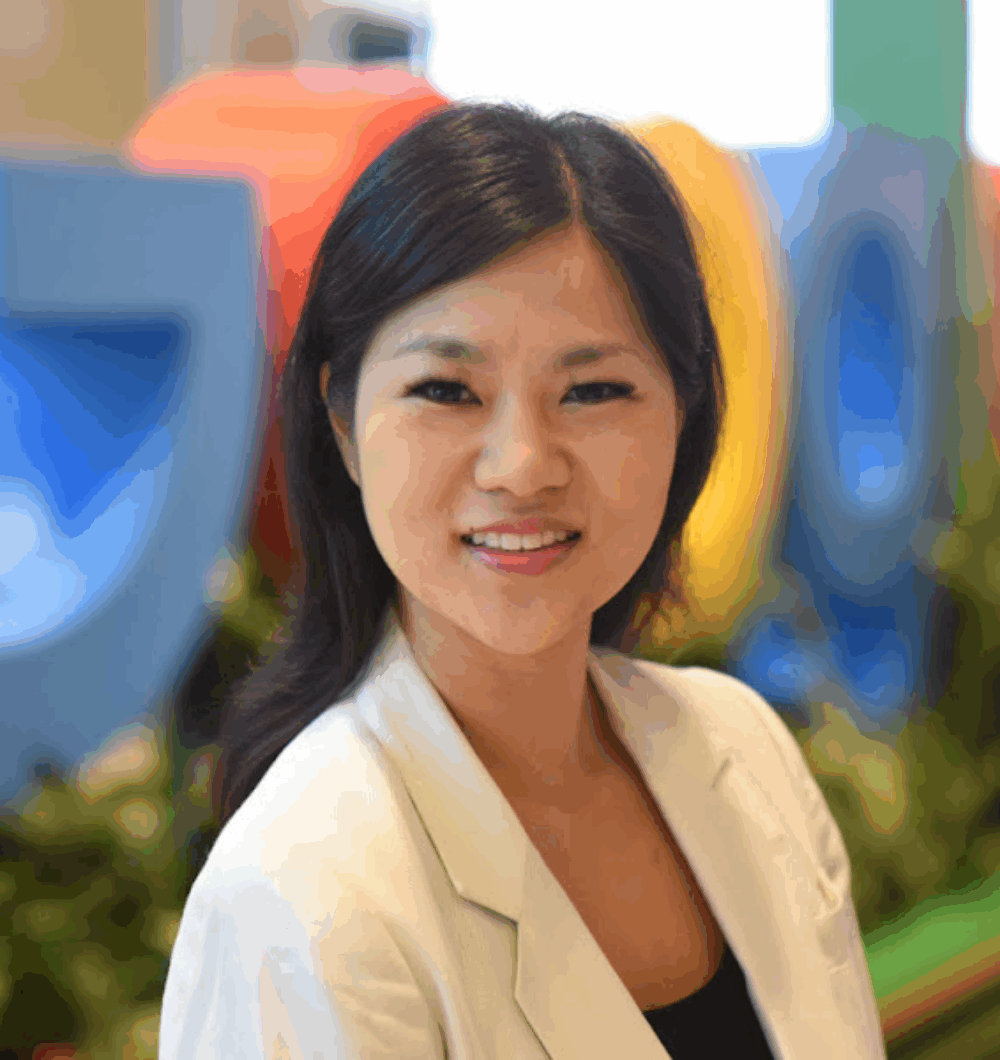
There is a direct line from approving a stranger's ad in 2003 to shaping how three million businesses advertise in 2026. Selin Song has walked every step of it.
The Long Way Up
The story that circulates about Selin Song - that she joined Google as a temp before it was Google in anyone's imagination of what it would become - is not a rags-to-riches myth. It is a story about someone who learned the machinery of online advertising from the ground floor, one approved ad at a time, and then spent twenty years mastering every part of it.
Before Google, she was an executive producer and on-air news anchor at the Stanford Cardinal Broadcasting Network. She studied Communication and then Sociology at Stanford, building a double fluency in how people talk and why they organize themselves the way they do. These are, it turns out, exactly the skills you need to run a global advertising organization.
After Stanford, she worked briefly at Tech TV - the scrappy San Francisco cable channel devoted entirely to technology at the peak of dot-com fever. Then came Google, and the long, deliberate climb.
"Google Marketing Live felt like the moment the training wheels finally came off for AI in marketing."- Selin Song, Google Marketing Live 2026
Four Countries, One Career
What sets Song apart from most executives who rise inside one company is geography. She did not climb the ladder in Mountain View, flying out to give keynotes and flying home. She lived in it - in India, in Singapore, in Ireland - leading Google Customer Solutions across APAC and then EMEA, becoming Site Lead for Google Ireland along the way.
This matters more than it sounds. Running GCS in Asia-Pacific means understanding that a tailor in Bangalore and a food stall owner in Jakarta have different relationships with digital advertising than a florist in Austin. Running it in EMEA means navigating the fragmented media landscape of 40-plus countries, each with its own privacy laws, language, and business culture. Song has had to actually solve these problems, not just report on them from headquarters.
By the time she became President of the entire global organization, she had already run more of it than almost anyone else in the building.
The AI Bet on Small Business
Song's central conviction - the one she has built her tenure as President around - is that AI is not primarily a story about large enterprises getting more efficient. It is a story about small businesses getting access to capabilities that were previously unavailable to them.
The pitch she makes, repeatedly and with evident belief in it, is that an AI-powered advertising suite can give a two-person bakery in Dublin or a three-employee clothing brand in Mumbai "the same elite strategic firepower as a global enterprise." Performance Max, Smart Bidding, AI-generated creative - these are not upsells. They are, in her framing, an equalizer.
At Google Marketing Live 2026, Song announced Ask Advisor, a unified agentic AI experience that acts as what she calls "an always-on collaborator" - connecting a business's product information to campaign creation while synthesizing performance insights automatically. It is the logical endpoint of everything Google has been building in customer solutions: a system smart enough that a small business owner who knows nothing about keyword planning can compete with brands that employ entire marketing departments.
"This shift levels the playing field for every dreamer, giving even the smallest startup the same elite strategic firepower as a global enterprise."- Selin Song, on AI democratization in advertising
How She Runs Teams
Song's management philosophy is not subtle. She has replaced status-update meetings with coaching conversations, a choice that sounds obvious until you try to do it across an organization spanning dozens of countries and time zones. She talks about connection, recognition, and energy as the three things global teams actually run on - not software, not OKRs, not process.
The broadcasting background surfaces here. Song was trained to communicate to an audience with clarity and presence. In an organization where a manager in Singapore and a team lead in Dublin and a sales director in Chicago all report into the same global structure, the person at the top has to project that presence without a studio.
She has also spoken about celebrating small wins - not as a motivational-poster sentiment, but as a tactical choice in a business where most of the companies you are serving are themselves small and struggling to win. The energy inside the organization, she implies, has to match the energy she wants people to bring to clients.
The Katie Couric Moment
In April 2025, Song sat down with Katie Couric for an interview on the AI opportunity for businesses of all sizes. The conversation spread across YouTube, Facebook, and Instagram - a rare moment of mainstream visibility for a B2B executive whose day job is usually invisible to everyone except the businesses depending on her team's work.
The clip traveled because Song does not speak in corporate hedges. She makes a specific, falsifiable argument: that AI is already changing what small business owners can do, right now, not in some speculative future. Audiences who had never heard of Google Customer Solutions before watched it and understood immediately what was at stake.
The Full Orbit
Song contributes regularly to Google's The Keyword blog and to Think with Google, the company's thought leadership platform for marketers. She has written and spoken about everything from managing distributed global teams to the mechanics of AI-powered campaign optimization for businesses that have never had a marketing manager.
She also speaks at conferences outside Google's orbit - appearing at the AI Horizons Pittsburgh Summit, taking the message about AI's role in small business growth to audiences that are not already in the Google ecosystem.
She contributes to Entrepreneur, making the case for AI tools in terms that resonate with founders who are skeptical of anything that sounds like a pitch from a trillion-dollar company. Somehow, it doesn't sound like one.
What She Is Building Toward
The stated aspiration is an internet where business size is no longer a proxy for marketing sophistication - where a first-generation immigrant opening a restaurant can access the same targeting, the same analytics, the same creative tools, and the same measurement capabilities as a Fortune 500 retailer.
Song has been working toward this for twenty-plus years, first from the inside of Google's infrastructure, then from the head of its regional organizations, and now from the top of the global structure that touches more small businesses than almost any other entity in the world.
The training wheels metaphor she used at Google Marketing Live is apt. Not because AI was previously theoretical - it was always real enough to change campaigns. But because Ask Advisor represents a moment where the interface finally became simple enough that the technology can do what it always promised.
Selin Song has been waiting for that moment for a long time. She approved the first ads by hand.
