Sean Byrnes once sent his investors a monthly update with a number so small that one of them assumed it was a mistake. Outlier, his new company, had burned $200. An investor read it as $200,000 and worried about the spending. Byrnes had to explain that the missing three zeros were quite deliberately missing. Venture capital had developed an expensive reading habit.
The story is funny because it reverses the usual founder performance. Here was a repeat entrepreneur, with a sale to Yahoo behind him, explaining how little he had spent. His next company would try to help businesses notice things hiding inside their numbers. Its investors had already supplied an encouraging demonstration of the problem.
Across Byrnes’s career, the interesting discoveries often arrive just outside the original plan. A mobile email business becomes an analytics platform. A collection of dashboards produces a demand for better questions. A founder who once wanted to have every answer ends up advising others to admit when they have none.
The email app with another business inside
In 2005, Byrnes started Flurry to bring email and news to ordinary mobile phones. BlackBerry owners had a taste of connected life; everyone else deserved a turn. The practical problem was familiar enough: useful information lived on a computer, while the device in your pocket mostly made calls.
Flurry’s consumer service found users overseas, including in India, Indonesia and Malaysia. Running it exposed a second problem. Counting downloads told the company remarkably little about what people actually did after installing an app. Flurry built internal analytics to understand its own customers. Other developers wanted those tools. In 2008, the company shifted toward supplying the platform.
There is something pleasingly untidy about that origin. The business eventually sold to Yahoo began as equipment for running another business. The useful discovery depended on paying attention to the work already happening, including the bits that had never been advertised as the product.
ordinary phones
app developers
by Yahoo
Flurry also grew through combination. Pinch Media, an analytics company backed by Union Square Ventures and First Round, had gained traction on the iPhone. Flurry brought strengths on other mobile platforms and a plan for monetization. The companies merged, with Flurry surviving as the name. The resulting business was a collaboration among founders, engineers, investors and customers, with Simon Khalaf leading it as CEO.
By July 2014, Flurry’s acquisition announcement counted more than 170,000 developers and 540,000 applications on its platform. Developers used it for analytics, advertising revenue and finding users. Yahoo wanted a closer place in that expanding mobile economy. The deal closed on August 25, 2014, for approximately $270 million in cash.
Yahoo’s purchase price for Flurry, completed August 25, 2014.
A purchase price gives a story a convenient full stop. It also makes the preceding years look rather more orderly than they felt. Flurry had started nine years earlier with a very different offering. Its route to that transaction included a pivot and a merger, a reminder that a company’s eventual description can be a poor guide to its beginnings.
A computer that could learn
Long before Outlier, Byrnes had wanted to work on machine learning. He began college studying engineering because he liked building things. Computer science gradually drew him toward systems whose construction required no physical materials. A machine-learning course introduced a more surprising possibility: a program could learn.
On the last day of that course, he approached the professor and said he wanted to spend his life working in the field. Graduate study followed. His education took him through Dartmouth, where he studied engineering and computer science, and Cornell, where he pursued computer science with a focus on AI.
The commercial timing was less cooperative. When he finished graduate school, machine learning had yet to offer the career he imagined. He worked in software and then built companies. By 2015, cloud technology had made another attempt possible. That was the year he founded Outlier with Mike Kim.
The question behind the company had followed him around while meeting Flurry customers: with all this data available, what should anyone look for? A dashboard could answer a question somebody had thought to ask. Important changes could still sit outside the frame. Outlier tried to discover those changes automatically and bring them to a business user’s attention.
The audience arrived before the software
Byrnes and Kim had another problem to solve before their analytics product could matter: reaching buyers. They began publishing Data Driven Daily before they had a product. The newsletter offered advice on making decisions with data. More than 6,000 people subscribed. Almost all of Outlier’s first customers came from that readership.
It is an unusually concrete example of the audience doing useful work. The newsletter attracted people who cared about the same problem the founders were studying. Podcasts and live talks were among the other approaches they tried. The newsletter happened to work.
Byrnes returned to the lesson in May 2025. A following has limited commercial value if it consists of people who would never buy the product. His practical test for a distribution advantage is whether a founder can arrange 50 meetings with potential customers quickly. It is a slightly less glamorous ambition than going viral, and considerably easier to put in a calendar.
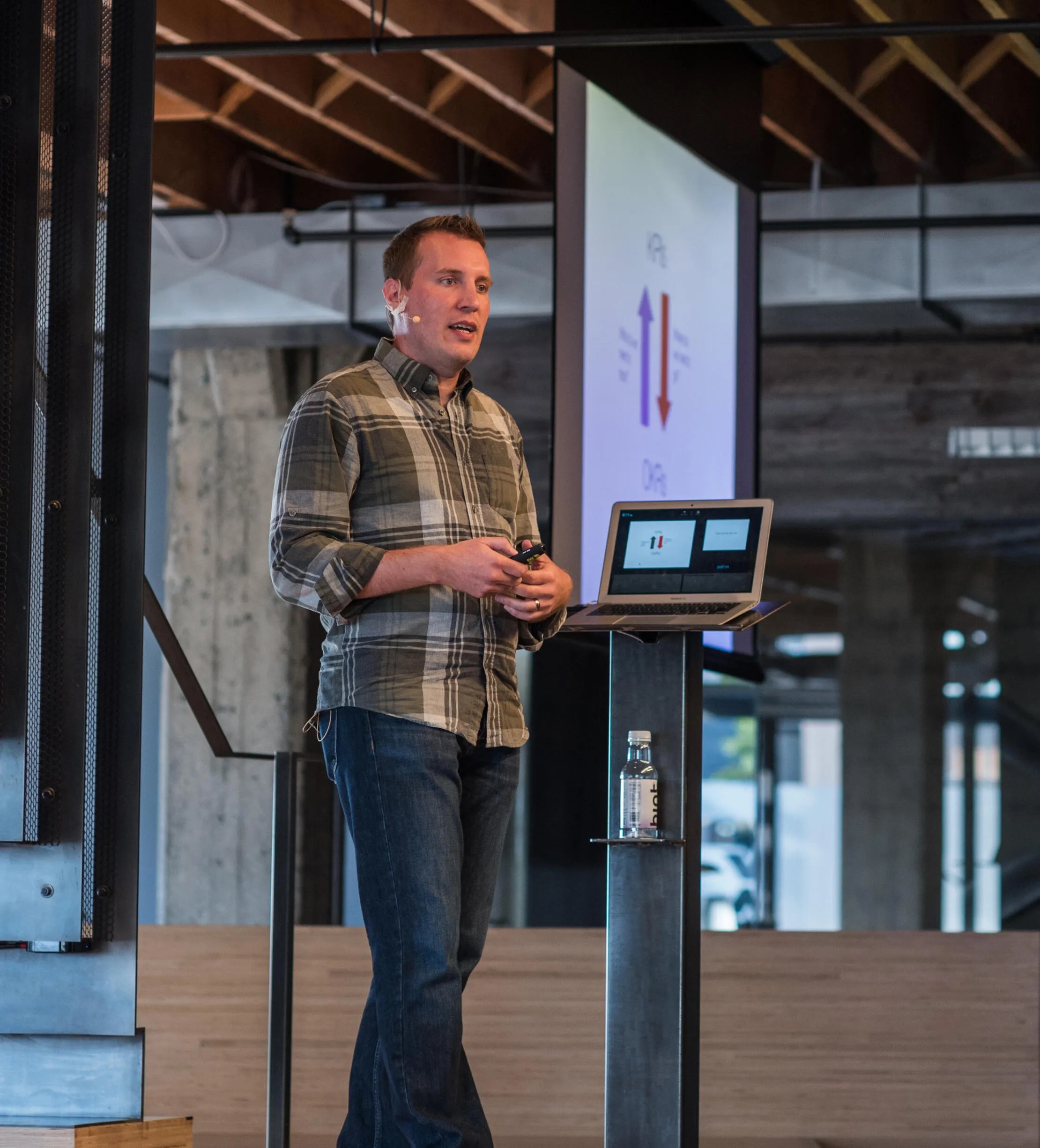
Outlier attracted customers including Nike and Capital One and backing from firms including Emergence Capital, Homebrew and First Round. Yet its independent service did not continue indefinitely. On May 2, 2022, Byrnes announced that Outlier was ending its service and closing its doors. His later professional biographies record an acquisition in 2022.
His farewell devoted its attention to the people involved. He thanked the team, customers and supporters, and described gratitude as a company value. He planned to spend time coaching CEOs, writing and returning to art. Seven years of company building ended with a fairly personal inventory of what he wanted to do next.
The CEO who lets the answer be missing
Byrnes had already been examining the founder’s relationship with certainty. In a 2015 essay, he described his early ambition to resemble the visionary leaders he admired: passionate, commanding, apparently equipped with the right answer for every occasion. The costume was difficult to wear in unfamiliar territory.
“I don’t know.”
Sean Byrnes, on the three words that made him a better founder
Those three words, he wrote, made room for other people’s ideas. A leader could be honest with a board, practical with investors and more receptive to colleagues. Teams given permission to acknowledge a gap could spend their effort closing it. His suggested follow-up was equally plain: “but let’s figure it out.”
That attitude carries into his distinction between coaches and cheerleaders. Founders need people who believe in them, particularly when the work is going badly. They also need someone prepared to disagree. Byrnes described learning to offer that second kind of support: encouragement accompanied by an honest assessment, including the unwelcome parts.
His coaching relationships put names to the idea. Aakrit Vaish of Haptik describes turning to him for difficult decisions. Carlos Vega of Tesorio points to frameworks used in executive hiring, operating plans and company meetings. On his own site, Byrnes describes coaching as a partnership that helps a CEO work through problems while retaining responsibility for the answer.
He has also made the discussion public. On The Startup Help Desk, he joins Ash Rust and Nic Meliones to answer questions submitted by founders. The format makes room for different views. A product decision or hiring problem rarely becomes easier merely because three experienced people have been invited to discuss it; disagreement can be the useful part.
Back at the workbench
At Near Horizon, where he is a general partner, Byrnes works with founders at company formation. The firm’s partners help interview customers, design products, write code and find early buyers. It typically works with solo founders pursuing AI businesses. The model gives his teaching an immediate practical test: somebody still has to build the thing and persuade a customer to use it.
His March 2025 essay on choosing a problem recommends more than 100 research interviews before settling on a solution. He asks founders to investigate urgency, the number of possible customers, existing alternatives and what a solution might be worth. Building is enjoyable; checking whether anyone urgently needs the result requires patience.
There is a modest comedy in an experienced software builder telling other builders to wait. Byrnes describes research conversations in which potential buyers followed up to ask whether a solution was ready yet. The team had not built one. That impatience from customers was precisely the information they wanted.

Room for a different kind of character
Outside the companies, Byrnes draws. His art portfolio includes traditional and digital illustration, character designs, fantasy settings, comics and short fiction. The titles wander further than the average board presentation: Cupid Kills, Megalodon, Athena. There is also a digital piece called The Founder, so the office occasionally follows him home.
He writes that characters can reveal themselves during visual exploration and become different from what he first expected. That observation sits comfortably beside Flurry’s history. You start with an intention, make something, look closely, and discover that the interesting part has moved.
Byrnes’s career now leaves room for several kinds of making: software with a new founder, a framework for a CEO, a drawn character finding its shape. The common pleasure seems to be in working through an unfinished problem. After two company journeys and years of advising others, he has made a public habit of leaving space for an answer he has yet to find.
Follow the questions
More writing, conversations and a few imaginary worlds.
- Sean’s website
- X / Twitter
- Instagram: Art by Byrnes
- GitHub
- The Breaking Point
- Sean on Startups
- Art by Byrnes
- Near Horizon biography
- The Startup Help Desk podcast
- Watch: a conversation about leadership
- Read: Flurry joins Yahoo
- Read: Farewell Outlier
- Read: the Flurry / Pinch merger
- Read: the $200 story
- Read: machine learning and Outlier
- Read: finding the right problem
- Read: distribution advantages