Aakrit Vaish had spent years trying to persuade people that talking to software could become an ordinary part of life. Then the world acquired the habit, rather suddenly, and he had a thoroughly ordinary reaction. For a brief period after ChatGPT appeared, he felt that the moment should have belonged to him.
“This should have been me.” It is an unusually candid admission from someone whose company had already attracted a majority investment from Reliance Jio. A successful transaction ought to provide a satisfying ending. Unfortunately, ambition has never shown much respect for the closing credits.
Vaish co-founded Haptik in 2013. The company’s early assistant reached users in 2014, years before a chatbot became something people casually asked to rewrite an email. By April 2026, when he discussed those feelings with investor Avnish Bajaj on Unstarted, he was building a different business: Activate, an investment firm for AI companies.
The dates offer a neat sequence. His experience was considerably less neat. There were changes of product, anxious periods over money, an acquisition that left years of work still to do, and eventually a handover to another CEO. He had correctly identified a direction of travel. Finding a business along the route required rather more improvisation.
A small team, a very large habit
Vaish was born and raised in Mumbai. In 2004 he left for the University of Illinois Urbana-Champaign, where he studied industrial engineering. He graduated in 2008 and moved to San Francisco. His early personal biography records a spell at Deloitte before he joined a startup, attracted by mobile technology and Silicon Valley.
It is a useful little document from before the retrospective polish. The interests he listed included mobile applications, advertising, analytics, social games and new media. AI had yet to swallow the professional biography. He was describing the machinery of a phone-based world still being assembled.
At Flurry, a mobile analytics and advertising company, he was employee number 12. He worked across business operations and established its India office. A small company offers an education in the distinction between the job on your business card and the jobs that need doing. Vaish acquired experience on both sides of that distinction.
Messaging supplied the observation that would matter. Working with mobile-app businesses, he could see people spending considerable time in services such as WhatsApp and WeChat. Texting let them have a conversation without arranging their lives around the other participant’s availability. Businesses, meanwhile, still made getting a simple answer feel unnecessarily procedural.
Haptik tried to connect those two realities. Vaish started it with Swapan Rajdev, whom he had met at Illinois. Their university connection extended beyond friendship: professor Dan Roth joined the board in 2015 to help with natural-language processing. The company began in Mumbai with relationships formed thousands of miles away.
The campus memories were less technical. Vaish remembered the cheerful mystery of his first St. Patrick’s Day. Rajdev remembered encountering snow. Neither detail explains a company’s finances, which is precisely its charm. Before the founders became a founding story, they were students noticing that other places had peculiar weather and interesting parties.
“it’s as bad being early as it is being late.”
Aakrit Vaish, reflecting on Haptik in 2025
That sentence is a compact rebuke to the romance of the visionary founder. A customer cannot pay an invoice with admiration for your foresight. The technology has to work well enough, the problem has to matter enough, and somebody has to be ready to make room in a budget.
A deal with two numbers
Haptik began as a chat-based virtual concierge. Over time, it concentrated on enterprise uses: customer support, lead generation, concierge services and live chat. This gave the conversational ambition a more specific commercial home. A business with customers waiting for answers had a reason to listen.
By the time Reliance announced its transaction in April 2019, Haptik’s client list included Samsung, Coca-Cola, KFC, Oyo Rooms and the Mahindra Group. Times Internet, which had invested in 2016, would exit as part of the arrangement. The company had found both enterprise customers and a much larger strategic partner.
The transaction is often compressed into a ₹700 crore headline. The actual announcement deserves its arithmetic back. The overall package, including money for growth and expansion, was estimated at ₹700 crore. The consideration for the initial business transfer was ₹230 crore. Reliance would hold approximately 87%, with the balance held by founders and employees through stock-option grants.
*Balance implied by the announced overall package. Money for the business and money to grow it have different jobs.
Keeping those amounts separate changes the meaning of the event. It was also a plan to keep building. The remaining work involved customers, revenue and making an enterprise company function inside a group whose scale was far beyond the startup’s own.
Vaish stayed. In February 2025 he said that, over five years under Reliance, Haptik had grown from a $500,000 business to $35 million in annual recurring revenue and become cash-flow positive. Those were his reported figures, and they describe the years after the announcement rather than the announcement itself.
He also disclosed that he had stepped down as CEO the previous year. Ahshad Jussawalla, already inside the business, took over after a search for a successor. Vaish said he would remain on the board while leaving daily operations. Building the company had required learning many jobs. This stage required letting someone else do the central one.
Mumbai is part of the product
Vaish’s attention has repeatedly returned to people. An earlier professional profile described him spending almost half his time recruiting for Haptik. Alongside revenue, finance and strategy sat the patient business of persuading capable people to join something whose future was still under construction.
He had other beginnings in motion too. In 2013 he co-founded and invested in Flat.to, a service for finding rental accommodation and flatmates, later acquired by CommonFloor. His career has room for a very practical housing problem as well as a long wager on conversational software. Founders, like everyone else, require somewhere to live.
Outside work, he follows Manchester United and enjoys travel. Supporting a football club offers a continuing education in the limits of prediction, although the connection to venture investing is best left as a spectator’s observation. The useful point is smaller: a professional biography need not consume the whole person.
Mumbai occupies a larger place in his public life. He helped establish the Tech Entrepreneurs Association of Mumbai, or TEAM, formed in 2022. In 2024 he and Dream Sports co-founder Harsh Jain were elected to co-chair its governing council for a two-year term.
The group brought together founders from businesses across the city. Its work included Mumbai Tech Week, which drew more than 4,000 technology enthusiasts to its early edition. Vaish’s stated priority for the next phase was grassroots development: getting young founders and engineers to consider Mumbai when choosing where to build.
A founder community is an interesting thing for an entrepreneur to spend time on. Its returns are distributed untidily. A useful introduction may benefit somebody else’s company. An event may produce a hire for a rival. Yet those are precisely the encounters that make a city feel possible to the person starting next.
Back at the beginning, with a cheque book
Vaish’s move into investing grew alongside a period in public service. He spent a year as a full-time advisor to the IndiaAI Mission, working on the country’s sovereign AI direction. In 2023, the World Economic Forum had named him a Young Global Leader. Its current biography records more than 100 startup investments.
Activate arrived in December 2025, co-founded with Pratyush Choudhury, previously an investor at Together Fund. The proposition was deliberately early: work with technical founders before a company is incorporated, then lead the first institutional round. Its announced investment range was $500,000 to $3 million.
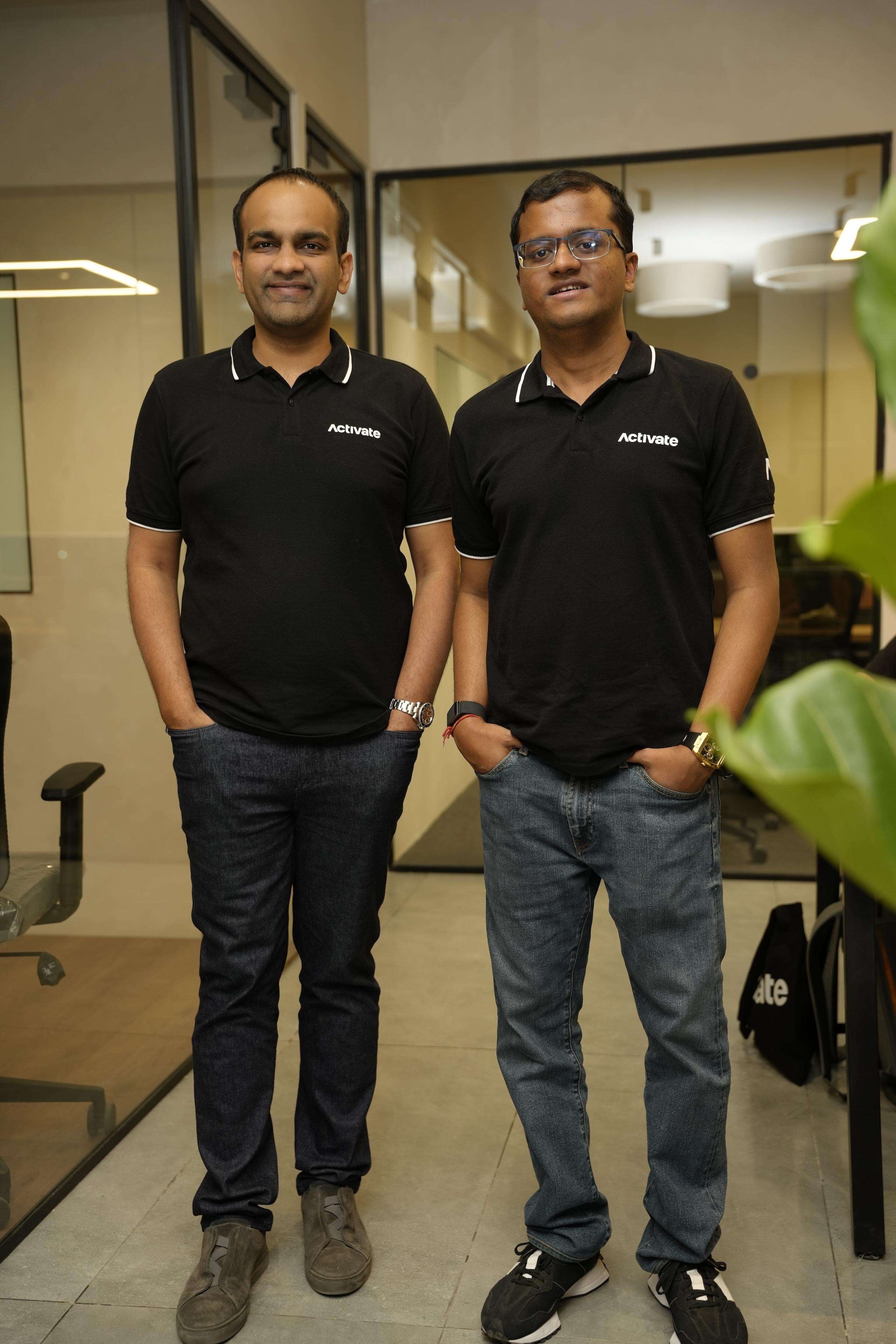
In February 2026, Activate announced a collaboration with Nvidia. Portfolio founders would gain access to technical teams, models and help with architecture and deployment. For a small team, deciding how to build can consume as much attention as deciding what to build. The arrangement put some practical assistance beside the cheque.
Vaish also argued that very early AI businesses should be assessed through evidence of progress rather than immediate revenue alone. At the incubation stage, teams may still be testing the product and its use. That puts responsibility on an investor to distinguish an experiment producing useful information from an experiment merely consuming time.
By September 2026, Activate had raised a $105 million investment platform: an $85 million early-stage fund and $20 million through growth vehicles. Its ten reported investments comprised seven early-stage companies and three growth investments. The latter included Sarvam AI, ElevenLabs and Wispr Flow.
The firm’s current approach extends from inception to growth, alongside venture building and community activity. It names sovereign AI, AI services and consumer AI as investment themes. The scope reflects an ambition to help Indian technical teams build companies and to connect global AI businesses with India.
There is an appealing circularity to the career. A young graduate left Mumbai, learned inside a small technology company, returned to build one and now helps other teams begin. The original frustration remains recognisable: how to turn a technological possibility into something people can actually use.
Experience gives Vaish more examples to draw on. It cannot tell him, or any founder he backs, exactly when the next market will be ready. Haptik supplied a long education in that uncertainty. Activate gives him another way to work on it, sitting beside the next team with a question worth testing.