Four fintech companies were being built. Their launches were waiting for licences. In September 2024, that was the situation Emad Kashgari, then chief executive of 1957 Ventures, described in an interview. It is a useful place to begin. In financial services, the distance between a promising prototype and a business allowed to serve customers can be considerable. Someone has to finance that distance, organise the work and understand which permission comes next.
- Riyad Bank backs an investor that also builds fintech businesses.
- The current direct-funding route targets Series A and B companies.
- Foundry offers a separate route for founders before launch.
The Riyadh firm proposes to do all three. Its website now advertises a SAR 1 billion investment fund. But its more interesting proposition concerns the things money alone leaves unfinished: recruiting operators, designing products, finding distribution and navigating a regulated market. For a founder, those can become the same problem, arriving on the same Monday morning.
The bank behind the building work
The company’s LinkedIn page gives 2023 as its founding year. Its public arrival happened in stages. Riyad Capital announced the closed-end fund in May 2024; the venture-building company was announced that August. The distinction matters. One provides investment capital. The other helps turn opportunities into operating companies.
Riyad Bank supplies the institutional backing. The launch board brought together banking, innovation and investment executives, with Nader Al-Koraya as chairman and Mazen Pharaon as vice chairman. The initiative connects to Saudi Arabia’s Vision 2030 and Financial Sector Development Program, specifically the effort to develop financial technology and broaden participation in financial services.
Its economic logic is investment-led. Build or back companies, help them become more valuable, and seek returns from those holdings. The practical offer includes technical expertise, mentorship and market access. Founders are its immediate audience; individuals and businesses using the resulting financial products are further down the chain.
It sits in a market with several ways to obtain help. Independent venture funds provide investment; venture studios work on company creation; corporate investors connect startup financing to an established institution. PwC’s regional corporate venture capital report places 1957 Ventures alongside Saudi vehicles such as SAB’s X-Tech and SAIB’s S60. For founders comparing options, the useful question is which organisation can help with their particular bottleneck, and what relationship comes with that help.
Fund commitments / advertised size. Different reporting dates; neither figure measures sales or investment returns.
Two doors, very different founders
Open the current funding application and the emphasis becomes precise: Series A and Series B. The form asks for headquarters, presence in Saudi Arabia, round size and a pitch deck. It accommodates companies already in the Kingdom and those planning expansion. An established fintech seeking Saudi growth has a clear starting point.
Someone arriving with an untested idea faces a different task. Foundry by 1957 describes a pre-launch program with customer discovery, AI workshops, prototype testing and co-founder matching. Its advertised schedule ran from December 2025 registration toward an April 2026 Demo Day. Those dates describe the published program plan.
This creates two distinct relationships. An investor evaluates a company that already exists. A builder helps assemble one. The firm’s recruitment materials make the latter tangible: entrepreneur-in-residence roles for founding executives, with operational autonomy, equity ownership and access to committed capital. The work includes product discovery, engineering, financial controls and hiring. It is a substantial commitment for the people doing it.
The prize has a timetable
Foundry advertises up to SAR 1 million for its first-place winner. Applying is free. The terms make the offer more specific: funding arrives in tranches tied to performance milestones, and all three prize-winning teams must join eight months of incubation. First-place investment can involve equity or a convertible note, negotiated in a separate agreement.
That structure tells founders what to prepare for. A prize announcement begins a period of work, reviews and obligations. Participation itself carries no mandatory equity requirement, but the investment agreement is a separate decision. A team should budget its time as carefully as its cash and understand the milestones before committing.
- 01Assess the founder
- 02Build a prototype
- 03Validate the market
- 04Prepare the pitch
- 05Present at Demo Day
The larger venture-building operation has its own capital demands. In the 2024 interview, Kashgari said some ventures could require as much as SAR 50 million, partly because of licensing requirements. He described investment across prototype development, launch and growth, with portfolio oversight and independent board members. That was an explanation of possible requirements, rather than a standard cheque offered to every applicant.
Build the route to the customer
The partnerships address different parts of this journey. At LEAP 2025, 1957 Ventures signed an agreement with the National Technology Development Program covering support for startups and mid-sized technology companies. The announced assistance included technical advice, funding and access to markets. In September 2025, Lean Node and 1957 Ventures announced a Fintech and AI Foundry, combining company-building expertise with financing and investor connections.
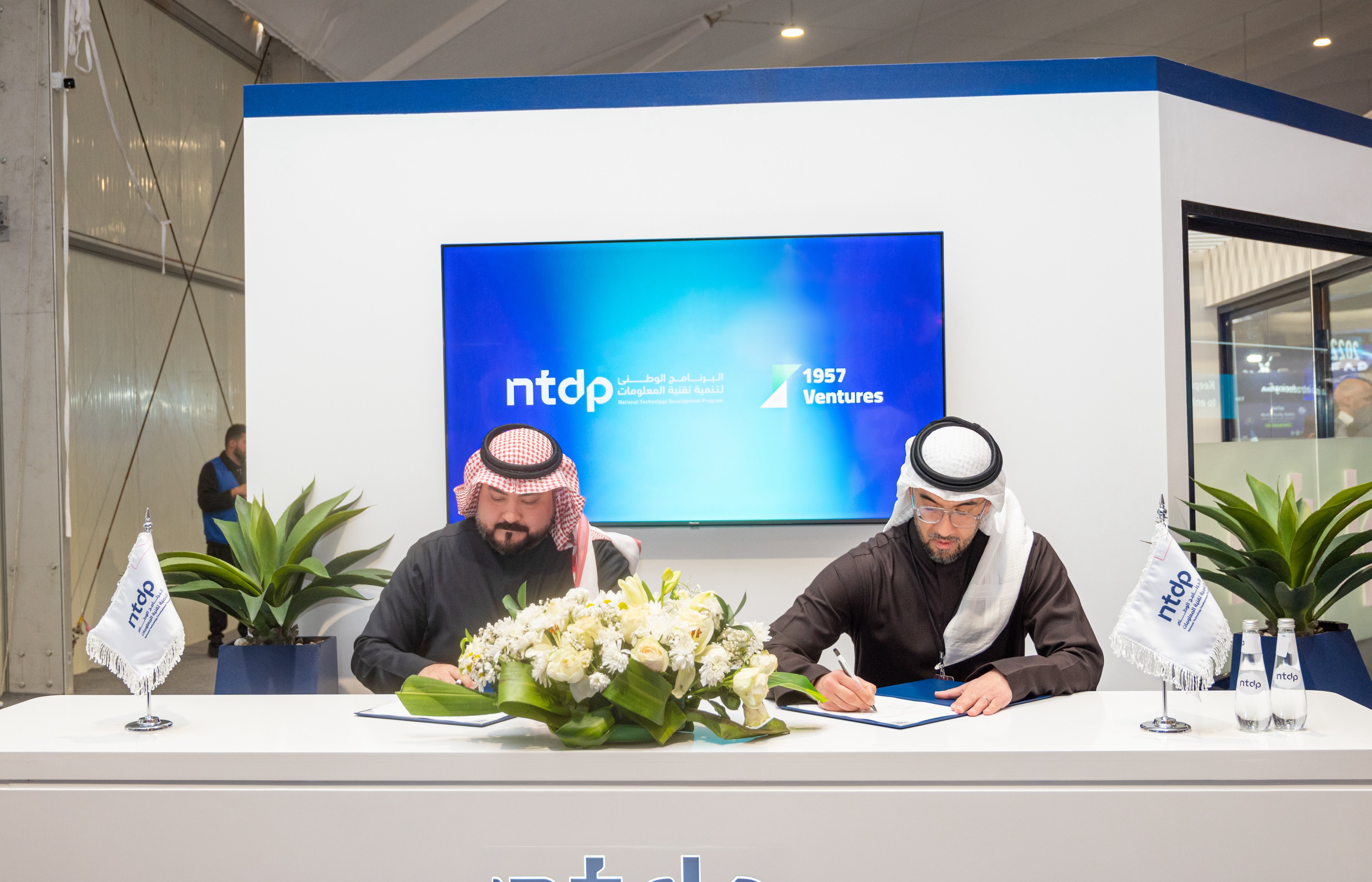
As Kashgari put it in the NTDP announcement: The success of startups hinges on access to capital, resources, and the right markets.
The list is revealing. Distribution sits beside funding. A financial product needs a way to reach customers, earn their confidence and keep serving them after the demonstration ends.
“If you don’t have customers, then it’s very hard to raise money.”Stuart Bateman · Unplugged with iSolution · June 2026
Bateman, the firm’s technology and marketing executive, put traction at the centre of that investment conversation. This gives founders a useful test: bring evidence of demand alongside evidence that the software works. Customer interviews, early usage and acquisition economics answer different questions from a polished interface.
There is a sequencing lesson here for anyone building outside finance, too. List the assumptions a business must satisfy before it can earn revenue. Test the expensive ones early. Assign an owner to each dependency, whether it concerns permissions, recruitment or customer acquisition. Then choose capital and partners around that sequence. A bigger funding round cannot, by itself, tell a team which assumption deserves the next experiment.
The model is particularly relevant when a Saudi-focused fintech needs patient capital and specialised operating help together. It fits less comfortably with a team seeking complete independence, a quick prize without incubation, or growth before it has tested demand. The lesson readers can copy is practical: map the route from prototype to permission to paying customer before deciding what kind of investor to approach.