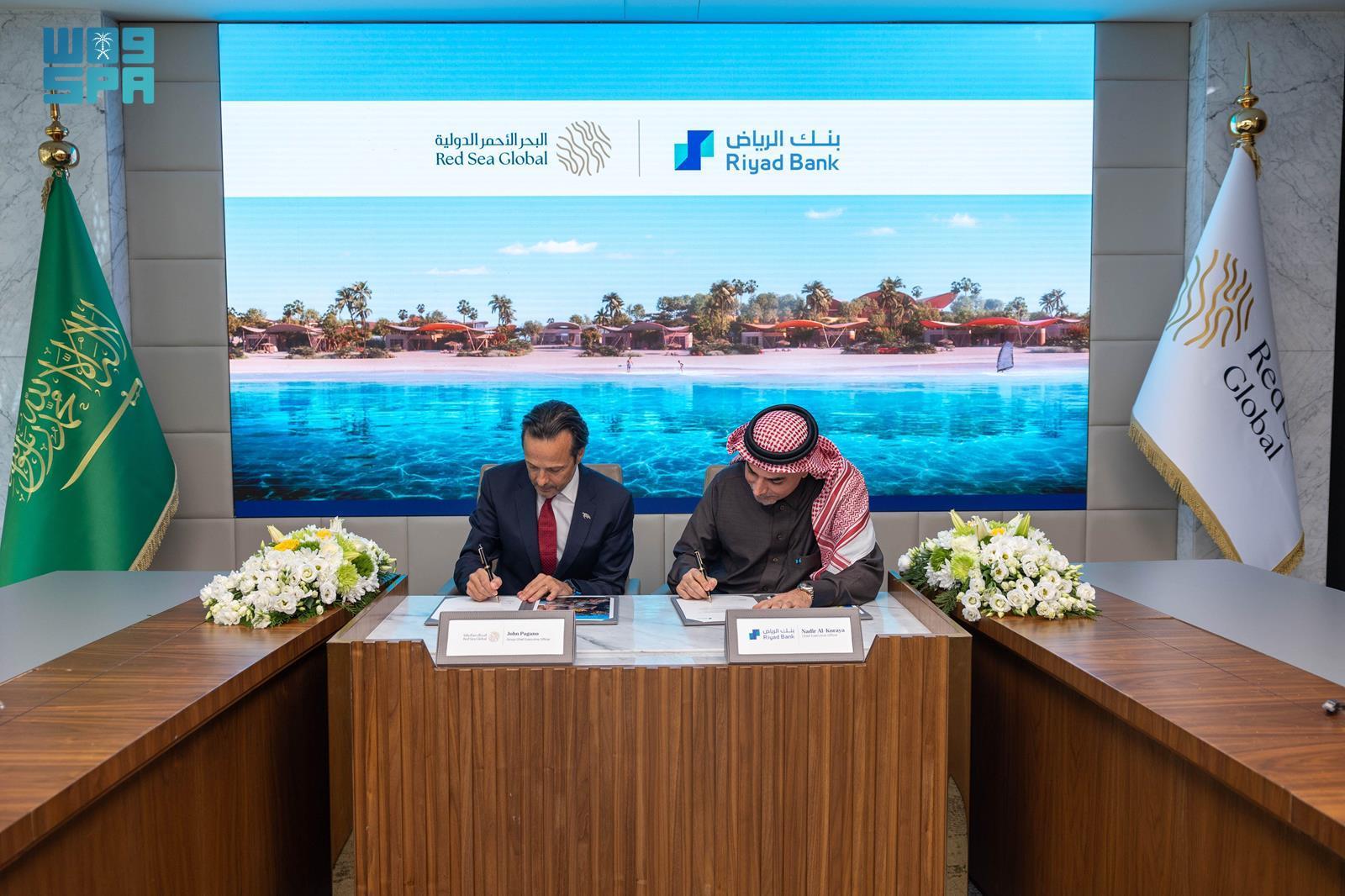
Ten days after Nadir Al-Koraya became chief executive of Riyad Bank, a photograph placed him beside Red Sea Global’s John Pagano, signing documents beneath a picture of an improbably blue sea. The setting behind them promised a holiday. The papers in front of them concerned SAR2 billion. Banking has a gift for putting the practical business of tomorrow on a table today.
The February 2024 financing supported the Four Seasons Resort development on Shura Island, through Red Sea Global’s joint venture with Kingdom Holding Company. Al-Koraya had inherited a relationship already under way: Riyad Bank had participated in the developer’s first debt financing in 2021. His arrival in the top job did not reset the clock on the bank’s commitments.
That is a useful place to begin his story. A CEO appointment makes a clean headline. The work beneath it usually has a longer history. In Al-Koraya’s case, the history includes twenty years at Samba Financial Group, a succession of treasury responsibilities at Riyad Bank, and a professional education that began with civil engineering. Long before the signing table, there were other kinds of structures to understand.
First, learn what holds things up
Al-Koraya earned a bachelor’s degree in civil engineering in 1987 and an MBA in 1989, both recorded at California State University. The pairing gives his résumé an unusual opening: an education in physical structures followed by one in business. It would be tempting to turn that into a neat origin myth. The qualifications themselves are interesting enough.
From 1993 to 2013, he worked at Samba, where his responsibilities included the treasury group and his eventual title was assistant general manager. Twenty years is a substantial stretch of any working life. It also makes his later promotion easier to understand: this was a career built through sustained responsibility inside financial institutions.
At Riyad Bank, the sequence moved from treasurer to head of treasury, then executive leadership in treasury and investment. Those jobs deal with the relationship between what a bank owns, what it owes, how it funds itself and the risks it accepts along the way. A customer may never encounter the treasury team. Its decisions still matter to the institution holding that customer’s money.
His later training included a leadership programme at Harvard Business School and an IMD board director diploma. These sit beside, rather than replace, the long banking apprenticeship. By the time he became CEO on 1 February 2024, succeeding Tareq Al-Sadhan, he had more than thirty years of financial-market experience. The new title arrived after the experience.
A hotel begins with a balance sheet
In the Red Sea financing announcement, Al-Koraya described confidence that had developed over time. “We believed in the vision its leadership presented back then at our first encounter,” he said. It is a revealing sentence because it locates the relationship before the finished destination, when the proposal still had to earn its financing.
There is a difference between admiring a destination and lending to the enterprise building it. The photograph catches the ceremonial end of a process whose central questions are rather less photogenic. How will the development be funded? What obligations will follow? How does an ambitious project fit within a lender’s wider commitments? The sea gets the backdrop; the documents get the signatures.
The relationship continued. In October 2025, Red Sea Global announced a SAR6.5 billion credit facility for AMAALA. Riyad Bank was sole underwriter, with Saudi Investment Bank and Bank AlBilad as mandated lead arrangers. The financing combined conventional and Islamic structures and followed the developer’s Green Loan Framework.
For Al-Koraya, that placed another tourism development alongside the familiar work of funding and risk. For the bank, it was a third partnership with the developer, following the 2021 facility and the Shura Island financing. Repeat business makes a quieter story than a first encounter, but it offers a useful measure of how a commercial relationship develops.
The branch gets a different job
Al-Koraya’s explanation of digital banking is strikingly practical. “Most banking operations are now conducted digitally,” he said in a 2024 interview. His description of the branch’s future was equally specific: branches were becoming places for advice and support, with personalised service taking greater importance as routine activity moved elsewhere.
The proposition changes the reason to walk through the door. An everyday transaction can migrate to a phone; a complicated financial decision may still benefit from a conversation. In this account of the future, the branch survives by changing its work. Marble floors are optional. A useful answer is rather more valuable.
He also described collaboration between banks and fintech businesses as important to financial inclusion, including digital onboarding and tools aimed at younger customers. His argument gave both sides a reason to participate: fintech businesses gain from banking relationships, while banks gain from innovation and access to customers. It is a cooperative account of an industry often discussed in terms of disruption.
The significance for his own career is the widening scope. Treasury asks how the institution funds and manages itself. Digital banking adds questions about how people encounter that institution, how easily they can use it and what they expect when they need help. As CEO, Al-Koraya has responsibility for both ends of that relationship.
“Most banking operations are now conducted digitally.”
Nadir Al-Koraya · 2024 interview
An old date on a new venture
One of the more pleasing names in his portfolio belongs to 1957 Ventures. Riyad Bank was established in 1957. The name lets a new financial-technology business carry an old institution’s date on its calling card. In banking, age can be a credential even when the business in question is concerned with what happens next.
Riyad Capital announced the closed-end 1957 Ventures fund in 2024, backed by Riyad Bank and intended to support financial-technology development in Saudi Arabia. Al-Koraya chairs the fund and also chairs Jeel Digital Innovation. He serves on Riyad Capital’s board and on Mastercard’s Middle East and Africa advisory council.
These roles put him at several points in the same conversation: an established lender, an investment business, digital innovation and payments. They also make it important to distinguish the chair’s role from the entrepreneur’s. Al-Koraya’s documented contribution is institutional leadership and support; the businesses building new products have their own executives and teams.
The interesting question is how an established bank makes room for ventures whose products are still taking shape. Funding is one part of the answer. Access to banking experience and an organisation able to support a financial service is another. The combination gives the venture activity a clear connection to his principal job.
A coffee cup enters the annual report
His first year as CEO produced the usual financial reckoning: Riyad Bank reported SAR9.3 billion in net income for 2024, up 16 percent. Yet a smaller detail in his account of the year offers a more human picture. He described departmental and regional visits, listening to teams and learning about the challenges in different parts of the business.
He also described “Coffee with the CEO,” meetings that let him connect personally with high-performing employees. Corporate life supplies enough programmes with elaborate names. This one has the advantage of telling participants roughly what to expect, including the beverage.
The meetings cannot, by themselves, establish what every employee thinks of the chief executive. They do show the kind of contact he chose to discuss publicly: direct conversations alongside structured development and training. A large bank is experienced through local teams as well as financial statements. Making time for those teams is a concrete use of a chief executive’s calendar.
16% higher than the previous year
The arithmetic catches up with the ambition
By 2026, his public discussion of the bank still carried the vocabulary of treasury. During the second-quarter earnings call, Al-Koraya spoke about funding costs, deposits, liquidity and the pipeline of government projects. His assessment was qualified: conditions were improving, but liquidity remained tighter than historical averages. Further normalisation depended on broadly unchanged market conditions.
The qualification matters. A national programme can create demand for financing; it cannot remove the cost of obtaining the money to provide it. Banking strategy has to meet the available funding, the timing of commitments and the terms on which deposits can be retained. His old specialism remains close to the centre of his newer responsibilities.
Sustainable finance provides another set of numbers to watch. By 2025, Riyad Bank had exceeded its original target of roughly $5.3 billion, reporting about $8.3 billion of eligible corporate financing and raising its 2030 target to around $16 billion. The bank issued a $1 billion sustainability bond in January 2026. Al-Koraya appeared in the banking category of the October 2026 Middle East sustainability leaders list.
Those are institutional figures, involving many people’s work. They belong in his story because they describe the scale and direction of the organisation he leads. They are also a reminder to separate a completed financing amount from a future target. Both have a place in a strategy; only one has already happened.
A target moves further out
The next set of signatures
His network extends into the Saudi French Business Council, whose November 2025 election placed him on the executive committee for the 2025-2029 term. Alongside his banking and payments roles, it gives him a formal place in a business relationship that crosses national borders. The executive who spent decades in domestic and international markets now represents a bank in several overlapping commercial circles.
The recurring ambition in his public statements is to make Riyad Bank the bank customers and employees choose. It is an ambition with many separate tests: a financing decision, a useful branch conversation, an app that makes a transaction easier, a team able to do its work. None is completed by the appointment of a chief executive.
Return to the signing photograph and the two versions of the future it contains. On the screen, the destination already looks complete. At the table, work is being committed to paper. Al-Koraya’s career has brought him steadily closer to the point where those two things meet. The next signature still has to be earned.