A rise in website traffic ought to be good news for a cruise line. More visitors, more prospective passengers, more reasons for the marketing team to congratulate itself. At Celebrity Cruises, however, a sudden rise could also mean something was wrong. A strange referring domain might be sending worthless visits. The number looked cheerful. The business underneath it was rather less so.
- Outlier searched business data for changes people had not thought to investigate.
- Its output was a small daily briefing, designed for busy business users.
- The original Oakland company closed in 2022. Scale’s current Outlier is unrelated.
That was the territory Outlier AI chose: the awkward distance between having a number and knowing whether it mattered. Its automated business analysis platform watched connected data and brought unexpected movements to the surface. It wanted to supply the question that a dashboard, however handsome, left unasked.
The question came before the software
Sean Byrnes had already helped build Flurry, the mobile analytics company acquired by Yahoo in 2014. Meeting its customers exposed a recurring problem. They appreciated the information but struggled to decide where to look. Providing more measurements had created another task: choosing which measurements deserved attention.
In 2015, Byrnes and co-founder Mike Kim started Outlier. Their first instrument was themselves. For six months, they worked as consultants, examining clients’ data manually for overlooked questions and insights. Byrnes later said it took five attempts to build a product that addressed the problem. Useful analysis could be demonstrated before its automation could be trusted.
There is something pleasingly unglamorous about this beginning. Before the statistical machinery came the professional equivalent of rolling up one’s sleeves. For a founder, the sequence is instructive: learn what a worthwhile discovery looks like in a customer’s working day. Then try to manufacture it reliably.
Four or five things, then breakfast
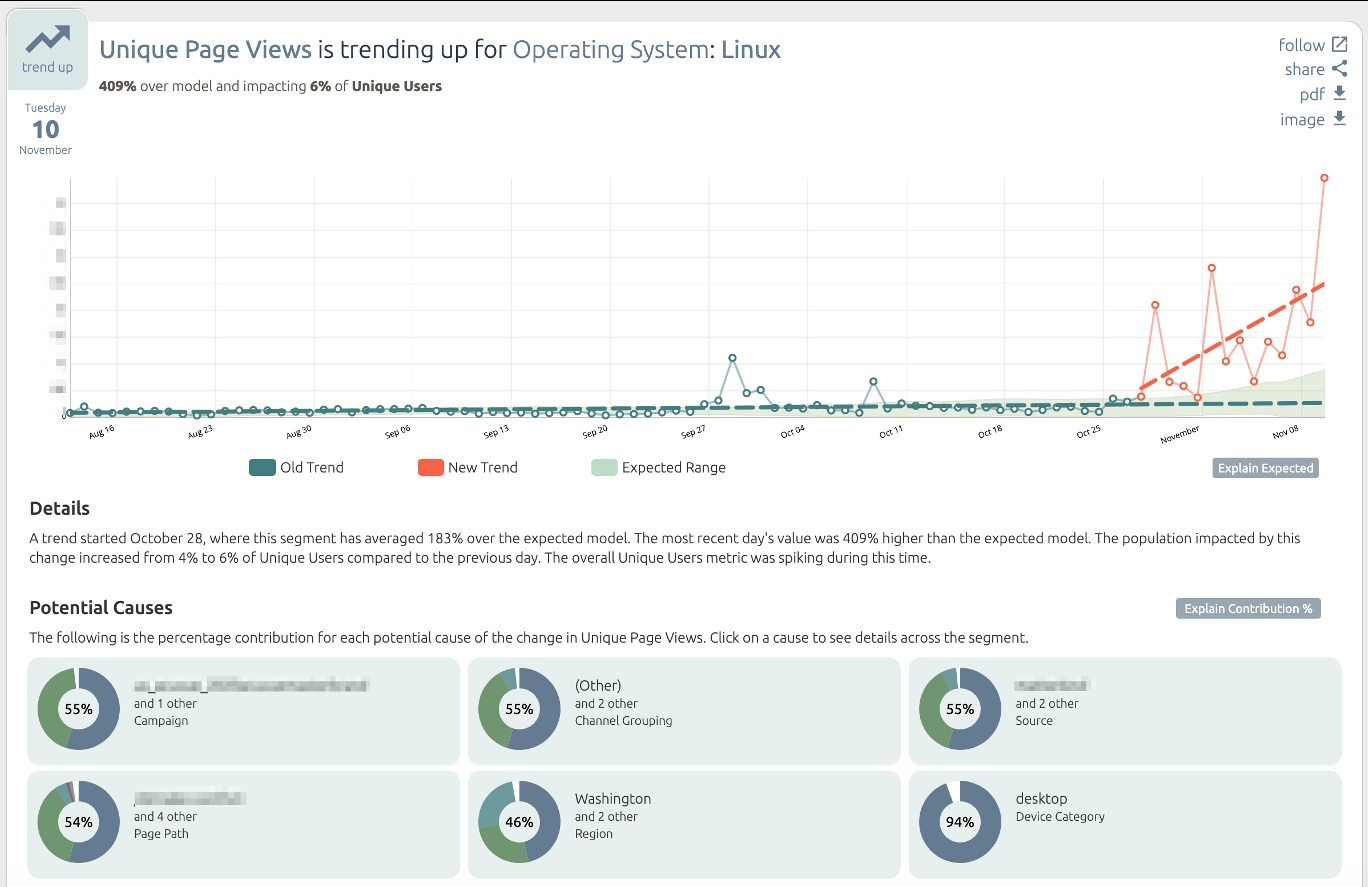
Outlier’s proposed bargain was simple. Connect the places where business data lived, then receive a short daily set of findings. Marketing staff, product teams and other business users could begin with something worth investigating instead of beginning with an empty query box. The company’s 2018 announcement described four or five selected insights.
“The last thing businesses need is another dashboard.”Sean Byrnes · 2018
The small number was central to the idea. An alerting system that notices everything can become another inbox that nobody reads. Outlier tried to select patterns relevant to each user, rather than deliver every statistical disturbance with equal ceremony. Its value depended on what it left out.
Technically, Byrnes described a collection of learning systems handling time-series models, clustering and recommendations. In a 2021 interview, he said explainability was a reason the platform did not use deep learning. A user needed to understand the finding. That was a particular design choice, not a general claim that one branch of machine learning always beats another.
A cruise line supplies the useful test
Celebrity Cruises had a suitably complicated business: thousands of travel partners, hundreds of sailings and many cabin categories and promotions. Its business intelligence leader, Matt Maule, wanted help deciding what deserved investigation across those combinations. Averages could remain placid while a particular channel or customer segment moved.
In a 2019 account, Maule described using Outlier to distinguish expected performance from departures that warranted attention. Suspicious web referrals were one application. He said alerts could arrive in less than 24 hours, helping the team respond to abnormal traffic rather than spend money on fake visits. It was a customer account, not a controlled performance study.
The same approach helped examine promotional demand and avoid overreacting to ordinary fluctuations. The practical appeal was a shorter route from movement to investigation. A chart still appeared in the process, but someone no longer had to guess which chart to open first.
- 01Connect data
- 02Notice change
- 03Inspect drivers
- 04Decide action
Investors bought the shortage of attention
Homebrew’s account of its investment made the thesis explicit: organizations would have more data than they could interpret efficiently. It named Capital One and Celebrity Cruises among customers. The opportunity lay in making that information usable without requiring each user to arrive with a hypothesis.
Outlier occupied the enterprise analytics market, alongside dashboard tools such as Tableau and Power BI and the people doing manual analysis. Its distinctive pitch was proactive discovery. Historical software listings describe a subscription sold through custom quotes. The buyer was purchasing recurring analysis, rather than a one-off report.
Ridge Ventures led the Series A. Emergence led the Series B, whose proceeds were intended for expansion and hiring. A separate 2019 investment and partnership with In-Q-Tel explored automated analysis for government datasets. These were different expressions of the same ambition: discover meaningful changes across more information than a person could comfortably review.
The business ended; the question remains
On May 2, 2022, Byrnes announced the end of Outlier’s service. Eight days later, SoundCommerce announced a transaction retaining key talent and leadership in sales, marketing, customer success and solutions engineering. Those dates matter. A team acquisition does not establish that the original software continued as an available product.
The name now creates a second puzzle. Today’s Outlier, associated with Scale AI, recruits contributors for AI training. Byrnes and the original company’s LinkedIn page explicitly distinguish that business from the Oakland startup. A familiar domain is a poor substitute for checking whose history one is reading.
For someone building analytics today, the useful inheritance is a discipline: test discoveries manually, ration the reader’s attention and make possible explanations inspectable. As a practical inference, that approach needs dependable measurements and someone empowered to investigate. Sparse data, broken tracking or an unattended alert feed would undermine it. Outlier’s experiment leaves a demanding product question: once the software has noticed something, who will care enough to act?