The meeting begins with a red number. Revenue is down 11 percent. A dashboard has done its job and delivered the bad weather; now six people begin inventing climates. Was it mobile? Europe? A promotion ending? A wonky pipeline? Somebody opens a notebook, somebody else asks the analyst to “slice it a few ways,” and lunch quietly dies. Sisu Data was built for this exact, expensive little ritual.
Its promise was narrow enough to be memorable: connect structured cloud data, choose a business metric, and let software test a huge field of possible explanations. Instead of manually filtering by region, device, customer tier, channel, week, and every combination thereof, Sisu ranked the segments most associated with the change. The product called itself a Decision Intelligence Engine. In ordinary language, it was the colleague who did the first, tedious sweep and returned with a list of suspects.
Analytics teams with a trustworthy cloud warehouse, more questions than analyst hours, and executives who would rather inspect ranked evidence than wait three days for another deck. It was not a rescue kit for messy source data, nor a casual dashboard for a tiny spreadsheet.
The useful trick: make “why” a button
Traditional business intelligence is good at describing. A line bends; a bar shrinks; an alert fires. Diagnosis begins after the visualization, usually as a human hunt through filters and SQL. Sisu tried to fold that hunt into the interface. Its machine-learning and statistical-analysis engine examined schemas, types, cardinalities, dimensions, and subpopulations, then prioritized findings by their impact on the chosen metric.
That distinction mattered. Correlation still required judgment. A ranked driver was a lead, not a courtroom verdict, and “root cause” was a bolder phrase than the math could always earn. Yet a disciplined shortlist is much better than filter roulette. Sisu’s job was to compress the search space so an analyst could spend time checking explanations, talking to operators, and deciding what to do.
The sweet spot for Sisu is quickly diagnosing what’s changing in critical areas of a business and why.Doug Henschen, Constellation Research, speaking to TechTarget in 2019
It grew into the dashboard it once sat beside
Early Sisu was a focused diagnostic companion to existing BI. Customers still explored with pivot tables, watched conventional dashboards, noticed something odd, and then jumped into Sisu. That tool-hopping became the product roadmap. In September 2021, Sisu added Explorations and Dashboards, pairing familiar drag-and-drop pivots and visualizations with one-click diagnostic analysis.
The workflow was sensible. Build a view by dragging revenue, product category, and region into place. Pin it to a dashboard. Add commentary for the team. When a tile looks strange, launch a key-driver investigation without rebuilding the question in another system. Smart Waterfall Charts then arranged the biggest drivers in sequence and adjusted for overlapping populations, avoiding the nonsense of counting the same cohort twice.
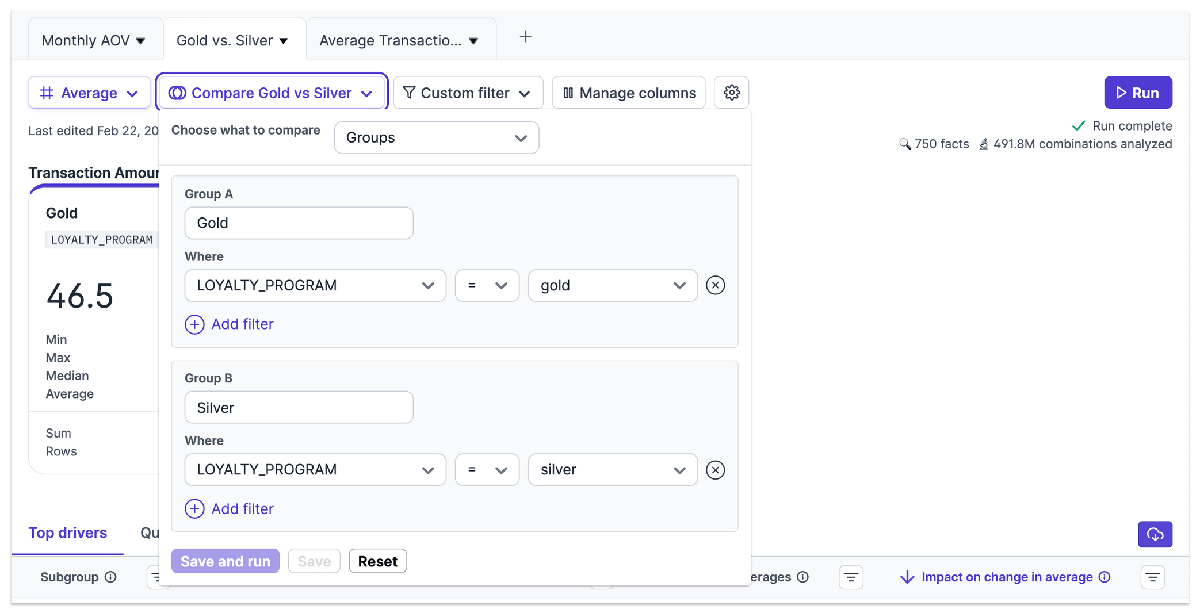
By 2022, the bundle included continuous trend and anomaly detection, predictive analytics, email and Slack alerts, a metric-grain control, and an integration with dbt Cloud Metrics. Metric grain sounds like a breakfast cereal for statisticians, but it solves a real modeling problem: a metric about orders should be analyzed at the order level, not accidentally distorted by line-item rows. The dbt connection aimed to reuse governed definitions rather than invite every tool to invent its own version of revenue.
The bill belonged in an enterprise budget
Sisu did not publish friendly little pricing cards. The surviving AWS Marketplace listing shows a 12-month Kickstart package at $25,000, including onboarding and standard support, plus $2,100 a year for each additional standard user. That is historical pricing for a discontinued product, but it tells you who the buyer was: an organization where analyst time, missed anomalies, and slow decisions could plausibly cost more than the contract.
The publicly named customer list backed that up: Mastercard, Samsung, Wayfair, Autodesk, Upwork, Gusto, Overstock, Ro, and Udacity. Sisu said revenue had more than tripled in the year before its $62 million Series C. It did not publish a dependable customer count. The product sold leverage, not seats for every curious spreadsheet owner.
| Question | Sisu’s old answer | Buyer’s reality check |
|---|---|---|
| What changed? | Dashboards, Explorations, monitoring | Plenty of BI tools already do this well. |
| Why did it change? | Automated key-driver ranking across many segments | Useful triage, but association needs human validation. |
| Who can use it? | No-code pivots and shareable findings | Clean metrics and warehouse discipline still come first. |
| What happens next? | Alerts, collaboration, monitoring, suggested drivers | The actual operational decision remains the customer’s. |
What reviews can and cannot tell us
There is remarkably little independent user commentary for a company this well funded. TrustRadius lists three ratings and describes the core workflow, but exposes no useful body of review text on its public page. Reddit searches are mostly noise from a Finnish concept, a Shanghai university acronym, and unrelated products named Sisu. Even the current AWS listing mixes in external reviews of an entirely different real-estate application. Those quotes should not be used to judge Sisu Data.
The strongest independent assessment came early. In 2019, Constellation Research analyst Doug Henschen praised the product’s diagnostic focus while warning that it looked like a feature set a larger vendor might acquire. That prediction aged with spooky precision. The review lesson is not that Sisu failed its idea. It is that a sharp analytical capability may have more gravity inside the warehouse or a broad BI platform than as another standalone destination.
I’d rather be great at diagnosing than do a bunch of things just OK.Peter Bailis, founder, speaking to TechTarget in 2019
The Snowflake ending changes the buying advice
In October 2023, Sisu said its team was joining forces with Snowflake. The announcement was explicit about discontinuing the standalone product and coy about transaction language or price. Some company databases call it an acquisition; the primary announcement simply says the teams joined forces. The practical outcome for a buyer is unambiguous: there is no standalone Sisu Data to buy today.
That also means the “latest model” question has a boring answer. Sisu did not market a named foundation model, and no current Sisu model or edition exists as an independent product. Its last documented form was a web-based decision-intelligence platform using proprietary analytical machinery, machine learning, and statistical testing over structured cloud data. Any current Snowflake feature should be evaluated under Snowflake’s own name and documentation, not assumed to be Sisu in a new coat.
What to buy instead - and what to ask
If you are shopping for the old Sisu job today, begin with the job, not the vanished brand. ThoughtSpot, Tellius, and Pyramid Analytics compete around search, augmented analysis, or decision intelligence. Looker, Tableau, and Power BI cover broader BI estates and have their own assisted-insight features. The right comparison depends on whether you need a focused diagnostic layer, a governed semantic model, a company-wide dashboard standard, or all three.
Give every contender the same ugly metric change from your own warehouse. Ask it to rank drivers, show its statistical assumptions, handle overlapping segments, preserve your metric definitions, and reveal how much compute the investigation consumes. Then ask a human analyst to challenge the top five findings. A demo that produces a clever observation is pleasant; a product that makes its reasoning inspectable and survives a skeptical operator is useful.
Also test the unglamorous pieces: permissions, row-level security, warehouse pushdown, freshness, alert fatigue, audit history, export, and the route from an insight to a ticket or business workflow. Sisu’s story suggests one final procurement question: is this capability durable as a standalone vendor, or is it likely to become a button in the data platform you already pay for?
Sisu Data is no longer a recommendation. It is a blueprint. Its best contribution was recognizing that a dashboard ending with “revenue fell” merely hands the hard question to a person. Automated diagnosis will not replace judgment, but it can spare good analysts from spending Tuesday morning opening 40 nearly identical tabs.
The backstory has excellent timing
Peter Bailis founded Sisu in 2018 from work connected to Stanford’s DAWN project and MacroBase, an analytical monitoring system designed to prioritize human attention. Bailis, half Finnish, has said his mother suggested “sisu,” a word associated with grit, perseverance, and resilience. He liked both the meaning and the sound: a sharp opening followed by something broader.
The company emerged for general use in 2019, raised $52.5 million in a Series B that year, and added a $62 million Series C in 2021 led by Green Bay Ventures. Andreessen Horowitz, NEA, and Geodesic Capital were among the backers. Gartner named it one of four 2021 Cool Vendors in Analytics and Data Science, according to Solutions Review, and Inc. named Sisu Data a Best Workplaces honoree in 2022.
Five years from founding to Snowflake is a short life for a platform and a long life for one question pursued stubbornly. The funny part is that the question has outlived the answer. Every modern analytics product now wants to explain, forecast, converse, and recommend. Sisu arrived before the chat box became compulsory and made the case with statistics, ranked segments, and a waterfall chart. There are worse things for a discontinued product to leave behind.