At a North Carolina farmers market, Patrick Mateer kept noticing the same quiet absurdity. Shoppers adored local fruit, farmers had more of it than they could reliably sell, and the whole exchange disappeared when the season ended. A rainstorm could erase a market day. A bumper crop could become a disposal problem. Meanwhile, supermarket freezers stayed open under fluorescent light, indifferent to weather and calendars.
Seal the Seasons was built in that gap. The company buys produce from American family farms, freezes it around harvest time and sells it in the same broad region where it grew. A bag in the Carolinas might contain North Carolina blueberries or South Carolina peaches. A Pacific Northwest assortment can feature Oregon and Washington cherries. The logo stays the same; the map on the bag does not.
To a shopper, this is convenient fruit for smoothies, pies and breakfasts. To a farmer, it can be a second market for crops that are plentiful, ripe and too perishable to wait. To a grocer, it is a recognizable frozen product with a local story attached. The company is a consumer brand, but its hard-earned expertise lives backstage: crop planning, food safety, individual quick freezing, packing, cold storage, distribution and retailer category resets.
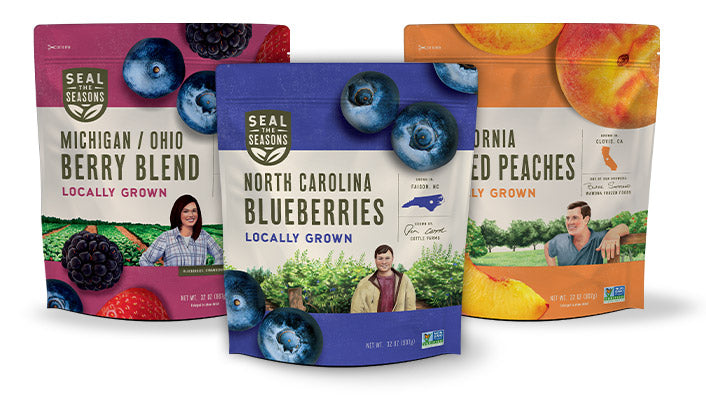
The product is fruit. The invention is the map.
Frozen fruit is not a novel category, and Seal the Seasons does not need it to be. Dole, Wyman's and supermarket private labels already offer convenient bags, often supplied through large national or international chains. Seal the Seasons changes the organizing principle. Instead of pulling everything into a few national hubs and sending it back out on long spokes, it assembles several regional systems with shorter spokes.
That distinction solves two problems at once. Local food becomes available outside a short harvest window, and frozen food becomes less anonymous. The company has printed farmer portraits and quotes on packages and has offered lot-code traceability online. It also emphasizes affordability over making everything organic. Some products are certified organic; the broader line is third-party Non-GMO certified.
“When it's frozen and you blend it up in a smoothie, you care less if it's blemished.”Patrick Mateer, founder and CEO
That sentence is the business in miniature. A peach marked by hail may struggle in the beauty pageant of the produce department. Sliced and frozen, its flavor matters more than its complexion. Freezing does not rescue spoiled food, but it can create a market for sound fruit whose shape or timing makes the fresh channel unforgiving.
What they actually did
The founding story began at the University of North Carolina at Chapel Hill, where Mateer worked around local-food distribution and food access. Public accounts connect the early team to Alejandro Piasecki, Daniella Uslan and Will Chapman. They developed the idea through campus social-innovation programs, then Mateer took a semester away to enter business competitions. The winnings totaled about $80,000.
That money bought a beginning, not a moat. In 2015 the team ran its own individual-quick-freezing line in a shared commissary kitchen in Hillsborough. Liquid nitrogen froze cleaned produce at extremely low temperatures. Seal the Seasons found roughly a half-dozen small retailers, then moved toward chains. Harris Teeter, Whole Foods and Lowes Foods took the young brand into hundreds of stores in 2016.
The early capital stack was practical and pieced together: a $50,000 loan helped secure office space, Slow Money NC supplied $100,000 in peer-to-peer loans, and Self-Help Credit Union provided another $150,000. A 2018 private-equity offering added $1.8 million. Later records show a $2.5 million bridge round in 2022 and undisclosed financings after that. One 2023 fundraising document listed annual revenue at about $10 million; a trade publication separately described sales as eight figures.
The regional freezer loop
What failed first: owning the cold part
Success exposed the weakness in the first setup. The team had gone from a shared kitchen to more of its own production space, but every new region threatened to require another expensive version of the same thing. Freezing equipment, certified rooms, labor and throughput are unforgiving assets. An idle line is costly; a packed line can choke growth.
In 2017, Seal the Seasons changed its mind about where production had to live. Some larger family farms already owned freezing and packing equipment, often with unused capacity. One partner, Cottle Farms, could process its own crops and those of dozens of neighboring growers. Seal the Seasons moved from doing most production itself to coordinating production through farmers and co-packers.
“We changed our model from us doing the production to partnering more with our farmers. We're able to utilize existing capacity to produce our products.”Patrick Mateer on the 2017 pivot
This was not outsourcing in the usual cost-cutting sense. It was a design decision that made the mission easier to scale. The company could enter a region by finding the right growers, certified processing and retail demand instead of pouring concrete first. By 2021, outside research counted more than 70 farms, over 65 products and at least 12 freezing and packing sites across six regions.
Who buys it - and what they are really buying
The consumer is a household that wants fruit ready when the blender is, without watching a carton of berries soften in the refrigerator. The retail customer is a grocer that needs reliable case packs, food-safety documentation and products that earn their freezer doors. Distributors such as UNFI and KeHE connect the brand to natural and conventional retail. Seal the Seasons also sells online in regional bundles, shipping with dry ice to the continental United States.
The range has expanded beyond single-origin fruit. Farmers Blends arrived in 2020. Smoothie Kits pair frozen fruit with concentrated “Superfood Gem” cubes and promise five smoothies per bag. A 2023 national rollout put those kits into ten UNFI and KeHE warehouses. The Florida Antioxidant Blend, launched with Publix, combined Florida and Georgia berries with Michigan dark sweet cherries and reached a chain operating more than 1,300 stores at the time.
Public store counts vary by date and definition. The company FAQ says more than 4,000 stores nationwide; 2023 trade coverage reported 6,000 retail stores and more than 1,000 carrying smoothie kits. The sensible conclusion is not one eternal number. It is that Seal the Seasons crossed from farmers-market experiment into mainstream grocery distribution.
The copyable bit is not the berry bag
Founders in other categories can borrow the architecture. Find a product trapped by time or geography. Identify expensive capacity that already exists near supply. Build one customer promise across several regional operating cells. Let each cell vary where local reality demands it, while standardizing quality, packaging and sales.
The four-part steal
- Start with waste or idle capacity. Surplus fruit and underused freezing lines gave both sides a reason to participate.
- Own the standard, not every asset. Food safety, sourcing rules and the retail brand stay consistent.
- Make regional variation visible. Different crops are a feature, not an operational embarrassment.
- Secure demand before duplicating supply. Retailer commitments make each new hub less speculative.
There is a softer lesson too. Mateer and Piasecki once described “mentor whiplash” from well-meaning experts giving conflicting advice. Their filter became the company mission. That does not mean ignoring operating math. It means using the mission to choose among plausible paths. The asset-light model survived that test because it supported farmers and reduced the capital required to expand.
When the playbook does not work
A distributed network is not magic. It replaces factory ownership with coordination, and coordination can be its own expensive machine. Seal the Seasons needs enough suitable crop volume, capable processors, cold storage, freight and retailer demand in each region. Miss one component and “local at scale” can become either local but tiny, or scaled but no longer meaningfully local.
Its partnerships reveal how the company tries to hold the model together. The Food Bank of Central & Eastern North Carolina once brought Seal the Seasons a large donation of sweet potatoes from Bone Farms that needed processing for local agencies. American Farmland Trust works with the brand on farmland conservation and small-farm grants. These efforts sit beside, not outside, the commercial engine: more processing and more demand can create more outlets for growers.
Seal the Seasons' ambition has always been larger than frozen fruit. Mateer once described a future with local food in every grocery aisle. The company is not there, and perhaps the interesting point is that it does not need to be. It already demonstrated a more portable idea: when a market is squeezed between seasonality and convenience, the answer may be neither a prettier storefront nor a giant new plant. It may be a network hiding in plain sight, waiting for someone to give its spare parts one label and one route to the shelf.
Open the freezer door