The egg company that put a farm's name on every carton
How a 20-hen Texas farm turned radical transparency and 108 square feet of pasture per bird into a $759 million business - one carton at a time.
In 2007, Matt O'Hayer and Catherine Stewart bought 20 hens and put them on a 27-acre patch of grass outside Austin. The idea was almost stubbornly simple: let the birds live outdoors, feed them well, and sell the eggs to people who cared how they were raised. Nearly two decades later, that idea has grown into Vital Farms - a Certified B Corporation on the Nasdaq that reported $759.4 million in net revenue for fiscal 2025 and now sources from a network of hundreds of family farms. The hens are still outdoors. What changed is everyone's willingness to pay for it.
Vital Farms sells pasture-raised eggs and, increasingly, pasture-raised butter, ghee, hard-boiled eggs and liquid eggs. But describing it as a food company undersells the trick at its center. The company built a business out of information as much as protein - it made the origin of an ordinary breakfast staple visible, verifiable, and, crucially, worth a premium.
A carton that tells on itself
Pick up a carton of Vital Farms eggs and you will find the name of a specific farm printed on it. Type that name into the company's Farm Finder tool and you can watch a 360-degree video of the actual place your eggs came from. It is a small feature that quietly reorganizes the entire value proposition. Most food supply chains are designed to be invisible. Vital Farms turned its supply chain into the marketing.
The transparency is backed by a hard number. Under the Certified Humane pasture-raised standard the company follows, every hen is given at least 108 square feet of outdoor space - roughly the footprint of a small hotel room, per bird. Compare that to "cage-free," where hens may never step outside, and the gap between marketing language and reality becomes the whole point.

Who actually buys this
The short answer: shoppers who read labels. Vital Farms products sit in more than 24,000 stores across the country, from Whole Foods - its earliest major retail partner, back in 2008 - to conventional supermarkets and club channels. The company estimates it accounts for roughly 3% of US egg volume, but a meaningfully larger slice of retail egg dollars, because its cartons cost more. That is the pasture-raised premium at work: fewer eggs, more revenue per egg.
Its customers skew toward people willing to trade price for a story they trust - the same instinct that powers organic produce, fair-trade coffee, and grass-fed beef. Vital Farms' bet was that this instinct was durable and growing, not a fad. Two decades of steady expansion suggest the bet held.
There is a second, quieter customer too: the food industry itself. By proving that a meaningful share of shoppers will pay up for verifiable welfare standards, Vital Farms gave grocers a reason to build out a premium egg set, and gave farmers a route to fairer compensation than the commodity market offers. The brand does not just sell to the aisle; it helped create the aisle.
The problem it set out to solve
The modern egg aisle is a thicket of vague claims. "Natural," "farm fresh," "cage-free," "vegetarian-fed" - terms that sound reassuring and mean very little, or nothing at all. Vital Farms' answer was almost confrontational. Its central marketing pillar is a registered trademark: "Keeping it Bullsh*t-Free." In an industry built on soft language, the company decided to make bluntness the brand.
That posture solves a real consumer problem - the impossibility of knowing what a food label actually delivers - by replacing adjectives with evidence: a named farm, a video, a certification, a square-footage figure you can picture. The genius is that legibility does the selling. You do not have to trust Vital Farms. You can go look.
How it differs from the rest of the aisle
Vital Farms' competitors fall into two camps. There are the specialty peers - Pete & Gerry's, Happy Egg Co., Handsome Brook Farms - who play in the same pasture-raised and organic tier. And there is the conventional-scale world of Eggland's Best, Land O'Lakes, and Costco's Kirkland private label, largely supplied by giants like Cal-Maine Foods.
What separates Vital Farms is structural, not cosmetic. Rather than concentrate production in a few enormous barns, it stitches together a distributed network of small farms, each held to the same welfare standard, and keeps the brand and the packing infrastructure for itself. It is an asset-light model on the farming side and asset-heavy where it counts - the washing, grading and packing done at its own facility, "Egg Central Station" in Springfield, Missouri, soon joined by a second in Indiana. The farms provide authenticity; the brand provides scale.
The product line, and where it's headed
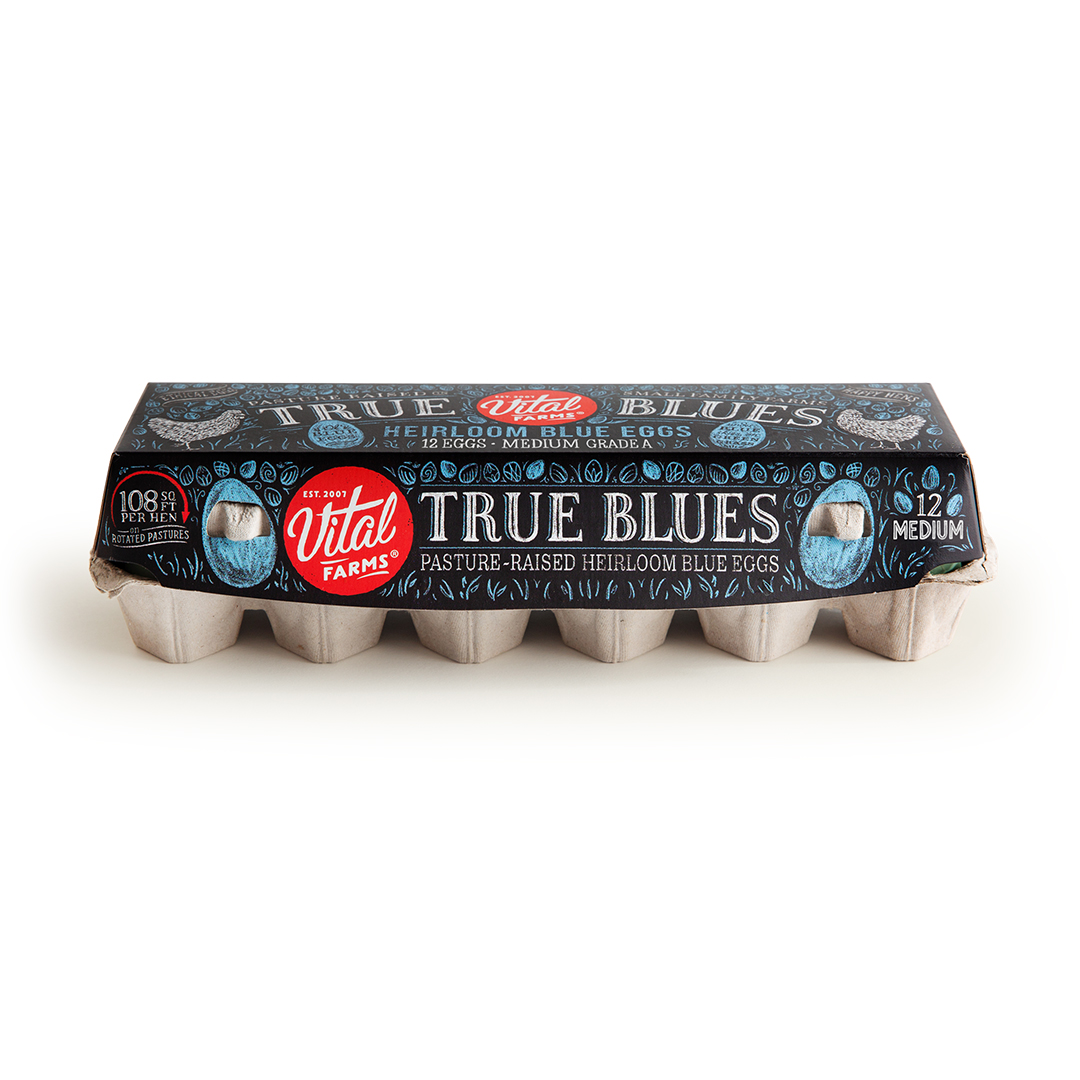
Eggs remain the heart of the business, but the shelf keeps widening. Vital Farms added pasture-raised butter in 2015, became the first brand to sell ready-to-eat pasture-raised hard-boiled eggs in 2018, and has since layered in ghee, liquid whole eggs, and the heirloom True Blues line. Each extension follows the same logic: take a familiar category, apply the pasture-raised standard and the traceability story, and charge accordingly.
Product Timeline
- 2007Pasture-raised shell eggs - the flagship, from 20 hens
- 2015Pasture-raised butter, salted and unsalted
- 2018First ready-to-eat pasture-raised hard-boiled eggs
- 2019Ghee, plus the Farm Finder traceability tool
- 2021Liquid whole eggs for baking and scrambles
- 2022True Blues heirloom blue eggs
The business behind the breakfast
Vital Farms went public on the Nasdaq in 2020 under the ticker VITL, raising roughly $125 million. The numbers since have compounded. Fiscal 2025 brought $759.4 million in net revenue, up more than 25% year over year, net income of $66.3 million, and - for the first time - Adjusted EBITDA above $100 million, at $114 million. Management has guided fiscal 2026 to between $900 million and $920 million, and has publicly set its sights on $2 billion in net revenue by 2030.
Net Revenue, Fiscal Year ($ millions)
To feed that growth, Vital Farms broke ground in 2025 on a second Egg Central Station in Seymour, Indiana - a 72-acre site expected to add around 400 jobs and hundreds of millions in additional revenue capacity once it comes online by early 2027. The same year, its farm network crossed 10 million hens. For a company that likes to talk about small farms and "the girls," it is quietly building serious industrial muscle.
Culture, and the people who set it
Vital Farms leans hard on the language of Conscious Capitalism, the movement associated with Whole Foods co-founder John Mackey. It runs on a stakeholder model that formally weighs eight groups - farmers, animals, crew members, stockholders, customers, the environment, the community, and vendors - rather than shareholders alone. It has been a Certified B Corporation since 2015, recertifying for a fourth time, and carries a Great Place To Work certification.
The leadership blends founder idealism with operator discipline. Matt O'Hayer, an accomplished chef and serial entrepreneur, remains executive chairman; his co-founder and wife Catherine Stewart sits on the board. President and CEO Russell Diez-Canseco, who joined in 2014 and built Egg Central Station, was named EY Entrepreneur Of The Year 2024 for the Gulf South. Chief Marketing Officer Kathryn McKeon, who also runs the butter business, has helped make the brand's blunt voice a competitive asset.
Where it fits in the market
Step back and Vital Farms occupies a specific and defensible slot: the premium, ethics-forward end of a commodity category, at national scale. Plenty of brands have tried to sell "better" eggs. Few have combined a genuinely differentiated welfare standard, a traceability mechanism consumers can actually use, a distinctive voice, and the packing infrastructure to reach 24,000 stores. That combination is the moat. Anyone can raise a pasture-raised hen; matching the whole system is far harder.
The company still faces the ordinary risks of its industry - avian influenza, feed costs, the perennial scrutiny that comes with any ethical-food marketing. Critics have questioned whether "pasture-raised" claims always match the pastoral image, and the company has drawn both lawsuits and praise over how it talks about its birds. That tension is arguably built into the model: the more a brand promises transparency, the more closely it will be checked.
But the through-line from 20 hens to $759 million has been remarkably consistent: make the invisible visible, and let people decide it is worth paying for. Vital Farms calls its hens "the girls" and gives each of them more than a hundred square feet of grass. Whether you read that as marketing or mission, the market has been answering the same way for eighteen years - with its wallet.