Scott Uzzell’s first telephone company had a problem. The telephones broke. He had recruited fellow students to sell them, promised to stand behind the merchandise and discovered that a guarantee becomes rather less charming when somebody uses it. Refunds overtook revenue. His parents helped him out. The aspiring businessman received an early education in the difference between selling a product and keeping a promise.
Today he runs Helen of Troy, the consumer products company behind OXO, Hydro Flask and Osprey, among other brands. Between those two enterprises lie sales jobs, business school, coconut water, Converse and responsibility for Nike’s North American business. The products changed. The customer’s freedom to choose somebody else remained.
That is a useful way into Uzzell’s career. His work happens where a company’s intentions meet somebody’s shopping basket. A corporate plan may survive several committees. A customer can dismiss it with a glance.
A business education with customers attached
Entrepreneurship was part of his family’s vocabulary. His father and grandfathers ran businesses. As a teenager, Uzzell tried several of his own, including washing cars and cutting grass. The telephone venture was one expression of an interest that predated any executive title.
At Florida A&M University, business came with practical assignments. His internships took him to Procter & Gamble, General Motors and Honeywell Information Systems. He also helped run an operation providing catering and dinners for students meeting visiting executives. Studying business while arranging dinner offers an efficient reminder: somebody still has to deliver what was promised.
There is a particular advantage to meeting customers before learning to describe them in a presentation. You encounter requests, preferences and objections in their original, inconvenient form. Uzzell’s early experience put established manufacturers and small enterprises in the same field of view. Both needed people to buy; their resources and room for mistakes differed.
The long route through the grocery aisle
His early employers included Procter & Gamble and Nabisco. A Florida A&M career biography records P&G roles from 1989 to 1994 and Nabisco roles from 1995 to 1998. He earned his Chicago Booth MBA in 1998 and returned to Coca-Cola in 2001.
These are businesses in which repeat purchase matters. A shopper may enjoy an advertisement once; the product must justify another purchase next week. For a future brand executive, that is demanding training. Recognition gets a product considered. Availability, price and experience help determine whether it stays in the household.
The succession of employers also complicates the tidy career story people tend to tell afterward. There was no single category he would spend his entire working life mastering. Instead, the record shows movement between organizations, responsibilities and eventually industries. The connective tissue was an interest in consumers, with sales and marketing providing a practical starting point.
Coconut water, corporate scale
At Coca-Cola, Uzzell’s work moved toward smaller brands and new categories. He took a leadership role at ZICO in 2012, then led Coca-Cola’s Venturing & Emerging Brands group. The portfolio associated with his tenure included Honest Tea, ZICO, Fairlife and Suja.
The assignment put him between two kinds of ambition. An emerging brand wants attention, distribution and enough room to develop. An established company wants growth it can sustain at scale. Bringing the two together requires decisions about investment, ownership and how much of a smaller business should change.
His titles tell part of that story: commercial leadership at ZICO, then responsibility for a portfolio inside Coca-Cola. One asks how a particular brand reaches buyers. The other adds a question about where the next opportunity might be. That combination would become relevant again when he joined a company whose name is less familiar than many of the products it sells.
The shoe decision
When the Converse opportunity arrived, Uzzell made a list of reasons to take it or stay at Coca-Cola. Then he set the list aside. He asked whether he would learn, feel passionate about the work and have fun. Those questions helped him accept the job.
He became Converse president and CEO in January 2019. The move took him from beverages to a business in which people could wear their allegiance. A pair of shoes has practical work to do, but its public life matters too. People see it. They associate it with a sport, a musician, a friend or a version of themselves.
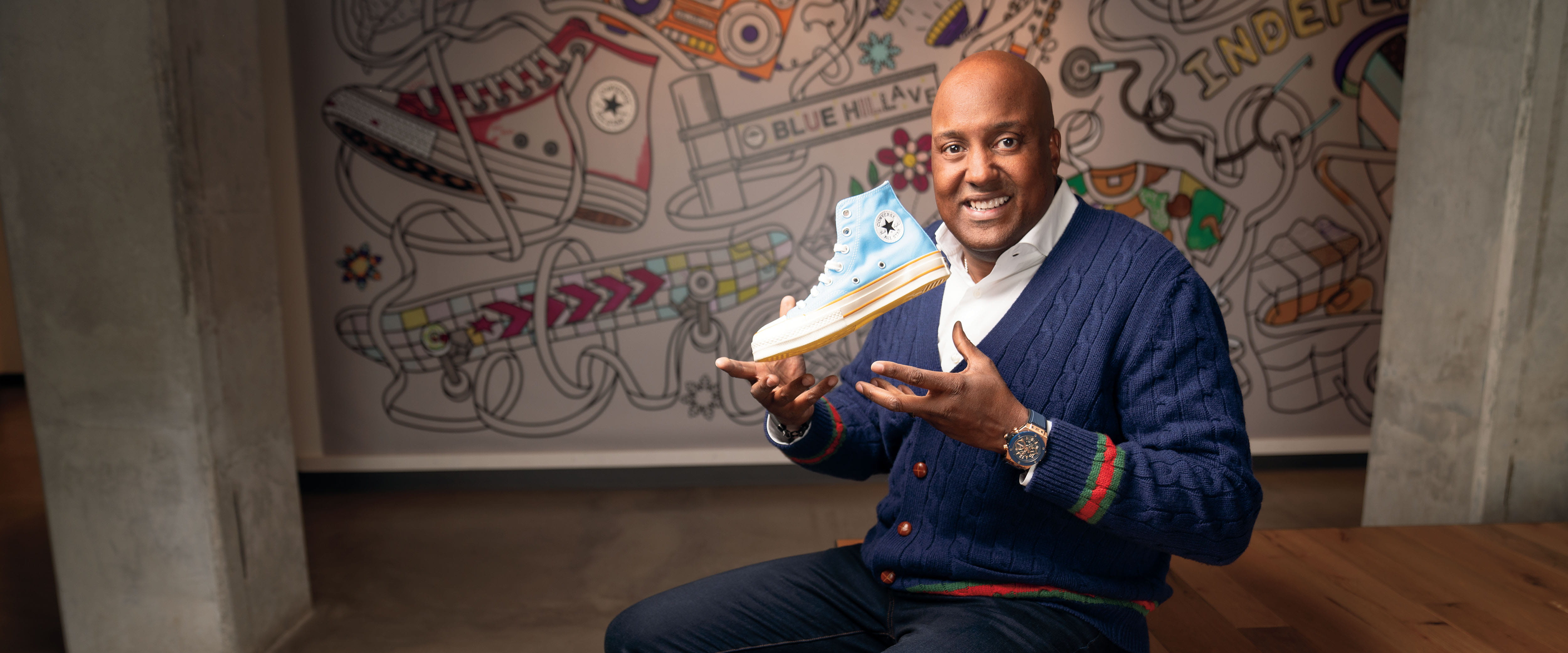
The task at Converse included its return to basketball after a decade away from the category. That gave the business an especially interesting brief: make something new in a sport already woven into the brand’s identity. Heritage supplied material to work with. Customers would decide whether the result belonged in the present.
When the audience talks back
Uzzell’s public discussion of Converse also reached beyond product launches. In a 2020 conversation about corporate responses to racial injustice, he described examining the company internally before speaking externally. Its public aspirations, he said, left work to be done inside the organization.
He discussed commitments to hire more Black creatives, designers and athletes, support businesses and amplify young voices. The larger point was about consistency. Customers and employees experience a company through decisions made across the year, including the ordinary days when no public statement is due.
“Can we really say that the audio and the video match?”Scott Uzzell, on examining a company’s commitments
That question has an unusually practical quality. It asks a listener to compare what is said with what is visible. For a brand built around self-expression, the comparison belongs close to the product. Who gets to design, contribute and make decisions affects the work that reaches the customer. Advertising cannot settle every question about the organization behind it.
The message from a shop floor
One smaller episode shows another side of Uzzell’s access to people. Helen He, then working at a Converse store in Southern California, contacted him through LinkedIn for an informational interview. She wanted to understand how to move toward the corporate side of the apparel business.
He encouraged her to consider graduate school. Later, she arranged for him to speak with her Sports MBA class at San Diego State University. The exchange connected a retail employee’s question to a classroom conversation with a chief executive. It is a more revealing measure of accessibility than an open-door slogan.
His advice to the students drew on a distinction he had taken time to understand: liking a field and wanting to build a working life in it are different tests. Being good at something can open a door. Deciding whether to keep walking through it requires a more personal judgment.
Basketball at Lincoln Center
In 2023, Nike named Uzzell to lead North America as part of a broader leadership reorganization. The company placed the changes within an effort to integrate its businesses and serve consumers across direct and wholesale channels. His assignment expanded from a particular brand to a regional business spanning Nike and Jordan.
That September, Nike brought its World Basketball Festival to Lincoln Center in New York. Eighty high-school players, drawn from 23 states and three countries, were scheduled to compete. Nike also announced a $2 million grant supporting young people’s access to arts programming through Lincoln Center.
The setting made the connection between sport and culture unusually literal. Basketball occupied a place associated with performance of another kind. For an executive whose route had taken him through Converse, the event offered a visible meeting point for competition, design and community. A shoe company’s audience could include the player, the spectator and the person drawn in by everything around the game.
A different collection of everyday loyalties
Uzzell became Helen of Troy’s CEO on September 1, 2025. The board’s appointment announcement emphasized brand building, product innovation, team leadership and capital allocation. His stated ambition was to restore consistent growth and create value for shareholders.
The portfolio makes that ambition tangible. OXO lives in kitchens. Hydro Flask travels with its owners. Osprey makes packs. Other businesses serve beauty and personal care routines. The parent company has to support these distinct relationships while deciding where money, attention and capabilities will do the most useful work.
Helen of Troy describes a review of strategic priorities and an effort to modernize its business model. The challenge brings together several strands of Uzzell’s experience: established names, changing consumer preferences and a portfolio that needs choices about investment. Familiarity helps a brand get noticed. It still has to earn the purchase.
Helen of Troy’s second-quarter fiscal 2027 net sales, up 2.1% from the comparable quarter. The period ended August 31, 2026.
The latest reported quarter provides a checkpoint. Alongside sales growth, the company reported $4.6 million in net income and $57.1 million in operating cash flow. It raised its full-year earnings and cash-flow outlook. Tariff refunds also contributed to the quarter, with most of the gross refund amount reinvested.
Those figures give the story a present tense without supplying an ending. A portfolio changes through many decisions, and the next set of results will test the current ones. Uzzell’s career has moved a long way from selling telephones at school. The obligation underneath the sale is still recognizable: give people a reason to choose the product, then deliver something worth choosing again.