A swimming pool manufacturer had a literature problem. It printed thousands of brochures, stored them, and sent them to dealers. The arrangement was perfectly recognizable: headquarters made the material; everyone else requested it. WhiteOak, the Lancaster printing company asked to improve the system, gave the dealers something more useful than another shipment. It gave them a way to make the brochure their own.
- Print, mail, merchandise and fulfillment share an ordering workflow.
- Local users can personalize approved corporate templates.
- The strongest fit is recurring work across distributed teams.
In WhiteOak’s published OMS brochure, dealers can upload photographs, add contact details and logos, and order within renewable budgets. More than 310 dealers are described as using the system. The document is a case snapshot, rather than a live customer counter. Still, the mechanism is worth examining. The manufacturer kept the corporate framework. The dealer gained room to be local. A brochure became a small negotiation between consistency and usefulness.
The expensive part can happen before the press
That negotiation helps explain WhiteOak’s place in the market. It produces business printing, direct mail, signs, promotional merchandise and corporate apparel. It also designs materials, assembles kits, stores inventory and distributes orders. The connecting service is Online Management Solutions, or OMS: a branded portal through which approved users can customize, proof and order materials.
Consider the humble business card. WhiteOak’s brochure describes an electronics manufacturer with more than 880 field representatives ordering through a portal. Requests go to corporate for approval before printing. The object remains a rectangle of card. The work around it becomes a repeatable process, with someone deciding what may change and someone else deciding whether the order may proceed.
- 01Approved template
- 02Local details
- 03Proof + approval
- 04Print / pick / ship
WhiteOak’s engineering-company example joins the portal to an internal procurement system and adds inventory picking and packing. Its separate Success Stories page reports average savings of 34% on products processed through OMS for an unnamed engineering client. That is a company-reported result for one customer, with no published calculation. The portable idea is to inspect the whole order: approvals, handling, storage and delivery belong in the comparison alongside the print quote.
A browser joins the production line
Founder David Wisehaupt started the business in 1984 in Marietta, Pennsylvania. It moved to Lancaster in 1987 and into its Dillerville Road building in 1995. The first digital color press arrived in 2001. The first online ordering system followed in 2004. These dates describe a printer gradually connecting the customer’s desk to the production floor.
Digital production makes that connection practical. WhiteOak offers variable-data printing, which changes text or images between individual pieces. A customer can commission personalized mail or a short run of materials without treating every version as an entirely separate design. Its HP Indigo 12000, installed in 2021, expanded the available sheet to roughly 20.8 by 29.5 inches, bringing larger projects into that digital workflow.
The service mix grew sideways, too. WhiteOak acquired promotional-products businesses GPI Marketing in 2012 and Creative Promotions Plus in 2013. Today its catalog of capabilities stretches from a printed mailer to a branded jacket, from a window graphic to a gift box. Its commercial logic is straightforward: sell production and related services, then help customers manage recurring orders. Promotional work moves from quotation to delivery; a custom project starts with its requirements.
The machine that seemed fine
There is a less tidy episode in this history. During roof replacement in July 2018, a storm sent rain into the building. Wisehaupt later put the damage above $500,000. A paper cutter dried out and resumed work. An initial insurance inspection considered it usable. By September, its performance had become troubling.
Dealer G.E. Richards and supplier Colter & Peterson investigated further. Disassembly revealed additional water damage, changing the assessment of its long-term safety. A second cutter also deteriorated after initially appearing all right. The insurer accepted the revised findings, and replacement PRISM cutters followed. For a buyer, the useful lesson sits in that second inspection: continued operation can conceal a problem that only closer examination reveals.
“We are more digital oriented by design”David Wisehaupt, describing WhiteOak’s production mix in 2019
The last few feet matter
Finishing provides another window into the business. WhiteOak put a Morgana BM4050 booklet maker to work at the beginning of 2023. In the supplier’s account, its production manager described the previous machine as difficult at times and praised the replacement’s simpler setup. Typical runs were about 2,000 copies. The improvement he emphasized was turnaround time.
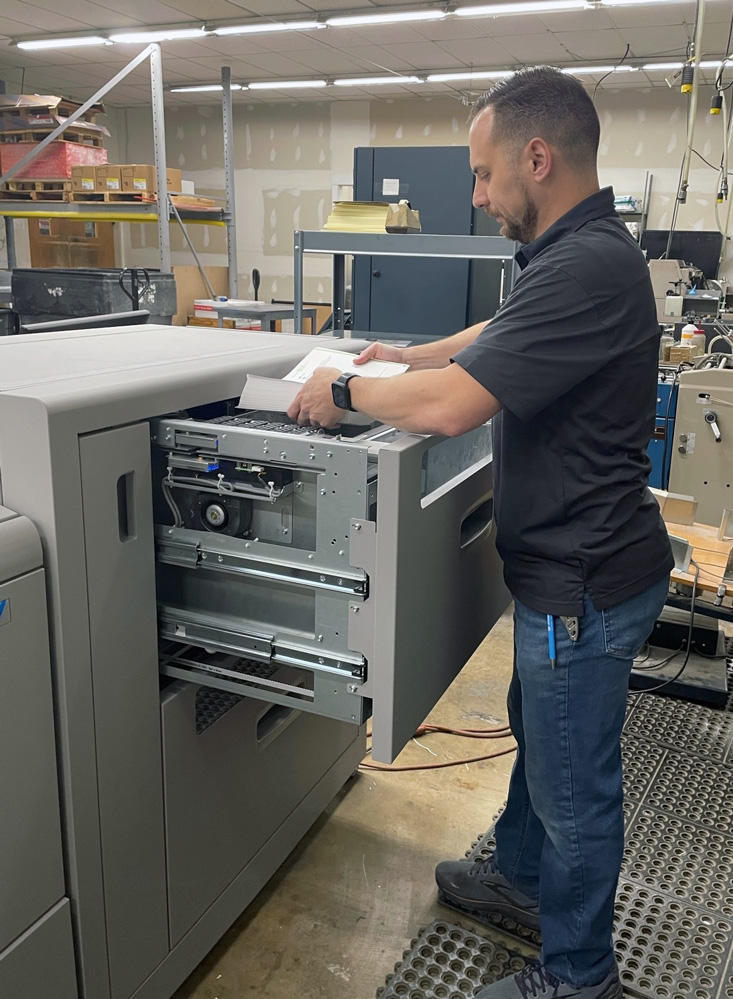
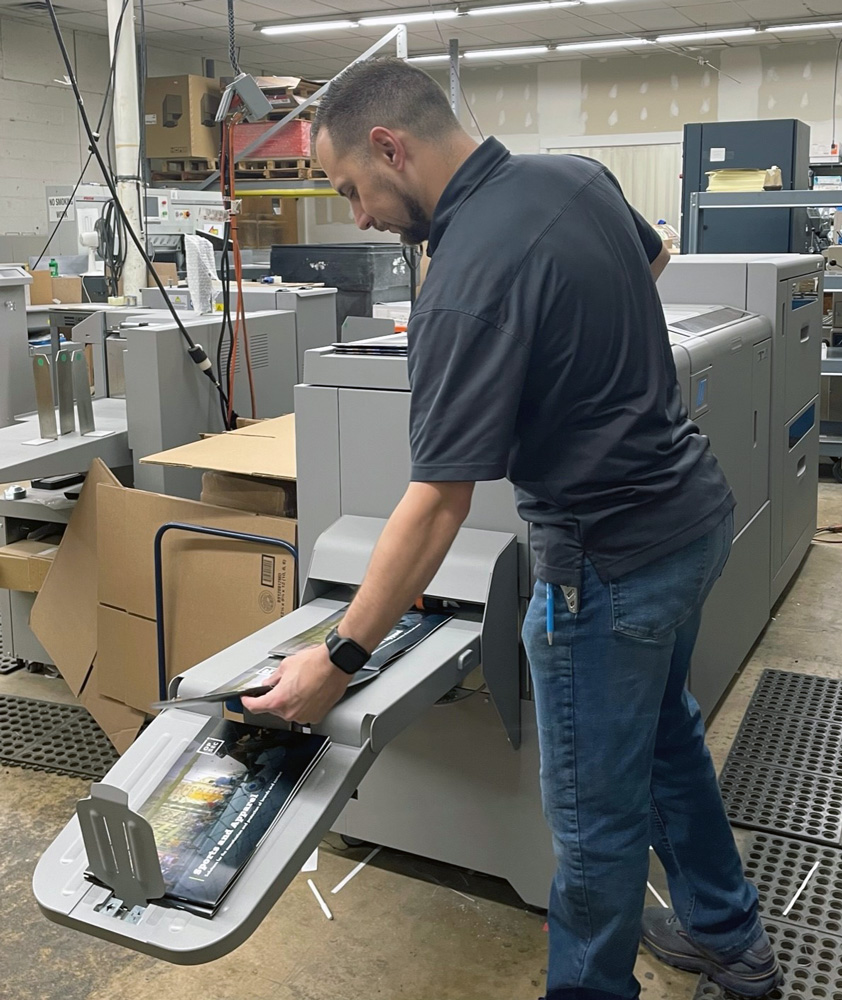
The resulting work includes commencement programs, construction-equipment manuals, church bulletins and concert programs. These are objects with specific readers and deadlines. Printing the sheet is one step; folding, stapling, trimming and getting it out the door determine whether the order is actually finished. WhiteOak’s expertise spans those handoffs, including the unglamorous business of knowing what is on a shelf.
One financial institution’s case makes the shelf concrete. WhiteOak describes moving products to its own facility, connecting ordering to fulfillment and managing 105 stock-keeping units. A client buying this arrangement is also buying relief from storing and distributing its own materials. Alongside regional commercial printers, merchandise distributors and mail houses, WhiteOak occupies the space where those services overlap.
Give the local team a useful set of rules
For a marketing manager, the copyable move is to begin with permissions. Decide which photographs, addresses and offers local users may change. Define who approves an order, what budget applies and when stock should be replenished. WhiteOak’s portal features turn those decisions into an ordering routine. The technology needs the organization to supply the rules.
The value is easiest to see when several locations repeatedly need related materials. A single occasional poster offers less administrative work to remove. Old customer data, unresolved approvals or unwanted merchandise will also limit what a connected workflow can accomplish. WhiteOak’s pool dealers offer the more promising picture: people close to the customer, choosing useful materials inside a shared brand. The paper arrives with the coordination already built in.