A ketchup bottle is a modest place to look for an argument about power. Yet there was Casey Keller at Heinz, listening to children describe a condiment they ate enthusiastically and a container they found considerably less cooperative. Small hands, awkward bottles, parental intervention. Dinner had acquired a supervisor. The product development opportunity was sitting there on the table.
Heinz responded with EZ Squirt: softer plastic, a shape children could hold, and a nozzle that let them direct the stream. Then came the part adults remember: green ketchup. In 2000, Keller was helping explain why a company so closely associated with red would put something green beside the fries. Children wanted more say over their food. Heinz was willing to give them the pen.
It is an unusually vivid opening to a career that later encompassed gum, mobile phones, coffee and a pantry full of American brands. But it also supplies a useful question to carry through Keller’s working life. What happens when an established business pays closer attention to the person actually holding the product?
A bottle small hands could boss around
The ketchup work began with a less photogenic problem than color. Heinz had lost ground. When Keller arrived from Procter & Gamble in 1998, the business was rebuilding a brand whose name recognition had outlasted some of its commercial discipline. Being familiar was proving insufficient.
The response included lower prices and renewed advertising. A standard 24-ounce bottle went from $2.09 to $1.49. Heinz brought ketchup back to television and pursued teenagers through programs and magazines they followed. By November 1999, its reported American market share had recovered from roughly 43 percent a year and a half earlier to 51 percent. Those gains preceded the green bottle.
That sequence matters. Keller’s Heinz chapter combined the basic work of price and advertising with the more conspicuous work of product development. Green ketchup made a better conversation starter. The ordinary red bottle still had to earn its place in the shopping basket.
“The fundamental principle is to get close to consumers and understand what they want.”
Casey Keller, discussing product development at Heinz
The packaging team and its suppliers worked together on the child-friendly bottle. Keller described bringing marketing and research colleagues into contact with consumers, rather than leaving the experience of eating to somebody else’s department. The implication was practical: a formulation could be perfectly competent while its container made the customer cross.
He also had a taste for the occasional condiment joke. When Heinz and Hunt’s announced competing bottles that dispensed from the bottom in 2002, Keller called the rival move an “apparent attempt to play ketch-up.” Competition, it seems, had finally reached the pun department.
Before the supermarket, a destroyer
Keller’s formal education took him through Cornell, where he earned a bachelor’s degree in economics and history, and Harvard Business School, where he earned an MBA. Between them came four years as a United States Navy officer. His assignments included leading divisions aboard the USS Dewey and working on the Pentagon staff supporting surface warfare.
He received Navy Commendation and Achievement medals. The early record is broader than the familiar business-school-to-brand-management route: a ship, a staff assignment, then consumer goods. It would be tempting to turn every later decision into a naval lesson. His record stands perfectly well without that embroidery.
At Procter & Gamble, he spent nearly a decade working with brands including Pringles and Duncan Hines. He subsequently led Heinz’s American ketchup, condiments and sauces business and became chief executive of Heinz Italy. These were jobs across products and countries, giving his career an operating dimension alongside the marketing titles.
A detour through the phone aisle
In October 2006, Motorola appointed Keller chief marketing officer. It was a conspicuous move away from the grocery shelf. His previous responsibilities at Heinz had included a $200 million marketing budget, and his P&G experience included American snacks and global development for Pringles. Motorola was recruiting someone trained to make consumer choices legible.
The assignment also placed him in a business where the product itself could change at an unforgiving pace. By 2007, with Nokia competing aggressively and the iPhone entering the market, he was reorganizing agency relationships and Motorola’s marketing arrangements. A recognizable name offered little shelter from a changing competitive field.
In 2008 he became president of Alberto Culver USA, remaining until Unilever acquired the company in 2011. Then he joined Wrigley as president of North America, subsequently adding the Americas and serving as global president. The recurring task was becoming larger: managing established brands inside companies whose own structures were changing.
Marketing chief
North America
Chief executive
Chief executive
Coffee goes public, by video call
Peet’s appointed Keller CEO effective August 2018. There was a small biographical flourish in the announcement: he was an enthusiastic coffee drinker who had once managed a pizza restaurant. For an executive arriving from confectionery, that was a pleasantly direct introduction to the business of serving people something they wanted to consume.
The assignment soon expanded. Jacobs Douwe Egberts and Peet’s combined in December 2019; Keller became president and CEO of JDE Peet’s in January 2020. The new business joined coffee names familiar in different countries under one corporate roof. His responsibilities now ran well beyond a California coffee counter.
On May 29, 2020, JDE Peet’s began trading in Amsterdam. The offer price was €31.50 a share, giving the company a €15.6 billion market capitalization at listing. The offering totaled €2.25 billion before the potential over-allotment. A business built around the everyday cup had arrived on a very public stage.
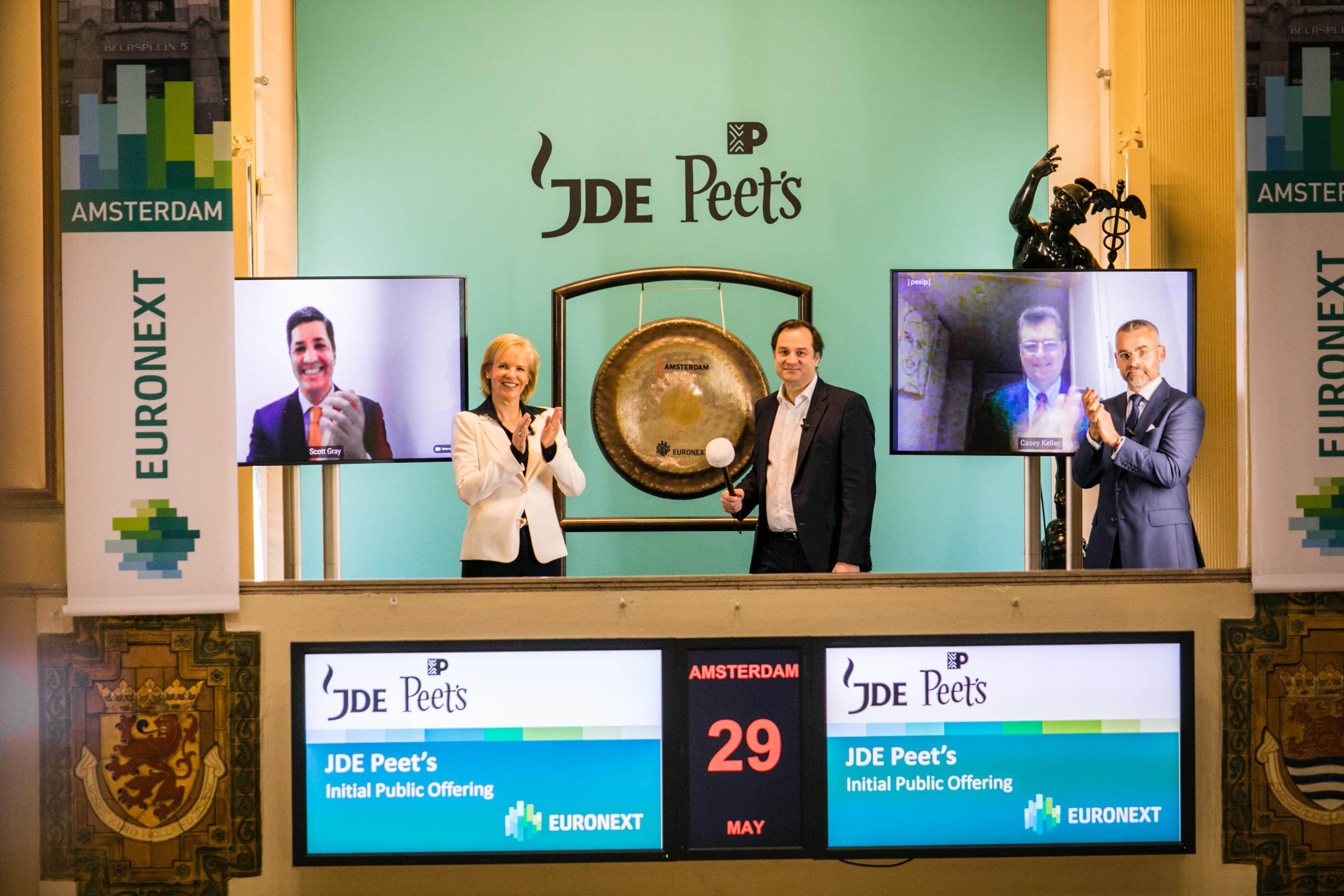
The photograph of the ceremony preserves the arrangement neatly. Fabien Simon holds the gong mallet in Amsterdam. Finance chief Scott Gray and Keller appear on separate screens. For once, a chief executive could attend the market debut without being within striking distance of the ceremonial instrument.
The transaction’s arithmetic deserves a moment. Of the base offering, €700 million came from new shares, while existing shareholders sold approximately €1.55 billion. Those are different destinations for investors’ money. A large flotation number alone does not tell you how much fresh capital reaches the business.
Keller left JDE Peet’s in September 2020 and returned to the United States to be with his family. His time leading the combined company was brief, but it included the merger’s opening chapter and the public listing. In June 2021, he took on a different collection of familiar names.
The pantry becomes a portfolio
B&G Foods appointed him president and CEO effective June 14, 2021, succeeding interim chief David Wenner. The attraction was easy to understand from his résumé: experience in food, international operations, corporate combinations and public-company finance. The products might sit quietly in cupboards. The work behind them was rather less settled.
His tenure eventually involved reshaping what B&G owned. In the first quarter of 2026, the company completed the sale of its Green Giant United States frozen business and acquired the College Inn and Kitchen Basics broth and stock brands. A portfolio can change direction through purchases and departures together.
Even a sale could leave an operating relationship behind. B&G retained its frozen vegetable factory in Irapuato, Mexico, and agreed to manufacture certain Green Giant products for the buyer. Ownership of the brand and responsibility for making the food had parted company. The factory’s work continued.
The financial picture remained difficult. For the first two quarters of 2026, B&G reported $792.2 million in net sales, down 6.8 percent from the comparable period. Divestitures explained much of the decline. Its measure of base business net sales, which removes specified portfolio changes, was flat. Both figures belong in an assessment of the period.
Adjusted EBITDA as a share of sales improved to 14.9 percent from 13.8 percent for those six months. That offers a more complicated picture than either a triumphant turnaround or a simple shrinking business. The company was changing its contents while still having to operate what remained.
Back to the label
Alongside the transactions, Keller remained interested in a familiar piece of commercial machinery: the package. At B&G, he pushed for more disciplined testing of proposed changes in realistic shopping conditions. A redesign had to make sense among the other products a shopper could choose.
“Your primary communication is on the shelf with the consumers.”
Casey Keller, 2025
The link with his Heinz years is striking. Earlier, he had considered how a child could handle a bottle. Later, he was considering how an adult could read a shelf. The setting had changed; both problems required paying attention to an ordinary moment that executives could easily hurry past.
His career also included work outside operating companies. He served on Cott’s board from October 2017 to August 2018, including its audit committee. His public professional profile lists a board-chair role at City Year Chicago beginning in 2010. These connections add a civic and governance thread to a résumé dominated by consumer brands.
An exit with work still to do
Keller retired as B&G’s president, CEO and a director on August 7, 2026. The company said he would assist with the leadership transition. Robert D. Mills succeeded him on August 10. In his departure statement, Keller expressed pride in the team and confidence in the portfolio changes already under way.
The ending resists a tidy ribbon. There had been a coffee flotation, changing corporate structures and a difficult stretch managing a food portfolio. There had also been the smaller work of getting a bottle, a price or a label right. Keller’s career is especially interesting at that scale, where the person running a large business still has to reckon with a shopper in a hurry, or a child who would rather draw on dinner.