Six startups scaled. Nine surgeries survived. One opioid addiction beaten cold turkey. Three bestselling books. And a sales conference he invented on a Costa Rica beach, tequila in hand. Scott Leese doesn't just teach sales - he lived the hardest version of the lesson first.
At 23, Scott Leese was healthy, athletic - a two-sport college athlete on scholarship at Dominican University of California, playing soccer and tennis, studying psychology. Then, in the span of two days, everything changed. He was hospitalized with severe ulcerative colitis and an autoimmune disease that doctors couldn't get ahead of fast enough.
What followed was four years of hospitals, operations, and pharmaceutical dependency. Nine surgeries total - four of them major abdominal procedures. Two were life-saving. He came out the other side with no large intestine and a serious opioid addiction that had developed under medical supervision. His exit from that addiction was characteristically blunt: cold turkey, against direct medical advice.
He didn't enter sales until he was 27. No background, no training, $30K starting salary at a Bay Area startup. Just a person who had learned, the hardest possible way, that time is finite and pain has to be confronted before anything else can move. That insight became the backbone of everything he'd teach later.
The parallel he drew - between a patient admitting they have a problem before recovery can begin, and a prospect admitting their pain before they'll buy anything - wasn't a clever metaphor. It was lived experience. His first book, Addicted to the Process, made that case with enough clarity that Jeffrey Gitomer endorsed it and it hit #1 on Amazon.
Within a decade of that first $30K sales job, he had scaled six consecutive early-stage startups to $25M+ ARR, each in under three years. One got acquired for $175 million. Another became a unicorn. He'd built a consulting practice that worked with 160+ companies, co-founded a surf retreat in Costa Rica, launched the world's largest virtual sales happy hour, and started writing checks into AI companies alongside OpenAI and Anthropic.
He does all of this from Austin, Texas, with his wife Janet, their two sons Brayden and Caleb, and two dogs named Loki and Mia. He listens to music all day long. He has no large intestine. He surfs when he can. He still plays soccer.
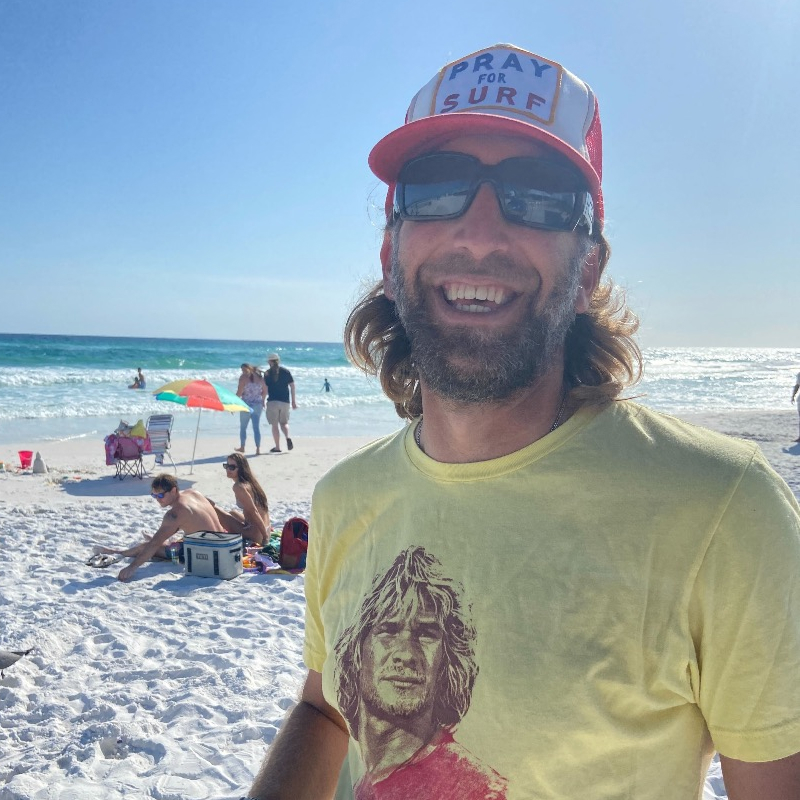
Including a total colectomy. He quit opioids cold turkey, against doctor's orders, and walked into his first sales job with zero background and no large intestine. The hospital experience directly shaped his entire sales philosophy.
Before leaving any role, Scott runs every decision through this three-part filter. It's the most honest career framework in sales - and it came from watching too many people leave too early or stay too long.
The story of Surf and Sales begins exactly the way you'd want it to: two sales guys, a Costa Rican beach, the sun going down, and a drink in hand after an evening surf session. Scott Leese and Richard Harris looked at each other and said, essentially, why don't the sales conferences we go to feel anything like this?
The insight wasn't about surfing. It was about the in-between moments. The conversations that happen not on stage but in the water, at dinner, walking back from the beach. Traditional conferences pack schedules so tight there's no room for the actual relationship-building that makes careers. So they built a different thing entirely.
The Surf and Sales Summit runs annually in Playa Grande, Costa Rica. No experience required for the surfing - they provide lessons. The sales coaching is real, the speakers are practitioners not theorists, and the format is deliberately loose enough to create space for the conversations that actually matter.
Scott and Richard Harris were sitting on a beach in Costa Rica with tequila after an evening surf session when they decided to build their own conference. The existing ones weren't working. Too formal. Too scripted. Not enough actual human connection. They wanted to build something where the strongest bonds happened between the sessions - in the water, at dinner, on the walk back from the beach.
In 2024, Scott formalized what he'd been doing informally for years - backing early-stage companies at the frontier. Milos Ventures, co-led with Taylor Leese (who had already made 40+ startup investments), focuses on the sectors that will define the next decade: AI, robotics, defense, energy, and cleantech.
The portfolio reads like a who's-who of the AI moment: OpenAI, Anthropic, Groq, Scale AI, Perplexity AI, Lambda, Rescale, and Thinking Machines Lab. These aren't passive bets - they're the companies Leese studies, talks about publicly, and integrates into his GTM advisory work.
After 15+ exits as an operator and advisor, including a unicorn and a $175M acquisition, the move into investing is less a career pivot than a natural extension. He understands how companies go from zero to revenue. Now he's writing checks to help the next generation do it faster.