Scot Wingo’s auction search engine lost its reason to exist. The useful part survived. AuctionRover, which he launched in 1999 and sold to GoTo.com, had also built tools for sellers. After the dot-com bubble burst, those tools offered a way forward. ChannelAdvisor followed in 2001. A business built to help people find auctions had supplied the beginnings of a business that helped merchants sell.
There is something pleasantly untidy about that origin. The familiar company comes after the original proposition has disappointed. Wingo’s career keeps returning to the practical difficulty left behind when an exciting new way of shopping meets the person who must actually operate it. Somebody has to make the inventory work. Somebody has to get the product information into the right place.
Today he is CEO and co-founder of ReFiBuy, working on how brands and retailers appear in AI shopping. ChannelAdvisor is the earlier chapter people recognize. It went public in 2013; he handed the CEO job to David Spitz in 2015. CommerceHub acquired the company in 2022. The new venture brings him back to merchants, product catalogs and an internet that has once again changed its front door.
Before the auction, a box of tools
Wingo was born in Columbia, South Carolina, in 1968 and grew up in Aiken. His route into the Triangle ran through computer engineering at the University of South Carolina and graduate study at NC State. Software came before retail. Stingray, his first company, made development tools for Windows programmers. He was selling help to people who were trying to build something themselves.
The company started in 1995 with three technical co-founders. In his account of those years, he describes seeing repeated requests from programmers for the same missing pieces. A recurring question could become a product. He took the CEO job while continuing to write code. His later occupation as a business builder began with a programmer paying attention to what other programmers kept asking for.
He also tried to raise venture capital and failed. Stingray was profitable, but funding its European ambitions was another matter. In 1998, Rogue Wave acquired the business in a stock transaction valued at approximately $21 million. Its Windows libraries and interface controls complemented Rogue Wave’s development tools. The first exit involved the decidedly unglamorous business of making other people’s software easier to write.
“What are bad experiences that you can make better?”
Scot Wingo, on looking for business ideas
A stock ticker, then a different kind of queue
ChannelAdvisor’s proposition was equally practical. Retailers could use a single inventory feed to list and advertise products across online channels, including Amazon, Google and eBay. The customer wanted more sales. Underneath that ambition sat integration, automation and a great deal of merchandise information. A growing collection of places to sell created a growing collection of things that could go wrong.
The company reached the New York Stock Exchange in May 2013 under the symbol ECOM. Shares priced at $14, and the offering raised $81 million. For Wingo, going public fulfilled an ambition he had held since he was a teenager. The ceremony had its own rewards: an avid CNBC viewer, he got to meet Jim Cramer and appear on Mad Money. Even a software executive is allowed a fan moment.
He has described the timing as a narrow window. Growing a business was something management could work on; an open IPO market was something it could not command. That distinction is useful in a career sometimes reduced to a procession of exits. Preparation and permission from the market arrive on different schedules. A successful offering requires both to turn up together.
In May 2015, Spitz became CEO and Wingo became executive chairman, continuing to work on products and strategy. Seven years later, CommerceHub agreed to pay $23.10 a share in cash for ChannelAdvisor. The acquisition closed in November 2022. It is easy to compress all this into one founder’s achievement, but the dates preserve a more interesting fact: a company can continue changing long after its founding CEO changes jobs.
- 1995StingrayTools for programmers
- 1999AuctionRoverFinding online auctions
- 2001ChannelAdvisorSelling across marketplaces
- 2014SpiffyCar care that comes to you
- 2025ReFiBuyProduct data for AI shopping
The driveway becomes a destination
Spiffy began in North Carolina’s Research Triangle Park in 2014, with Wingo and co-founder Karl Murphy. The move from ecommerce software to car care invites a raised eyebrow. Wingo’s explanation starts with convenience. If products could come to the customer, services might follow. The car sitting outside an office or a house offered a particularly visible opportunity.
He had owned car washes as investments. That gave him a little knowledge of the trade and a reason to consider its inconvenient rituals. The customer must otherwise travel, wait, and arrange part of a day around a vehicle. Spiffy brought the service to the vehicle instead. In Wingo’s career, the driveway belongs alongside the online marketplace: another location where an ordinary transaction could be reorganized.
The operation required more than a booking screen. Spiffy combined proprietary software, fitted service vans and technician training. It expanded beyond washing into mobile maintenance. In the August 2024 announcement of Wingo’s departure as CEO, the company reported three million services over its first decade. The arithmetic belongs to a physical business: people, vehicles and work completed in parking lots.
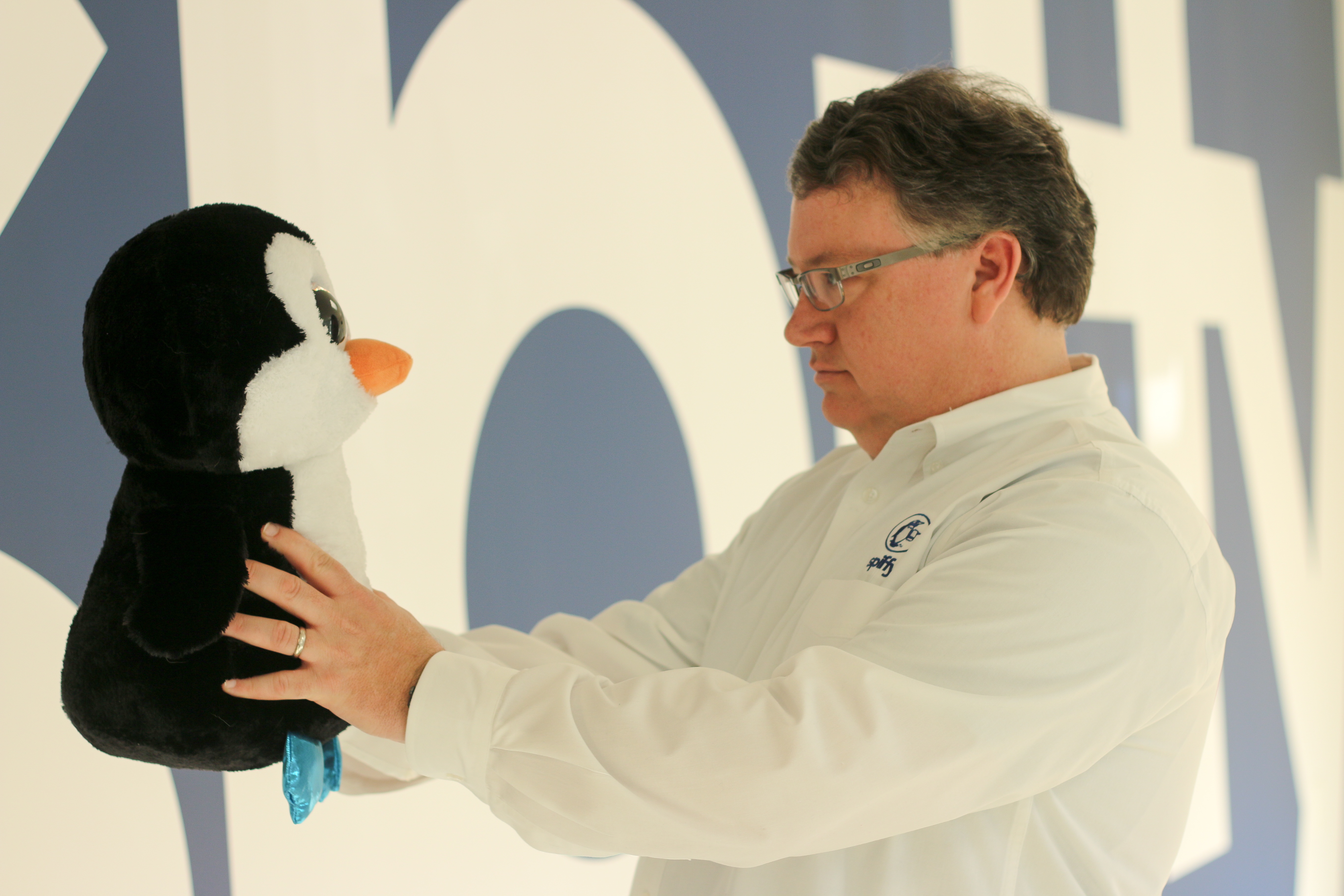
Murphy succeeded him on August 16, 2024, and Wingo remained on the board. The handover made room for another beginning. There is also a small visual correction to the solemn image of the serial founder. In a Spiffy photograph accompanying his 2018 CEO award announcement, Wingo holds the company’s penguin mascot at arm’s length. Corporate leadership occasionally involves a serious conversation with a stuffed bird.
A list develops an investment habit
Alongside his companies, Wingo began keeping track of other people’s. He launched the Triangle Tweener List in 2015 to draw attention to technology businesses reaching a useful middle stage. These were companies with at least $1 million in annual revenue or 10 employees. They had enough substance to deserve attention, even if they had yet to become a familiar local success story.
The list preceded the fund. In 2022, the Triangle Tweener Fund began investing with an index-style approach. Wingo and fellow general partner Robbie Allen spread bets across a collection of companies rather than concentrating the entire argument on a handful of favorites. A local directory had become a way to put capital behind the businesses it made visible.
In February 2026, the project widened its geography. A partnership with NC IDEA brought a $4 million commitment over five years and a statewide mandate under the name NC Tweener Fund, Powered by NC IDEA. The foundation describes investments of approximately $50,000 each. The general partners make the decisions; NC IDEA says it has no influence over those choices.
That sequence says something about Wingo’s approach to community work. First, make the companies easier to see. Then build a mechanism for backing them. Then extend the map. The ambition is specific enough to measure in founders reached and checks written. It gives his connection to North Carolina a practical expression beyond appearing at an occasional event.
The catalog gets another chance
ReFiBuy’s name divides the shopping journey into research, find and buy. Wingo’s return to ecommerce joins him with ChannelAdvisor alumni Cameron Bowe, James Frawley and Derek Conlin. The problem is familiar, though the intended reader of the product information is changing. An AI assistant needs usable details before it can confidently put an item in front of a shopper.
A merchant’s catalog may contain the products without containing enough context to answer a complicated request. ReFiBuy’s Commerce Intelligence Engine evaluates catalog data, identifies gaps, enriches it and distributes updates across commerce systems. The company calls this Agentic Commerce Optimization. The phrase is new; the merchant’s desire to be found is considerably older.
Wingo’s earlier experience helps explain why he returned. He had seen the difficulty of turning inconsistent merchant files into information that outside selling channels could use. AI offered a reason to revisit work that had resisted complete automation. The opportunity was sitting in the untidy catalog, waiting for a different set of tools.
The new team also brought back some familiar investors. Its initial funding reached $1.7 million, with G20 Ventures, Knoll Ventures and Commerce Ventures among the backers. Jason Goldberg, Wingo’s podcast co-host, was an individual investor. Relationships from earlier chapters became part of the next company’s starting equipment. Experience accumulated as a network as well as a collection of lessons.
On May 5, 2026, ReFiBuy announced a $13.6 million seed round led by NewRoad Capital Partners. The stated purpose was to expand its engine and go-to-market work. In July, the company and Digital Commerce 360 launched AI Commerce Rankings for retailer readiness. By October, Wingo was still publicly explaining the shift from search engines toward answer engines. His new business and his public commentary were examining the same changing shop window.
The company prepares product data for AI-assisted discovery and shopping.
There is usually a microphone nearby
Wingo’s work has a running conversation attached. He co-hosts The Jason & Scot Show with Jason Goldberg, discussing ecommerce and retail, and publishes Retailgentic on agentic commerce. NC Tweener Talks gives founders room to describe how their companies developed. His own episode, the first in that series, runs for about an hour. There is plenty to discuss before anybody reaches the latest venture.
He has been answering founder questions for years. When introducing an Ask Scot column in 2014, he invited questions about fundraising, co-founders, stock options and pricing, along with the spelling of his first name. His promised method was to work through pros and cons and the experience of what had succeeded or failed. The one-T question earned a place beside the term sheets.
His advice also leaves room for ordinary human contact. He urges technical founders to talk to customers, and treats persuasion as part of the job. That fits the path from programmer to CEO: understanding a problem is one task; getting someone else interested in the proposed answer is another. Wingo has had repeated opportunities to practice both.
The latest venture brings those habits together. There is the engineer’s attention to incomplete information, the operator’s familiarity with merchants, and the podcaster’s appetite for talking through what comes next. AI may change how a product is discovered and purchased. Wingo has returned to the work between the merchant and the shopper, where he has been finding things to build since an auction search engine left its selling tools behind.