A book is meant to settle down once it has been printed. Tom McFadyen’s latest has other plans. In January 2026, his company released AI Best Practices for Commerce, a 524-page guide to putting artificial intelligence to work. It belongs to a publishing project that now also lives online, where the catalogue of possible applications keeps expanding. The covers can hold the paper. Keeping the subject inside them is another matter.
For McFadyen, founder and CEO of McFadyen Digital, this is a familiar professional inconvenience. He has spent decades helping businesses change how they sell, then explaining the change to people who have to run the resulting business. His four books form a reading list of successive commercial anxieties. How do you sell online? How do you operate a marketplace? How does that marketplace earn money? What, exactly, should you ask AI to do?
Read in order, the books become a working biography. They show a founder returning to the space between a promising technology and an organization capable of using it. That space has room for a great deal of consulting. It also has room for a surprising amount of homework.
A company older than its online subject
McFadyen started the business in 1987. The date puts his company’s beginnings before the commercial web that would come to define so much of its work. He studied systems engineering at the University of Virginia, an educational detail that fits the subject matter without explaining away the person. Commerce systems require many things to agree with one another: prices, product descriptions, inventory, orders and the people responsible for each.
His professional base is Vienna, Virginia. The company grew into an international operation, with teams in North America, South America and Asia. Its present work connects business strategy with the machinery of commerce: enterprise systems, product information, order management and marketplace platforms. A customer may encounter a search box and a checkout button. Behind them sits an organization trying to coordinate its promises.
His first book, Ecommerce Best Practices, appeared in 2008. Its audience included retailers making the move from physical stores to online selling. That is an unusually useful starting point for understanding his later work. Before the questions about multiple sellers and autonomous shopping agents came the basic job of helping an existing business conduct itself on a screen.
The seller has to show up, too
By June 2017, McFadyen Digital was formalizing a marketplace partnership with Mirakl. The announcement described a method that extended from discovery through launch and ongoing operation. Vendor recruitment, customer recruitment, pilot testing and communications all belonged in the plan. The platform would need participants as well as code.
The economics of building it were changing, too. McFadyen described earlier custom marketplace projects built on enterprise platforms as seven-figure investments that could take a year or more to launch. He said the Mirakl approach could shorten the process and reduce cost. This was a business proposition with an engineer’s practical concern underneath it: how much work must be repeated before the business can begin?
A marketplace adds a second constituency to the familiar retailer-customer relationship. Sellers have their own priorities, catalogues and reasons for staying. Recruiting them is an operating responsibility. So is giving them a reason to keep their information current and their orders moving. An empty shopping mall can have excellent lighting; the lighting will have a difficult quarter.
“It is really a matchmaking network that connects buyers and sellers.”
Tom McFadyen, on marketplace operations
In 2020, the company joined the MACH Alliance, which advocates software built from services that can work together through open interfaces. McFadyen’s explanation focused on recurring implementation concerns: extending a system, scaling it and maintaining it. The terminology had changed since 2008. The responsibility for making the parts cooperate remained.
A field guide acquires a travelling life
Marketplace Best Practices, published in January 2021, addressed strategy, launch and optimization across different marketplace models. McFadyen was writing for leaders who wanted to build an ecosystem of sellers around an existing commerce business. The subject had moved beyond putting the retailer’s own stock online.
The book also gave his ideas a portable form. At VTEX DAY in 2022, he delivered a keynote on driving scale through retail marketplaces, and McFadyen Digital distributed more than a thousand copies. A company can have an international delivery operation; a book can travel into rooms where its author will never take a meeting. The two activities suit each other.
That October, McFadyen was appointed chairman of the National Retail Federation’s Associate Member Council. He had served four years as vice-chairman and almost thirteen years as a council member. The council represents businesses supplying goods and services to retail. Its work gave him another setting for discussing what retailers needed from the companies selling them expertise and technology.
His public biography also lists board and council work with YPO and the Oracle Commerce User Group. LinkedIn records his membership in Entrepreneurs’ Organization. Those affiliations add another layer to the author-and-consultant role: ongoing contact with other operators. They place his books within a working business community, where readers may also be colleagues, partners, customers or fellow executives.
There is a useful distinction between speaking at an industry gathering and helping its supplier community organize its concerns. McFadyen’s public career includes both. The books, conference appearances and council service put him in repeated conversation with the people buying, building and operating commerce systems.
After the launch, the arithmetic
The next book’s title was less patient with abstraction. Marketplace Monetization: How to Make Money as a Multi-Vendor Ecommerce Operator arrived in 2024. The company announced a 258-page guide built around the ways an operator could earn revenue. Having explained the marketplace, McFadyen had moved to the question an operator cannot indefinitely postpone.
Transaction commissions are one answer. The wider discussion included subscriptions, embedded financial services, retail media, cross-border business and additional services for sellers. The commercial attraction is understandable: the same marketplace may support several useful activities around a sale. Each activity also asks the operator to understand what participants value enough to pay for.
The company’s explanation compared this with a shopping mall, where rent can sit alongside advertising and other paid services. It is an accessible comparison because it keeps the participants in view. The marketplace operator is arranging a place for other businesses to trade, while deciding which surrounding services belong in its own business.
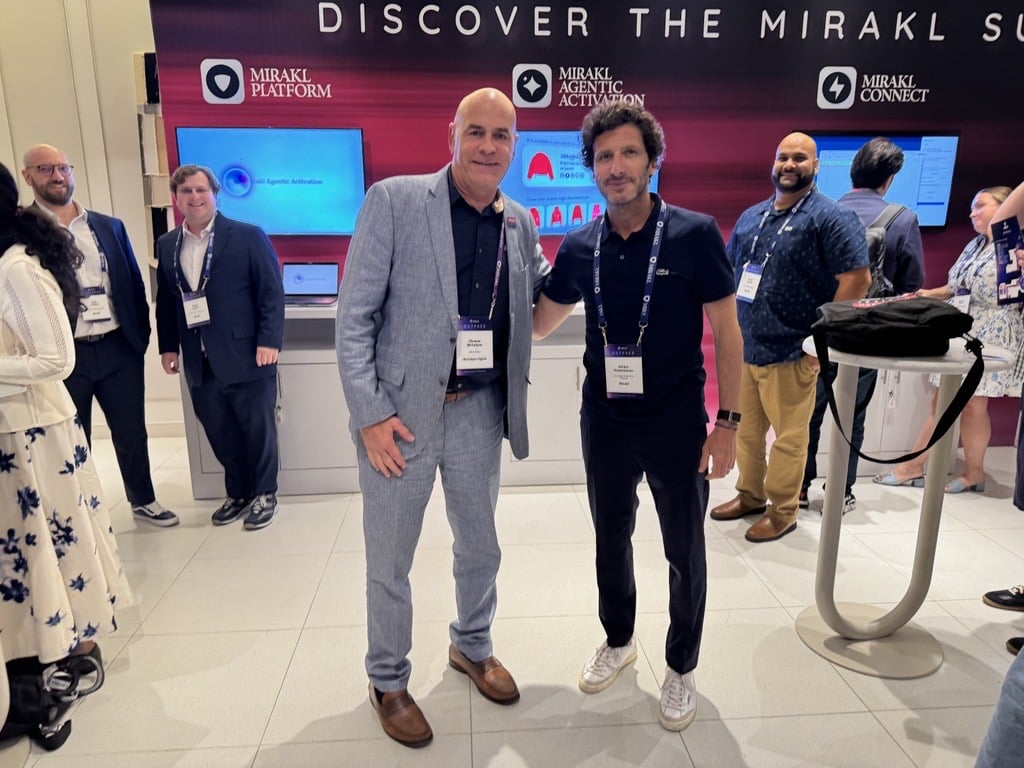
McFadyen discussed those possibilities with Mirakl co-founder Adrien Nussenbaum and Balance co-founder Bar Geron in a monetization webinar. At Mirakl’s 2024 New York summit, he also took part in a session about combining marketplace and dropship approaches. These were conversations about choosing among operating models, with their different implications for assortment and profitability.
That attention to combinations matters. A business may have reasons to use more than one way of getting products to customers. The interesting work lies in deciding which arrangement fits which products, then making the arrangements behave sensibly together. A tidy label is easier to produce than a tidy operation.
The work around the order
The four commerce phases used in McFadyen’s AI discussion. Each brings its own decisions.
The next book needs a working address
By 2026, AI had become the fourth book’s subject. The January release brought together contributions from a dozen company experts, organized around applications and implementation. The book’s scale is a concrete detail: 524 pages is a substantial request for a reader’s attention, especially from a field that produces fresh vocabulary while the reader is still finding a bookmark.
The companion online initiative gives the material a form that can change. It organizes use cases, tool evaluations and guidance around the commerce value chain. Readers can explore applications by role as well as by business activity. The organizing idea is practical: help a team locate relevant work before asking it to navigate the whole subject.
In his May 2026 MDM Amplify appearance, McFadyen discussed AI discovery, business priorities and the prospect of agents transacting for buyers. The conversation returned to familiar obstacles, including data quality and organizational alignment. A distributor’s products must be discoverable, its information useful, and its investment connected to an operational result. Those requirements are less glamorous than an autonomous order. They may determine whether one happens.
The continuing thread is an insistence on the business around the technology. Across his published work, the unit of attention keeps widening: the online store, the seller ecosystem, the revenue model, the commerce workflow. Each enlargement brings more decisions for people to make.
Some decisions have already been made
One example from his October 2026 conversation with Rick Watson brings the argument down to wardrobe size. McFadyen buys the same socks repeatedly and would be comfortable letting an AI agent reorder them. Choosing his wife’s outfit for a wedding would be a different proposition. A familiar repeat purchase leaves relatively little judgment to delegate. An occasion calls for taste.
The example is modest enough to be useful. It asks a person to consider the decision inside a purchase, rather than admire the fact that software can place an order. A business exploring AI faces its own version of that question: which parts of the work are sufficiently understood, and where does judgment still matter?
McFadyen’s books have followed those questions through successive changes in commerce. The latest can be updated online, which is fortunate for the book and presumably a relief to the bindings. The work continues wherever a business has to decide what to hand over, what to build next, and how to keep its promises once the demonstration is over.