In February 2013, Jason Wells announced that he was going to try keeping a website up to date. Again. This would be attempt number three. He hoped he had learned something from the previous two, wanted to be open about his projects, and wanted somewhere to put his thoughts. The post was short. Its ambition was refreshingly domestic: maintain a small corner of the internet without abandoning the gardening.
The following year, he launched Pattern’s software platform. That project proved rather more durable. Wells spent more than a decade as the company’s chief technology officer before becoming chief architect and technical advisor to the CEO. There is something pleasing about the sequence. A person can struggle to maintain a blog and still help build the systems of a global business. The internet, mercifully, does not grade every assignment equally.
His story is easiest to follow through the things he has tried to make visible: which seller matters, which product can compete, which detail a shopper needs, which task a person should handle. The tools have changed considerably. The problem of deciding where to look has kept him employed.
A small promise, then a much larger project
Wells studied information technology at Brigham Young University, graduating in 2012. His earlier work included software development at Quomation Insurance Services and technical and engineering roles at The Church of Jesus Christ of Latter-day Saints. His professional background ranged across business intelligence, software architecture, analytics, and infrastructure. Those disciplines meet at an inconvenient place: a business has information, but possessing it does not automatically make a decision easier.
Pattern began in 2013. Co-founder Dave Wright’s account of the idea starts with a cousin selling girls’ headbands online. Wright considered using data to help other brands sell, rather than starting a brand himself. Melanie Alder worked full-time on the business before Wright and Wells joined full-time. The origin is useful because it puts a real commercial problem ahead of the technology. Someone had products to sell. Someone else thought the numbers could help.
Wells’s contribution acquired a concrete milestone in 2014 with the launch of the software platform. He was building within a business that sold on marketplaces, where the consequences of a technical choice could eventually appear in a product listing, an advertising decision, or a sale. For an architect, that supplies a demanding audience. A system may be elegant; the merchandise still has to move.
The seller with only two listings
By 2020, Wells was explaining a particularly good trap in marketplace data. Imagine two sellers violating a brand’s pricing policies. One has 40 non-compliant listings. The other has two. A simple ranking puts the first seller at the top of the problem list. Forty is larger than two. Even a meeting can agree on that.
Then add sales volume. In Wells’s example, the seller with 40 listings moves ten units a month. The seller with two moves a thousand. Suddenly the smaller-looking problem deserves the larger share of attention. Pattern’s Predict software used volume and Buy Box tracking to help make that distinction. Counting violations was insufficient; the business needed to understand their weight.
That example offers a compact explanation of his work. Software can spare people the labor of collecting prices by hand, but collecting faster is only part of the job. The ordering matters. A screen full of accurate information can still send someone toward the wrong task. In this case, the useful improvement was a better answer to a very human question: where should I start?
A patent for a crowded shelf
On May 3, 2022, a product evaluation patent naming Wells, Matthew Smith, and Jacob N. Miller as inventors was granted. Assigned originally to Pattern, U.S. Patent 11,321,724 describes evaluating a product against organic competitors on a digital marketplace. Its ingredients include product attributes, descriptive terms, comparisons, and a report of projected performance. The title is admirably unromantic: Product evaluation system and method of use.
The underlying difficulty is familiar to anyone who has searched for an ordinary object and received an extraordinary number of results. A product occupies a crowded shelf even when the shelf is virtual. Describing its qualities is only the beginning. A seller also needs to understand how those qualities compare with the alternatives a shopper will see.
The patent gives Wells’s career a useful point of specificity. Here is a named technical contribution, made with other inventors, to a defined problem. It also connects the business-intelligence work of his earlier career with the marketplace questions at Pattern. Comparisons become more useful when they can guide an action. A score earns its space on the screen by helping someone decide what comes next.
Permission to try the difficult thing
In a 2023 conversation about developer teams, Wells described leaders setting a difficult challenge even when engineers initially doubted it was possible. His instruction, in its shortest form, was: “I think it’s possible. Go tell me how.” He connected some of Pattern’s interesting products to that process of asking a team to take an apparently difficult idea seriously.
“I think it’s possible. Go tell me how.”
Jason Wells, on challenging engineering teams
There is a delicate management problem inside that sentence. A leader can announce an outcome with impressive confidence and leave everyone else to discover the laws of physics. Wells’s account places the next step with the team: go investigate. The productive part is the invitation to think beyond the first objection. It is an approach that asks engineers for judgment as well as execution.
His public celebrations of the work have room for colleagues, too. When Content Brief received attention, he named people across the team. When Pattern became public, he thanked his family, engineers, data scientists, product leaders, and global partners, and acknowledged Wright and Alder’s friendship and trust. The company’s technical history, in his telling, has a sizeable cast.
When the product photograph becomes a data problem
Content Brief brought that long-running interest in useful comparisons into product content. A listing has words, images, reviews, and competing offers. Each gives a brand something to examine. Together, they give a busy team enough tabs to make a browser reconsider its career choices.
By February 2025, Pattern’s Content Brief was using its ecommerce data to help brands decide which product attributes to emphasize, how to present images, and how to interpret customer feedback and search behavior. The workflow could turn dispersed observations into recommendations for the content a shopper actually encounters. This is where the architecture becomes visible to an ordinary buyer: a clearer image, a more useful description, an answer to a question before checkout.
One test involving Select Brands’ Triple Buffet Server gives the idea a tangible example. The product’s Amazon image stack was revised using Content Brief’s analysis. Reported results included 21 percent month-over-month revenue growth, 14.5 percent more traffic, and a 21 basis-point increase in conversion. These were results for a particular test, rather than a promise attached to every product. Their value here is the connection between a technical system and an identifiable piece of merchandise.
month over month
in traffic
increase
Running that analysis economically mattered as well. In June 2025, Pattern reported that adopting Amazon Nova models had reduced generative AI costs by more than 76 percent against comparable models. Wells’s explanation focused on reliability, accuracy, and affordability as the company looked toward serving thousands or potentially millions of users. An impressive answer becomes a less impressive business proposition if every repetition arrives with an extravagant bill.
Back at the front of the room
By July 2026, Wells was in front of a builder audience in Lehi, speaking about Pattern Intelligence, or Pi. A photograph catches him holding a microphone beneath a slide about architecture primitives. He wears a baseball cap and gestures with his free hand. It is a useful picture of the job: making the machinery legible to other people who build machinery.
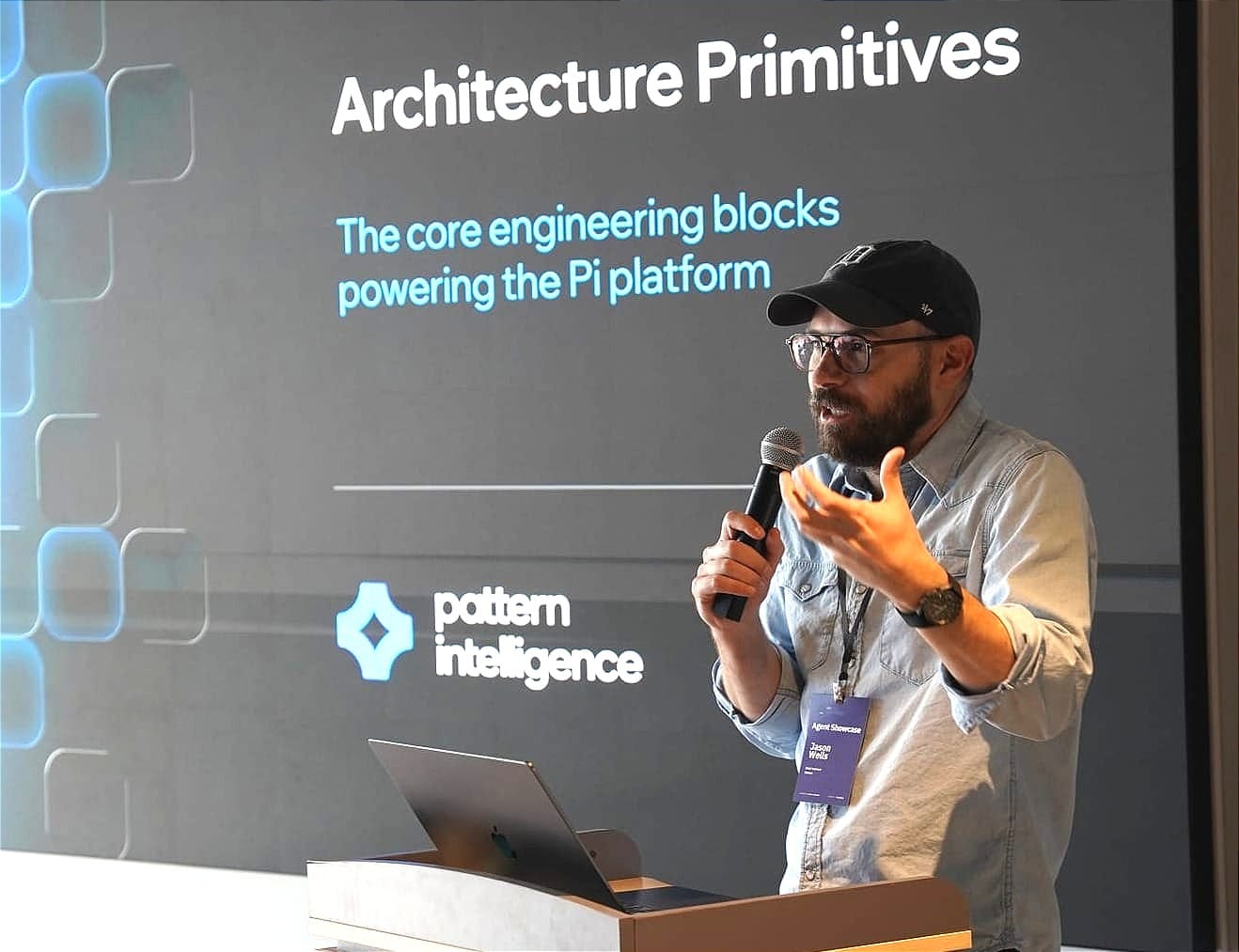
Pattern had launched Pi that May. Its advertised purpose extended from detecting marketplace problems to acting on them: monitoring advertising, pricing, content, inventory, and featured offers, then carrying out automated responses. Decisions requiring a brand’s judgment were routed for approval. Actions were logged. That distinction matters for the people using it. Delegating a recurring task is easier when they can see what happened and retain control over consequential choices.
The connection to Wells’s earlier work is a matter of progression. Predict helped identify the seller worth investigating. Content Brief helped identify a content change worth making. Pi brought automated execution further into the process. Each step addressed another portion of the distance between a business noticing something and doing something about it.
The person behind “planning & building”
Wells’s personal homepage carries just a few words: “planning & building.” His older blog supplies a warmer introduction. He describes himself as a husband and father, a technology geek, and someone who enjoys baseball, tennis, the outdoors, and good food. He calls Utah the eleventh state he has lived in. The detail lends movement to a career now strongly associated with Lehi.
His public GitHub includes a family-history application called Story alongside development utilities and configuration files. It is a modest but telling change of scale from global marketplaces. Easy access to a family’s past is another problem someone might reasonably want software to solve. The audience is smaller. The reason to care needs no financial model.
Return to that short 2013 blog post and the ambition looks familiar: share projects, contribute thoughts, try again with something learned. A third attempt is a sensible place to begin a story about building. It leaves room for revision. Wells’s career has since acquired patents, a public company, and AI systems with far larger workloads. The small promise still fits: keep making something useful, and give other people a way to understand it.