Before Eddie Wu could help build an internet company, he had to get the machines working. One early colleague remembered imported workstations and servers arriving with English instruction manuals. Wu’s English was limited. He took out a dictionary and worked through them. It is an unusually useful image to carry into a story about artificial intelligence: a young programmer, an unfamiliar machine, and the patient business of finding out how the thing fits together.
Wu had joined Jack Ma’s China Pages after graduating in 1996. Three years later, he was among Alibaba’s 18 founders in Hangzhou, serving as technology director. Ma supplied the public voice. Wu helped supply the working parts. The distinction would become less tidy as the years passed, but it makes a sensible starting point for a career spent moving between technical construction and commercial decisions.
In September 2023, Wu became Alibaba Group’s chief executive. A founder was returning to the center of a company that needed to reconsider its direction. His instructions soon included a startup mindset. Coming from someone who had attended the actual startup, the phrase carried a certain weight. He knew what the early version had required. He also knew how much equipment had accumulated since.
A career behind the storefront
The familiar way to tell Alibaba’s story is through its storefronts: the marketplaces, the shopping, the enormous circulation of goods. Wu’s career offers another route through the building. Follow him and you encounter the systems that make those activities possible, then the business decisions that determine whether the systems earn their keep.
He became Alipay’s chief technology officer in December 2004. In November 2005 he moved into the business director role at Alimama, Alibaba’s advertising platform, becoming its general manager in December 2007. The progression put a technical founder directly into the work of monetization. Advertising requires technology, of course. It also requires an advertiser willing to pay for what the technology delivers.
At Alimama, colleagues came to know him as Mama Wu. The nickname played on the platform’s name, but former team members also connected it with his habit of looking after people: helping with bugs, technical architecture and access to resources. Corporate nicknames can become suspiciously convenient character sketches. This one at least came with descriptions of work. The maternal duties included getting the software fixed.
By September 2008, Wu was Taobao’s chief technology officer. In October 2011 he took charge of Alibaba’s search, advertising and mobile business. Put those responsibilities together and a pattern emerges: finding things, paying for things, reaching customers, carrying the marketplace into a different interface. His experience crossed the boundaries that an organization chart might prefer to keep comfortably separate.
These jobs help explain why describing him simply as an engineer leaves something out. He had worked on the technical side of transactions and on the commercial side of attention. He had seen a platform as a collection of systems and as a business with customers. That combination would matter when Alibaba began asking how AI might change both its products and the infrastructure underneath them.
The investor comes back inside
From September 2014 to September 2019, Wu served as special assistant to Alibaba’s chairman. Meanwhile, in August 2015, he founded Vision Plus Capital. The move added another perspective to his working life: instead of only deciding what an established company should build, he would also help decide which younger companies deserved capital.
Vision Plus identifies him as its chairman and founding partner. His investment record includes UC Web, AutoNavi, Momo, Tuya and Minieye. The firm’s portfolio extends into electric vehicles, software and cross-border services. Those are different businesses with different customers. Together they gave his work a reach beyond the daily operations of Alibaba’s marketplaces.
The investor’s position has an appealing freedom. You can back a new approach without asking an entire established organization to adopt it. Returning to operations removes that convenience. A CEO must turn preferences into budgets and reporting lines, while keeping existing businesses functioning. An investment thesis can fit on a few pages. A company takes rather more persuasion.
Alibaba announced Wu’s succession in June 2023. He took over in September, replacing Daniel Zhang, while fellow co-founder Joe Tsai became chairman. Wu also assumed leadership of the cloud business. By December he was taking charge of Taobao and Tmall as well, a role he held until November 2024. The assignments brought cloud computing and core commerce unusually close to the group CEO’s desk.
The setting was uncomfortable. Alibaba was facing pressure from shopping rivals, including Pinduoduo, while revising a reorganization that had envisaged separate businesses pursuing their own financing and listings. Plans for a cloud spin-off were abandoned amid uncertainty over American restrictions on advanced chips. Wu’s return came with immediate decisions about what should remain together and where investment should go.
The third-day letter
On September 12, 2023, his third day as CEO, Wu wrote to employees. He named two priorities: “User First” and “AI-driven.” The letter argued that familiar internet business models were becoming too similar and that Alibaba needed to change. It asked the company to invest in technology platforms, AI businesses and a global commercial network.
“User First”
Eddie Wu’s priorities in his September 2023 employee letter
“AI-driven”
There were instructions beneath the slogans. Businesses should seek broad cooperation, including with companies traditionally considered competitors. Globalization should help smaller businesses find opportunities abroad. Managers should be able to judge trends more than five years ahead. Within four years, employees born after 1985 and in the 1990s should become the main force in the management teams.
A founding generation asking for younger managers is a more interesting proposition than a founding generation asking for gratitude. Wu was proposing that Alibaba’s future leadership should look different from its past. The startup language also asked something of veterans: experience would have to support experimentation rather than settle every argument before it began.
The letter suggests a practical reading of his return. The point of remembering the early company was to recover a willingness to act before everything was comfortable. Alibaba could hardly recreate 1999. Its customers, responsibilities and competitors had changed. It could decide whether familiarity with its existing businesses would help it notice the next opportunity or make it slower to respond.
A startup with an infrastructure bill
In their May 2024 shareholder letter, Tsai and Wu identified e-commerce and cloud computing as Alibaba’s core businesses. They described continued investment in those operations and in fundamental technology, including AI. The pairing placed the familiar source of commercial activity beside the computing infrastructure expected to support new demand.
Then came a figure difficult to mistake for a motivational poster. In February 2025, Alibaba announced plans to invest at least RMB380 billion in cloud and AI infrastructure over three years. The company said the commitment exceeded its spending in those areas over the previous decade. The startup mindset now had a procurement problem of considerable size.
Minimum planned investment in AI and cloud infrastructure over three years.
A spending commitment, not a statement of completed investment.Wu’s argument connected AI development to cloud demand. Models need computing resources to train and to answer users. Businesses developing applications need somewhere to run them. Alibaba could pursue AI while also selling the infrastructure on which other organizations pursued it. The opportunity depended on useful services attracting sustained demand, rather than attention alone.
At the 2025 Apsara Conference, Wu reiterated a commitment to open-source Qwen. Alibaba’s AI program included both models made available to developers and services delivered through its cloud platform. In their May 2026 shareholder letter, Wu and Tsai reported that external cloud revenue had grown 40% in the final quarter of fiscal 2026, with AI-related products accounting for 30% of that revenue.
Those figures describe a particular period and a particular business. They do not settle the return on years of infrastructure spending. They do show why Wu’s technical and commercial responsibilities belong in the same biography. Building capability and persuading people to use it remain connected tasks, even when the vocabulary changes.
The electricity argument
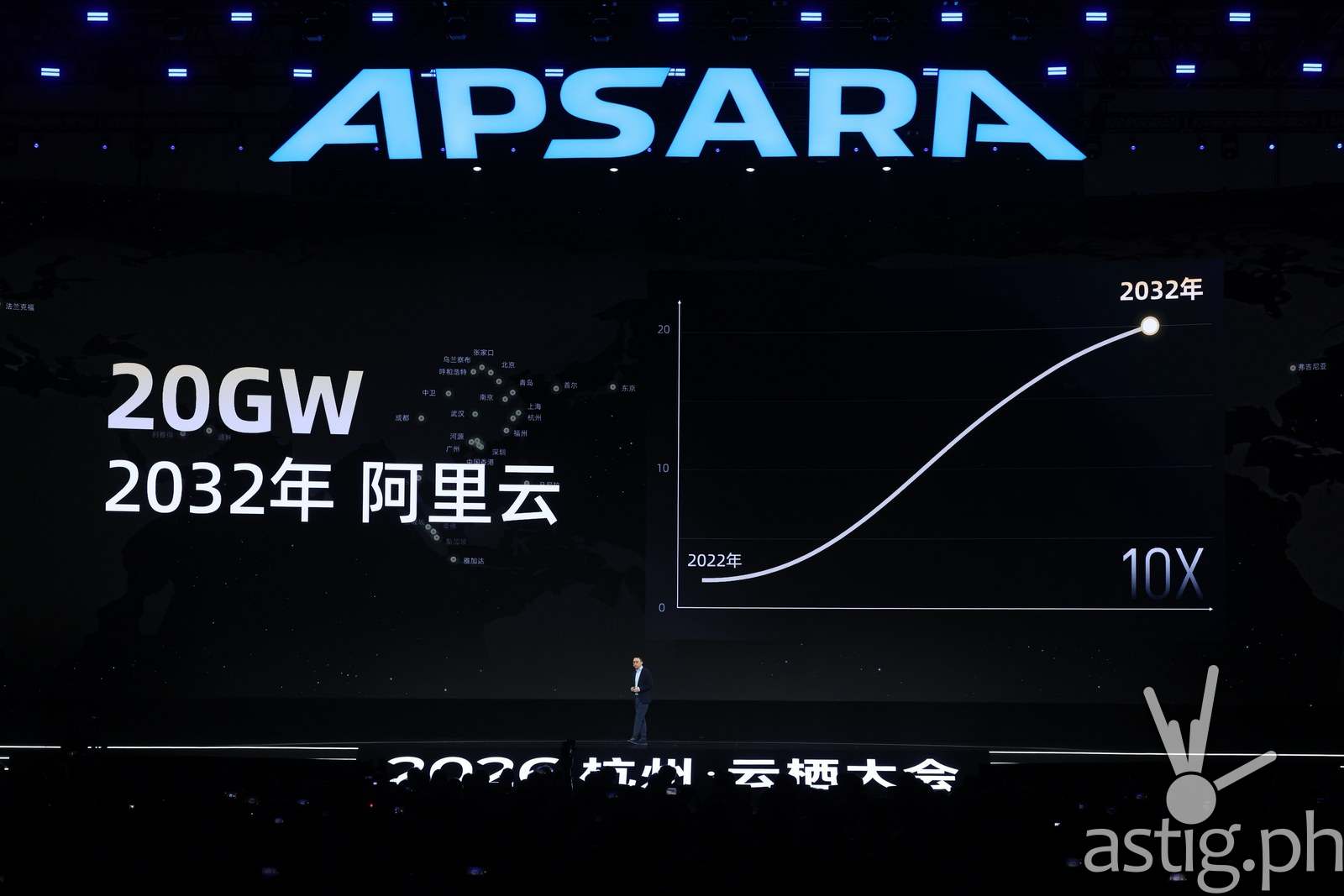
At Apsara in September 2026, Wu compared AI’s development with the spread of electricity. He argued that today’s applications reveal only part of what the technology might eventually enable. His phrase for the current programming boom was memorable: “AI coding is simply the light bulb of the Machine Intelligence era.” A former programmer was suggesting that programming might be the introductory attraction.
The company’s roadmap had three foundations: models, chips and cloud. Wu discussed research toward more capable models, Alibaba’s chip development and a target for operated global data-center capacity to exceed 20 gigawatts by 2032. He also acknowledged supply-chain shortages limiting how quickly computing infrastructure could expand. The ambitions were forward-looking. The constraints were already present.
Three connected investments in Alibaba’s stated roadmap, rather than three completed outcomes.
There is a long distance between an early workstation and a global cloud network. Wu’s career has covered it through a sequence of concrete jobs: assembling, building, operating, investing, allocating. The dictionary anecdote survives the journey because it keeps the scale from swallowing the person. Someone still has to understand how the parts work together.
His current task adds a difficulty that no equipment manual can resolve. Alibaba must keep serving people who need its existing businesses while making room for uses of technology that remain unsettled. The co-founder who helped supply the first working parts is now deciding which parts the next company will need. Beginning again, it turns out, involves a great deal of maintenance.