Frank Holding joined First Citizens in 1983. Forty-three years later, he still works there. Read that quickly and it sounds like a story about staying in one place. Then consider what happened around his desk: a North Carolina banking franchise absorbed CIT, bought the operating business of Silicon Valley Bank out of receivership, and took on customers whose ambitions stretched well beyond the state line. The employer stayed on the résumé. The job kept getting bigger.
Holding’s career has an unusual rhythm. Long stretches of institutional continuity are interrupted by transactions that alter the institution itself. His name connects him to the bank’s past. His decisions have repeatedly enlarged its future. The interesting question is how a banker shaped by one organization handles the moment when that organization becomes something considerably more complicated.
A surname, then an apprenticeship
Begin in Smithfield, North Carolina, where Holding is a native and where the bank began in 1898. His grandfather, Robert Powell Holding, joined the business in 1918 and later became its president. The family connection developed through employment and leadership; the Holdings did not establish the original Bank of Smithfield. That distinction gives the history some useful texture. Even a banking dynasty has a first day at work.
Leadership passed to the next generation in 1957. Frank’s father and uncles helped extend a business rooted in eastern North Carolina. By 1974, its headquarters had moved to Raleigh. The young Frank inherited a surname already attached to banking, along with an institution whose geography was changing before he entered it.
He earned a business degree at the University of North Carolina at Chapel Hill in 1982 and an MBA at Wharton in 1986. His employment at First Citizens began between those two graduations. His management experience took him through Charlotte, Raleigh, Wilmington, Swansboro and Fayetteville. The map matters: these were operating assignments inside the franchise, giving him experience of the bank through individual markets before he ran the whole.
He became president in 1994. By the time he became chief executive in January 2008, he had already spent roughly a quarter-century at First Citizens. A familiar last name and a long apprenticeship occupied the same résumé. Any account of his rise needs room for both.
- 1983Joins First Citizens
- 1994Becomes president
- 2008Becomes CEO
- 2009Becomes chairman
The usefulness of being ready
January 2008 was an awkward time to receive a bank’s keys. The financial crisis would make judgments about lending, capital and liquidity painfully concrete across the industry. Holding became chairman in February 2009. His early tenure at the top unfolded during the period when an acquisition opportunity could arrive wrapped in another institution’s failure.
First Citizens bought failed community banks through FDIC-assisted transactions after the recession hit. These purchases gave it experience in a specialized kind of work: evaluating a bank under pressure, accepting the parts it could manage, and incorporating those businesses into its own operation. Repetition mattered. By 2023, the company described its record of FDIC-assisted transactions since 2009 as central to its qualifications for another purchase.
Holding’s public language about expansion was often more practical than romantic. In a 2014 interview, he spoke about adding density and efficiency to an existing franchise. He also discussed the rising cost of compliance and the need for scale. Here was a banker discussing growth partly as the cost of keeping the machinery running.
“We would rather add flesh to our existing frame.”
Frank Holding, 2014
The metaphor is agreeably unglamorous. It suggests a person looking at the fit of a business rather than admiring a bigger map. That year’s combination with the separately operated South Carolina First Citizens brought together two banks with family ties and a common name. Shared ancestry helped explain the pairing. Making the combined operation convenient for customers was the work that followed.
A bigger bank arrives in pieces
The CIT merger, completed in January 2022, changed the range of businesses under Holding’s supervision. First Citizens brought its retail banking franchise; CIT contributed nationwide commercial lending and direct digital banking strengths. The combined institution had more than $100 billion in assets at completion. A bank associated with branches and local relationships now had a broader collection of specialist businesses to coordinate.
That combination also required a sequence of practical decisions. Existing CIT customers initially continued through familiar channels while conversions were planned. Different brands, systems and teams had to become useful parts of one bank. The announcement supplied a date for the transaction. Customers would encounter its consequences over a much longer period.
Then came March 2023. First Citizens entered an FDIC agreement to acquire substantially all loans and certain other assets of Silicon Valley Bridge Bank and assume its customer deposits and certain liabilities. Holding’s organization suddenly had responsibility for relationships woven through venture capital, private equity and technology companies. The acquisition gave his career a new national audience.
Loan and deposit balances are different measures. These figures describe the acquired business, not a purchase price.
The terms deserve care. The FDIC reported a $16.5 billion discount on approximately $72 billion of purchased assets and an agreement to share losses on commercial loans. First Citizens did not buy the former parent company, SVB Financial Group, or assume all its obligations. The boundaries of the transaction were part of the story, as was the public mechanism that enabled it.
For borrowers and depositors, the first instruction was reassuringly ordinary: keep using the existing channels and continue making loan payments. Behind a transaction large enough to command national attention sat the immediate obligation to make Monday morning banking work.
The ordinary work after the extraordinary deal
The acquired business came with people who understood particular customers and markets. Keeping that knowledge useful was part of what First Citizens had purchased. A technology founder, a fund manager and a longtime branch customer could all belong to the same institution while expecting different things from their banker.
Holding’s letter accompanying the 2025 annual report described materially all SVB integration efforts as complete. It also described work on risk capabilities appropriate to the bank’s increased size and complexity. The emphasis then moved toward simplifying and modernizing technology platforms. Acquisition changes a balance sheet quickly; creating an organization that can support the enlarged business takes sustained attention.
The same letter acknowledged stress in some lending portfolios, including office property, innovation and equipment finance. That detail belongs in the account alongside growth. A larger bank has more opportunities to serve clients and more exposures to monitor. Experience buying businesses does not release management from the daily obligations of underwriting, assessing loans and controlling costs.
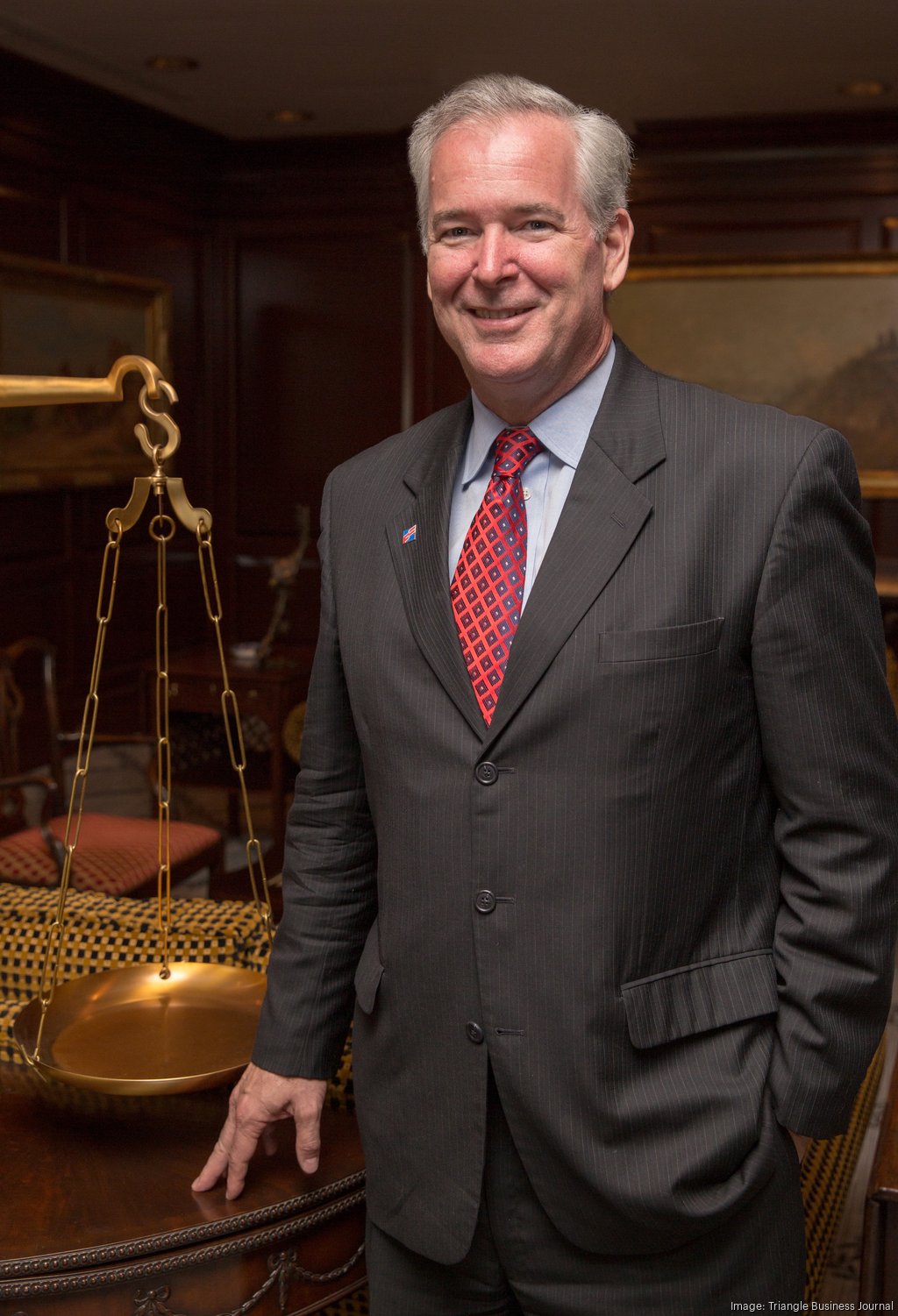
The office photograph supplies an almost excessively cooperative prop: a brass balance scale next to a banker. The composition could hardly work harder. Yet balance is a useful way to describe the management problem his career presents. Preserve the relationships and judgment accumulated over decades, while changing systems and structures enough to support a business those earlier decades could scarcely have anticipated.
He shares that responsibility with a leadership team that includes his sister, Vice Chairwoman Hope Holding Bryant, and his brother-in-law, President Peter Bristow. Family continuity is visible in the executive ranks. It operates within a publicly traded company, with directors, investors and customers all having reasons to examine the results.
Pickles, policy and a longer calendar
Holding’s public responsibilities extend beyond the bank. His board affiliations include Mount Olive Pickle Company and aviation company flyExclusive; he also serves as a Wake Forest University trustee. It is a pleasantly varied list. Pickles provide a memorable detail in a banking biography, though a board seat should never be mistaken for evidence of someone’s lunch preferences.
His civic work has a more explicit connection to his management outlook. He helped establish the NC Chamber Foundation in 2010, supporting an organization concerned with the state’s long-term economic competitiveness. In April 2026, its board named him chair emeritus. The foundation’s account of its origins emphasized the need to look beyond a two-year political cycle.
That concern with time offers a useful connection between his banking and civic roles. Investments in institutions, infrastructure and economic development can take years to justify themselves. Leadership continuity gives a person the opportunity to remain accountable for choices beyond the announcement and the next round of applause.
In February 2026, First Citizens announced Holding’s appointment to the Federal Advisory Council, representing the Fifth District through the Federal Reserve Bank of Richmond. The council brings together one banking representative from each of the twelve Federal Reserve districts. His role is advisory, bringing banking experience into discussions with the Board of Governors. A career spent interpreting conditions inside one expanding institution now has another setting in which to be heard.
Silicon Valley, with a Raleigh return address
On October 6, 2026, First Citizens launched First Citizens Innovation Banking and First Citizens Fund Banking. The names carried the acquired Silicon Valley businesses further into the parent company’s identity. Holding restated a commitment to investing in the innovation economy over the long term. After the emergency transaction and the integration work came a more visible statement about where the business belonged.
There had already been a public moment of arrival. In September 2024, Holding rang the Nasdaq closing bell at MarketSite in Times Square. It supplied the familiar photograph of corporate achievement: the executive, the occasion, the company name. His career is more revealing when read between such moments.
There are decades of work before the bell and obligations after it. A family-controlled bank has become responsible for specialist lending, national customer relationships and businesses tied to the innovation economy. Holding’s record gives the story continuity without making its outcome automatic. The next customer still needs a useful answer. The next investment still needs to work. After forty-three years at the same employer, there is plenty left to do when he gets to the office.
Keep reading & watching
- First Citizens Bank
- Frank Holding on LinkedIn
- 2026 innovation banking launch
- The CIT merger
- The FDIC transaction
- Chairman’s letter and annual report
- Watch: growth and M&A with Rob Nichols (23 min)
- Watch: Holding’s CIT merger message
- First Citizens on YouTube (company channel)
- First Citizens on X (company account)
- First Citizens on Facebook (company account)