Before Stuart Frantz was running a holding company, he was thinking about footprints. In 1994, the president of Carolinas Golf Group explained why his company wanted to keep its courses within a manageable stretch of the Southeast. Expansion had attractions. Distance had consequences. He borrowed a saying from one of the firm's principals: “One of the best fertilizers is the owner's footprints.”
It is a pleasingly muddy answer to a financial question. An owner can supply money from anywhere. Footprints require attendance. Someone has to arrive, notice the condition of the place, and care enough to return. The phrase also has a useful lack of grandeur. Nobody gets a ceremonial ribbon for walking around a golf course and paying attention.
Frantz's career would take him from banking into golf operations, then into the leadership of a partner company and, in 2017, to the presidency and chief executive role at Investors Management Corporation in Raleigh. Jen Moses succeeded him as IMC's CEO in 2026. Across those chapters, the most interesting subject is what an owner owes the people doing the work.
A banker walks onto the course
Carolinas Golf Group began in 1988 with Roger Watson and Frantz as its original partners. Watson brought a golf professional's experience to the enterprise. Frantz had worked in commercial banking and was a senior vice president at Wheat First Securities in Raleigh when he met Watson, then the owner of Wildwood Green Golf Club.
Their company brought together people with different kinds of authority. Richard Urquhart, a Raleigh businessman, and club professional Buck Adams subsequently joined them. The first project was Devils Ridge in Holly Springs. The Neuse in Clayton, Oak Valley in Advance, the Currituck Club in Corolla, and Kiskiack in Williamsburg, Virginia, followed. These were real places with their own surroundings, customers, and operating demands.
The golf setting matters. A course is a business spread over a landscape. The guest experiences the whole thing, from the playing surface to the pro shop. A fine view cannot settle every complaint. Nor can an agreeable balance sheet make a disappointing afternoon more enjoyable. The owner has to understand how the pieces meet in the customer's day.
By February 1996, Carolinas Golf Group operated six North Carolina courses. Oak Valley had opened with an Arnold Palmer design. A Rees Jones course at Currituck was expected to open that July. One site put the company near Winston-Salem; another placed it among the live oaks and dunes of the Outer Banks. Expansion gave the business a wider map while keeping its work rooted in particular destinations.
In 1998, Cobblestone Golf purchased the company for $60 million. Watson revived the Carolinas Golf Group name in 2000 with a focus on club management. The original enterprise had reached a transaction; its name would have another life.
The promotion hidden inside expansion
There was another ambition inside the golf business. Frantz wanted assistants to advance into leading positions as facilities became available. New courses would create places for the next generation of managers. The business was also developing training and retirement programs for its 110 employees. Growth, in this version, had a staffing plan attached.
That detail gives the word “opportunity” some substance. A company can promise employees a future, but the promise becomes easier to understand when a future job has a name. Assistant superintendent. Head superintendent. Assistant professional. Head professional. The ladder need not be glamorous to be useful. It does need another rung.
The same account describes a practical feedback system: customers rated aspects of the operation, and employees received updated assessments. When fairway grass at Devils Ridge failed and customers marked the course down, Frantz said the company installed 40 truckloads of new sod within a week. An unhappy customer had become a problem with a delivery schedule.
There is humor in the scale of that answer. Forty truckloads is a rather emphatic way to acknowledge a complaint. It also keeps the story grounded. Service does not improve because a company has found a more flattering adjective for it. Somebody has to arrange the trucks.
Forty truckloads of sod make a fairly concrete reply to a customer complaint.
An episode from Frantz's golf years
An early investor becomes a lasting connection
One of the original investors in Frantz's golf venture was James Maynard, the founder of IMC. Their relationship continued over the years, with Maynard becoming an adviser, friend, and mentor. Frantz's eventual arrival at the head of IMC therefore followed a connection that had begun long before the appointment.
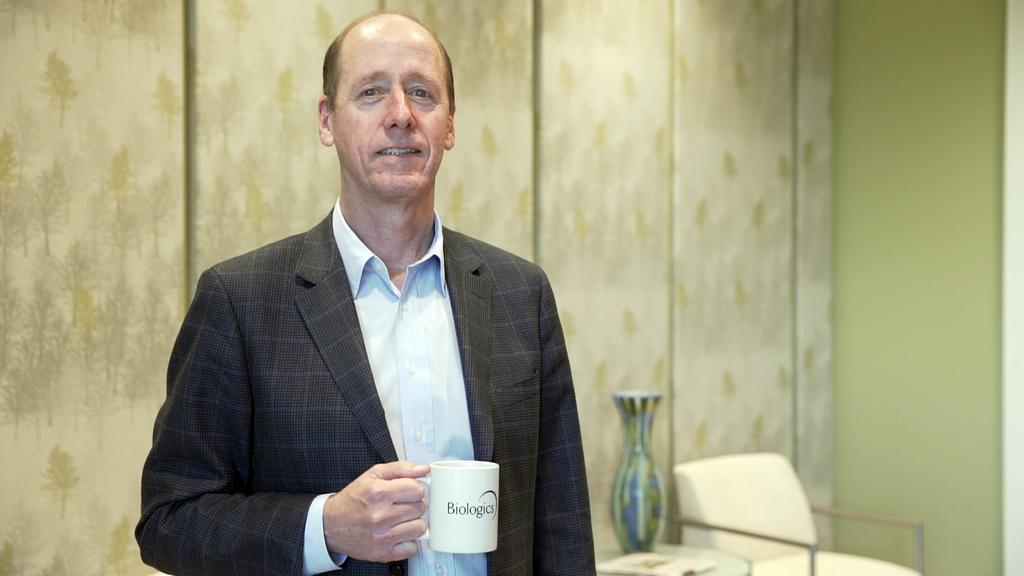
Frantz graduated from the University of North Carolina at Chapel Hill and earned an MBA at the University of Virginia's Darden School of Business. He later led IMC partner company Biologics as president and CEO until its sale to McKesson in 2016. His route combined financial training, the creation of an operating business, and executive responsibility inside the IMC family.
In 2014, that operating responsibility included a new headquarters project. Highwoods Properties announced a 75,000-square-foot building for Biologics in Cary's Weston area, with an investment of approximately $14.9 million. The development was fully pre-leased. Frantz's comments connected the move to expansion and to providing a suitable environment for employees.
A building supplies a different kind of evidence from a corporate motto. It fixes a decision in space. Where will people work? How much room will the business need? Which amenities make the location suitable? A lease gives a growth plan an address, along with obligations that outlast the announcement.
Triangle Business Journal featured Frantz in its 2016 CEO Awards coverage. In November 2017, it reported his appointment as IMC president and CEO. The executive who had once brought a banker’s background to a golf partnership was now leading the company founded by one of that partnership's early investors.
The tacos passed the atmosphere test
In 2021, IMC partnered with Taco Bamba, the taqueria business founded by chef Victor Albisu. Frantz recalled his first visit through what he encountered inside: “The food, music and aroma created an electric atmosphere.” His memory included the energy of both the team and the guests.
At the time of the partnership, Taco Bamba had six locations in the Washington region, with a seventh scheduled for 2022. Its menus were tailored to individual neighborhoods. Albisu had started the business in 2013 with his mother and stepfather. The proposed expansion would begin around Washington before reaching new markets along the Mid-Atlantic and East Coast.
A neighborhood menu makes growth an interesting management problem. Each additional restaurant has to belong to the business while having something of its own to say. The ordinary temptation of expansion is to make everything easier to repeat. A distinctive restaurant gives its operators a second obligation: preserve the reasons people came in the first place.
Restaurant count at partnership announcement and CEO appointment. These snapshots describe Taco Bamba's expansion, not a measure of Frantz's individual contribution.
In January 2026, Taco Bamba appointed Michael Pereira as CEO. The concept had reached 16 locations. Pereira's job involved developing talent and the systems needed for expansion while maintaining the identity of individual restaurants. Albisu would continue to lead the culinary and creative work.
Frantz's comments on the appointment emphasized the search for someone who understood the brand and had experience building teams and expanding operations. The ingredients of the decision were specific: a connection to the company, an operating record, and respect for its culture. The first-visit memory had become a question about who could carry the business forward.
There is a useful continuity here. In the golf years, expansion created positions for developing managers. In the restaurant partnership, expansion required a leader able to develop operators. Different businesses, different appointments, the same practical dependency: additional locations need people capable of taking responsibility for them.
Who gets to make the next decision?
Frantz also supported IMC's community giving alongside board chair Easter Maynard. In 2019, the company launched IMC Gives, an employee-managed fund working with Triangle Community Foundation. It broadened the company's giving beyond ChildTrust Foundation's established focus on early childhood education and literacy in North Carolina.
The fund made grants twice yearly. Katherine Dorsey and four colleagues oversaw it, working with the foundation's donor engagement team. Committee members came from tax, business development, finance, and personnel administration. They developed guidelines and a mission statement while carrying out their regular jobs. Authority to give was spread across the office.
That arrangement belongs in a story about ownership because it concerns who is allowed to exercise judgment. Employees were helping choose community priorities and grant recipients. Frantz and Maynard endorsed the approach; the committee did the work. The distinction makes the example more revealing than a photograph of a chief executive presenting an oversized check.
Frantz's community commitments have also included board service with the Boys and Girls Clubs of Wake County and service as a church deacon and elder. Barton College lists him among its voting trustees for 2025-2026, based in Raleigh. These roles place his public record alongside institutions with obligations extending beyond a commercial transaction.
IMC's current ownership approach uses internal capital and sets a long horizon for its businesses. Its leaders also meet across partner companies to share operating experience. The structure brings together separate businesses, each with its own leadership, while creating opportunities for their teams to learn from one another.
In 2026, Moses took over as CEO after joining IMC as CFO in 2023. Frantz's tenure had lasted nearly a decade. The change gives his chapter a clear boundary, and leaves the longer project in other hands. A business that speaks about enduring ownership eventually has to make room for a successor.
The footprints remain the most memorable image. They fit a course owner, a company leader, and an investor learning a restaurant by walking through its door. Frantz's record supplies less theatrical versions of the same concern: future jobs for assistants, room for employees, managers for expanding businesses, and colleagues trusted to make giving decisions. The work keeps returning to the people who will be there tomorrow.