In October 2023, a Vancouver investment firm acquired a football club in Limerick. Alongside the familiar vocabulary of capital and governance came a different set of concerns: players, supporters, volunteers, and the future of a young Irish club. Shawn Lewis, Tricor Pacific Capital’s chief executive, spoke about generations of footballers. It was an unusually expansive horizon for an acquisition announcement.
The partner was Ciara McCormack, a former Republic of Ireland international who became Treaty United’s co-owner and CEO. She had approached Tricor with a vision for the club’s community role. Treaty had been founded in 2020; its women’s team entered league competition that year, and its men’s team followed in the First Division in 2021. There was a recent foundation to build on, rather than a century of trophies to polish.
Lewis’s statement placed Tricor alongside the League of Ireland and the Limerick community in the work ahead. The ambition was to develop an organisation that could inspire future players. That gives this particular transaction its human scale. The institution being purchased mattered to people who would never appear on an investment committee’s attendance sheet.
A football club makes the obligations of ownership unusually visible. Results arrive in public. Supporters have memories. The next generation has to be given somewhere to play. For Lewis, Treaty offers a useful starting point for understanding a career spent moving closer to the businesses behind the paperwork.
Three degrees, then two sides of the deal
Before the portfolio came an education with an unexpected combination. At McGill University, Lewis earned a Bachelor of Science in architecture, then degrees in both common law and civil law. Buildings and contracts make different demands on their authors, although both punish carelessness. The architecture qualification gives his biography an opening more distinctive than the usual procession through finance.
His early professional years were spent at Paul, Weiss, Rifkind, Wharton & Garrison in New York. During six years there, his work covered mergers and acquisitions, private equity transactions, and corporate matters, including deals crossing national borders. The setting was the legal side of buying and selling businesses, where an agreement has to survive contact with all the things its parties might later disagree about.
The next move took him to Stern Partners in Vancouver. He stayed for 15 years as vice president and general counsel. His responsibilities extended beyond legal affairs into acquisitions, disposals, corporate development, finance, and continuing business strategy. The word continuing is useful here: ownership gives a company a life after the signing ceremony, and someone has to attend to it.
Viewed together, those roles describe a change in proximity. Outside counsel works on the transaction. A general counsel inside an investment business also lives with its consequences. It is a practical progression toward the job Lewis took at Tricor in 2019, when he became CEO and managing director and Rod Senft moved into the chairman’s role.
- McGillArchitecture + two law degrees
- New YorkSix years at Paul, Weiss
- Vancouver15 years at Stern Partners
- 2019 onwardCEO & Managing Director, Tricor
The clock on the capital
Tricor had already changed its own structure before Lewis arrived. In 2015, it became a single-family office under Senft, while the institutional fund-management business became Parallel49 Equity. That distinction matters to the working conditions of its chief executive. A family office investing its own capital can set a different timetable from a fund managing money toward a scheduled exit.
Tricor describes its ownership approach as open-ended, without a fixed deadline to sell. It seeks majority stakes in established businesses, with sellers or management retaining equity. Its stated range for new standalone investments is $5 million to $25 million in EBITDA, a measure of earnings before interest, taxes, depreciation, and amortisation. Add-on acquisitions have no minimum size threshold.
The numbers establish a scale, but the retained equity establishes a relationship. A founder may sell control and still have a financial interest in what happens next. The buyer and the existing leadership then share a future whose practical details have to be worked out. Patience, in this setting, still requires decisions; a longer timetable simply changes which decisions can make sense.
Lewis oversees investments, operations, and strategy, working with the leadership of portfolio companies. The remit combines choosing businesses with supporting the ones already owned. Tricor’s leadership includes chairman Rod Senft, vice chair Lauren Senft, CFO Lisa Oleson, and managing director Derek Senft. Lewis leads within that group, rather than standing at the centre of a story that began with him.
EBITDA range for new standalone investments.
No minimum size for add-on acquisitions.
Wisconsin, with the builders still aboard
In June 2023, Lewis shared the announcement of Tricor’s investment in Eden-Valders Stone. His own accompanying note was short: “Exceptionally proud of our team and our newest partnership.” It is the sort of sentence that tells you where he puts the emphasis when the formal transaction language has already been written.
The investment brought Tricor together with Eden-Valders president Barry Gesell, EXI Investment Partners, and members of the company’s management team. The Wisconsin producer served residential, commercial, and institutional customers across North America. Its business was grounded in quarrying and fabricating natural stone, a pleasingly literal occupation to sit somewhere in an architecture graduate’s investment portfolio.
Eden-Valders brought histories of its own. Eden Stone was founded in 1950, while Valders Stone & Marble dated to 1906. The combined company produces materials including high-density dolomitic limestone and quartzitic sandstone. Buying into such a business means entering a line of work with accumulated craft, relationships, and physical assets already in place.
The same practical interest in property appears in Lewis’s connection to Areva Living, which lists him as a partner involved in overseeing real estate investments and developing new business relationships. Tricor Property Partners also names him on its acquisition team. Its sale-leaseback model connects investment capital to industrial premises: a business can sell a property and continue occupying it under a lease. The factory need not move merely because its ownership paperwork does.
“Exceptionally proud of our team and our newest partnership.”
Shawn Lewis · Eden-Valders Stone · June 2023
Keeping the machinery moving
On October 29, 2025, Tricor announced an investment in Big Country Equipment Repair, based in Kamloops, British Columbia. Founder and president Spencer Harrison would remain in charge. The work was concrete: maintaining and repairing heavy equipment for industrial customers, with mechanics, welders, machinists, electricians, and fuel and lubrication technicians among the people keeping it running.
Lewis framed the partnership around expanding Big Country’s services and reach. It also added to Tricor’s industrial platform. The announcement made the division of responsibilities visible: Harrison continued to lead the company, while Tricor supplied capital, experience, and strategic support. A founder’s next chapter could include a new shareholder without requiring his immediate departure.
Another industrial combination followed on July 3, 2026, when Tricor acquired Arctec Alloys and brought it together with portfolio company Rockmount Research & Alloys. Both supply specialised products used in repair and maintenance welding. Arctec president Mark Trenke remained in his role and retained equity alongside Tricor. Chuck Cosman, a Tricor principal and Rockmount president, would work with him on the combined platform.
These announcements offer two specific examples of the ownership model Lewis oversees. Existing leaders remain involved; related capabilities are assembled around them. Equipment repair and welding consumables also serve a wonderfully unglamorous purpose: making useful things last longer. The investment language talks about platforms. The customer wants the machinery to work.
A room with a longer memory
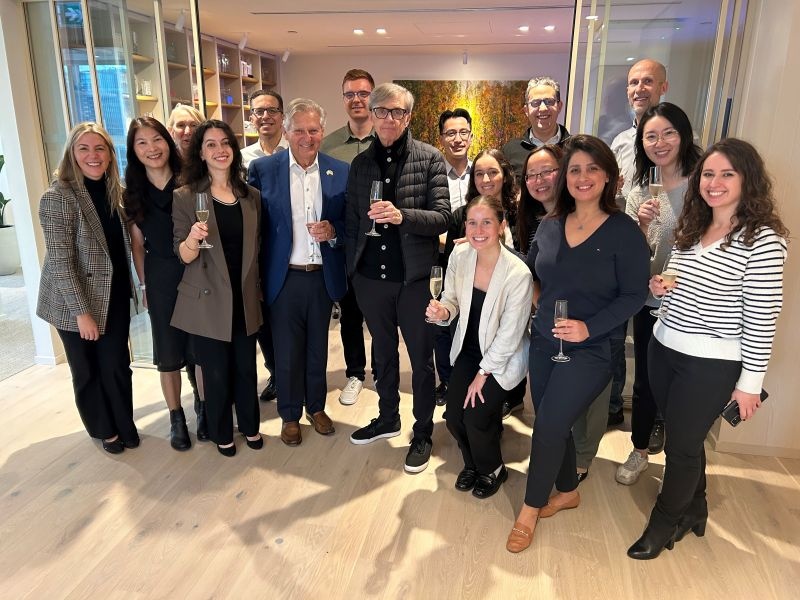
One revealing moment took place closer to home. Tricor’s team celebrated the opening of the Johnstone Room in its Vancouver office, named to honour Trevor and Heather Johnstone. Trevor was one of the firm’s original founders and remained a senior advisor. A meeting room, ordinarily a place where enthusiasm goes to encounter an agenda, became a small act of institutional memory.
Lewis added a comment to the company’s post, wondering whether Trevor would ever see it and saying that the honour deserved to be recognised more widely. He credited Trevor’s contribution to Tricor’s success and expressed appreciation for his leadership and friendship. It was public gratitude directed backward, toward someone who had helped establish the organisation Lewis now led.
The team photograph shows a crowded gathering with raised glasses, rather than a solitary executive at a desk. Its subject is the occasion itself. It also supplies a useful visual companion to Lewis’s comment: colleagues assembled around an acknowledgement of people whose work predates the latest transaction.
His own interests outside work include time at the ice rink, on the tennis court, and on the ski hill, as well as family and community involvement. Those are modest details, but they bring a person back into a biography dominated by corporate nouns. A career can cover law firms, quarries, real estate, and football without consuming every hour of the person living it.
Choosing a destination
Lewis selects a line about direction among the quotations that inspire him: “If you don’t know where you’re going, any road will take you there.” He credits the line to Lewis Carroll. Read alongside his responsibilities, the appeal is understandable: a varied portfolio needs direction even when its companies make entirely different things.
That direction becomes clearest in the choices already described. At Treaty United, Lewis articulated an ambition reaching toward future players. In Wisconsin, he celebrated a partnership involving existing management. In Kamloops, the founder stayed at the wheel. Each setting gives long-term ownership a different practical meaning, because each organisation has different people to answer to.
The public record continued into September 2026, when Lewis signed a securities filing for Tricor and its holding company concerning CPI Card Group. The signature is a reminder of the formal responsibility that accompanies the warmer language of partnership. Investment leadership still involves documents, ownership structures, and accountable decisions.
There is a considerable distance between an architecture degree and an Irish football club. Lewis’s career connects them through the intervening work of law, investment, and management. Today his job is to decide where capital belongs and help the people there carry on building. The purchase announcement starts the relationship. Much of the interesting work comes afterward.
Follow the partnerships
Explore Lewis’s professional profile and the businesses discussed here.