Imagine trying to sell a company without letting everyone know it is for sale. You need attention from exactly the right people, accompanied by discretion from everyone else. An ordinary advertisement would be rather like announcing a surprise party over the building’s fire alarm. Aurigin’s answer is to begin with the transaction, keep the names out of the first exchange, and arrange an introduction when both parties are interested.
- Middle-market companies and advisers bring opportunities; investors and acquirers bring mandates.
- Algorithms propose matches. Investment banking analysts review them.
- Mutual interest comes before identity disclosure in the matching workflow.
The address-book problem
Consider the awkward symmetry of private capital. A business needs an investor. An investor needs a business. Neither shortage necessarily disappears because both attend another conference. The difficulty lies in finding someone whose geography, sector and transaction requirements fit. A large network can still contain very few useful answers to a particular question.
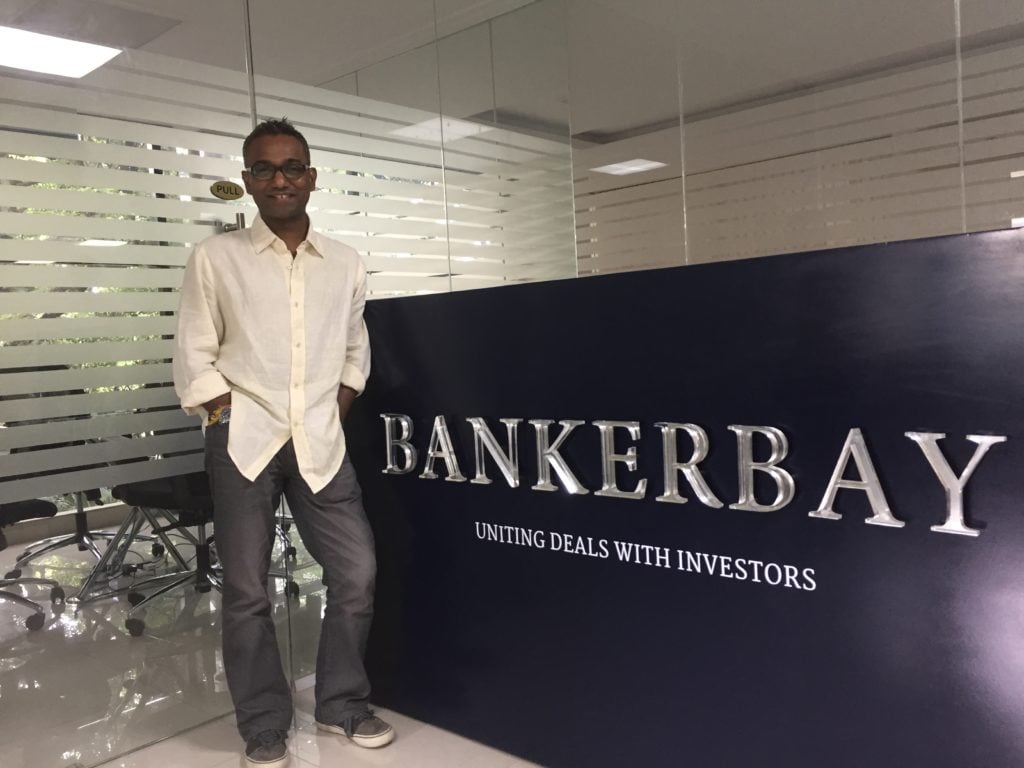
Romesh Jayawickrama brought experience at Nomura, ING and CLSA to that problem. He had also established Amura, a corporate finance and consulting firm focused on middle-market private equity and M&A. BankerBay, the company that became Aurigin, paired his banking background with software. Early reporting also identifies Ash Narain as a co-founder. The proposition was straightforward: describe the deal well enough, and the search need not stop at the banker’s familiar contacts.
The algorithm gets a second opinion
Aurigin connects businesses seeking capital with institutional providers, and acquisition opportunities with buyers. Private equity funds, investment banks, corporate advisers, banks and family offices use the network. A corporate development team can enter an acquisition mandate; an adviser can submit a sell-side proposition. Those descriptions give the matching system something more useful than an impressive job title.
The workflow has four stages: submit a proposition, let the platform identify counterparties, review the resulting matches, then request an introduction. Aurigin combines its algorithms with investment banking analysts. After both sides express interest, they can communicate directly and share documents through its Deal Room. The software narrows the search; people remain involved in deciding what deserves someone else’s time.
- 01Define
the mandate - 02Match +
analyst review - 03Both sides
express interest - 04Introduction +
deal discussion
There is also M&A Vault, launched in September 2015 with more than 500 live listings and search by characteristics such as geography and sector. It supplied a more direct discovery route alongside the introduction service. That distinction matters: Aurigin’s deal-matching FAQ discourages treating the network as a searchable directory of people, while the Vault was explicitly built for searching opportunities.
The luxury of saying no
The intriguing part is the filtering. In June 2015, BankerBay said it received roughly $4 billion to $5 billion of submitted deals each month, of which about $2 billion passed its vetting. These were company-reported opportunity values. Still, the proportions describe a service prepared to leave a substantial amount outside the door. A marketplace can make itself more useful by declining inventory.
Company-reported figures. Bar lengths illustrate approximate value, not deal count or completed investments.
By the December 2019 rebrand, the company reported more than 35,000 members across over 145 countries and over $250 billion of live investable deals. Those figures describe reach and inventory, rather than money successfully invested. The name Aurigin accompanied Jayawickrama’s description of an ambition for “capital without borders.” The interesting question is whether a particular mandate finds a relevant counterparty within that reach.
What an introduction costs
Aurigin’s published buy-side subscriptions list $625, $835 and $1,250 per month, billed annually. That translates to $7,500, $10,020 and $15,000 a year. Separately listed high-touch plans run from $4,999 to $9,999 per user per month. The range suggests that buyers should establish which service and contract they need before treating any headline price as the whole bill.
The pricing page also publishes closing-fee schedules: for advisers, 1% of the first $10 million, 0.5% of the next $10 million and 0.25% above $20 million. For corporates, the listed tiers are 3% of the first $3 million, 2% of the next $7 million and 1% above $10 million. These are separate commercial schedules. An introduction has value, but the economics depend on the agreement attached to it.
When banking’s habits met Covid
Getting bankers to change their routines was itself a hurdle. In a 2017 interview, Jayawickrama described resistance to technology and recommended showing prospects its usefulness through experience. His sales advice began: “Letting potential clients just use the platform offers the best illustration”. For an unfamiliar product, a trial can answer objections that another presentation merely rearranges.
The network becomes useful when the opportunity is specific.THE PRACTICAL LESSON
In August 2020, Aurigin announced AiB, an enterprise product intended to join investment banking origination and execution workflows. Its proposed scope included preparing marketing materials, populating data rooms and routing capital requirements across bank divisions. Covid was the company’s stated catalyst. This was an expansion of the software proposition from finding an introduction to coordinating work around a client’s capital needs.
A mandate is better than a mailing list
Aurigin occupies a market with other private deal networks. Axial concentrates on the North American lower middle market; Dealsuite positions itself around European M&A. Aurigin emphasizes global matching and analyst curation. None of those descriptions makes geography irrelevant. The sensible comparison starts with where the desired counterparties operate and how closely their mandates fit.
The lesson readers can borrow is modest and useful: state the transaction precisely, review automated suggestions, and establish mutual interest before disclosing sensitive identities. A network cannot compensate for an undefined mandate. Nor does screening settle valuation, diligence or financing. Aurigin’s contribution happens earlier: helping two potentially suitable parties find each other. Even in finance, an introduction should earn the right to interrupt.
Follow the deal
Explore Aurigin, its matching workflow and published plans. Follow the company on LinkedIn, X and Facebook.
Read the founder interview, the BankerBay rebrand announcement and the AiB launch announcement.