David Williams bought a company before he had spent very long working for one. In 1988, at 25, he acquired Merkle, a small Maryland data-processing business. The purchase gave him a chief executive’s title and a much larger question: how do you turn an existing business into something its previous owners never built?
The answer occupied more than three decades. Merkle expanded into marketing services, followed its customers into a changing digital economy, and eventually joined Japan’s Dentsu Group. Williams now runs MRE Capital in Annapolis, where he invests in other companies and helps their leaders wrestle with a familiar problem. Buying a business is an event. Making it grow is a recurring appointment.
His career is especially interesting at the point where an acquisition story usually ends. The sale did not conclude his interest in budgets, people, customers, or company culture. It gave him another way to work on them. Through a family office established in 2008, he has assembled a portfolio whose businesses range from commercial landscaping and event rentals to restaurants and business services.
An entrepreneur before the job title
Williams’s early experience of management came with grass attached. As a teenager, he was already running a landscaping team. He later studied business administration at Shippensburg University in Pennsylvania and began his professional career at the Philadelphia investment bank Butcher & Singer. He had encountered the work of running a business before encountering the language of financing one.
In his 2015 leadership talk at the University of Virginia’s Darden School of Business, he recalled an awkward career suggestion. A landscaping customer had encouraged him to become a stockbroker. When Williams pursued the suggestion, that same customer considered him too inexperienced in sales to hire. Williams kept interviewing elsewhere. Encouragement, apparently, could arrive with an unusually restrictive returns policy.
Brokerage brought him into contact with business owners, and Merkle Computer Systems became the opportunity he pursued. It was an established operation rather than a company conjured from a blank page. That distinction matters in his story: entrepreneurship can begin with taking responsibility for something already running. There are customers to serve on day one, employees with established habits, and a past that cannot simply be rewritten.
The customer kept moving
Merkle’s development followed a practical question: what could the company do next for its clients? Its early work involved managing data and mailing lists. Over time, direct marketing opened into a much broader business in analytics, technology, digital media, and customer experience. Williams’s original acquisition lived through a substantial change in what marketing meant.
The company’s history records an expanding collection of capabilities, including acquisitions such as RKG in 2014 and Periscopix in 2015. Bringing in businesses let Merkle extend what it could offer. The attraction of that approach is straightforward; the management challenge is less accommodating. A wider menu of services also means more teams, more decisions, and more opportunities for a customer to get lost between departments.
Williams explored the customer side of that problem in his 2014 book, Connected CRM: Implementing a Data-Driven, Customer-Centric Business Strategy. Its argument put customer relationships near the center of business strategy and treated data as a means of improving them. The subject fits his operating history. A company could possess considerable technology and still need to change how its people made decisions.
Writing a book made the reasoning portable. A chief executive’s experience usually circulates through meetings and conversations; a published framework can be examined by people outside the company. Williams had spent years working through the intersection of customer strategy and execution. He was now giving that work a form other managers could use.
- 1988Williams acquires Merkle
- 2008MRE family office formed
- 2016Dentsu buys majority stake
- 2020Dentsu confirms full ownership
Ten years. Ninety days.
At Darden, Williams described two planning horizons: what Merkle should become over ten years, and what it should do over the next ninety days to move toward that future. The pairing gives ambition a deadline without pretending that a large company can be built in a quarter. It also leaves surprisingly little room for the comfortable promise to get around to something eventually.
His advice to the students included “Think big and write it down.” Writing an ambition down creates something colleagues can question, remember, and use to judge subsequent decisions. It exposes the gap between what a leader says the company wants and what the organization spends its time doing. That gap is where a considerable amount of management happens.
He also urged entrepreneurs to avoid selling too early. In Williams’s case, ownership and leadership lasted long enough for the underlying business to change substantially. Patience did not mean preserving the company exactly as he bought it. The point was to remain involved while it developed new capabilities and a broader reach.
By 2015, Merkle had more than 2,000 employees, with operations in the United States, China, and the United Kingdom. The business Williams described to the students was far removed from the small operation he had acquired. Yet he continued to frame his experience through the difficulties of growing a company, rather than treating scale as a reason to forget its beginnings.
“Think big and write it down.”
David Williams, Darden leadership talk, 2015
A sale in two chapters
Dentsu acquired a majority stake in Merkle in 2016. In 2020, it accelerated the purchase of the remaining shares and confirmed full ownership. The distinction between those dates is useful: Merkle’s sale was a process with more than one milestone, and Williams’s long involvement overlapped its integration into a larger group.
The transaction placed Merkle’s data and customer relationship capabilities alongside Dentsu’s other marketing services. For Williams, it followed a career spent building the company well beyond its original size. MRE’s account of that career places Merkle above $1.2 billion in annual revenue under his leadership. The dollars are one measure of the distance traveled; the change in the company’s work is another.
His subsequent activity carries a recognizable continuity. He serves as executive chairman of Trilliad, which focuses on growth services for business-to-business companies. Craig Dempster leads Trilliad as chief executive. Their connection extends back to Merkle, putting shared operating experience into a new setting. Williams’s next chapter includes people who understand how the previous one was built.
Ownership with room on the calendar
MRE gives Williams a vehicle for backing management teams over a long period. Its family-office structure allows an investment horizon without a fixed fund life. The practical question becomes whether an industry, a company, and its leaders offer an opportunity worth working on together. The quality of that relationship is central to how he describes the work.
He names respect, trust, and enjoyment of the people around him as personal measures of success. That is a revealing test for someone whose job includes financial returns. An investment partnership can occupy years of board meetings, difficult conversations, and decisions about other people’s careers. Choosing the company also means choosing a recurring cast.
The portfolio makes the scope tangible. Curated Events rents equipment for occasions that need to happen on time. DJ’s Landscape Management serves commercial grounds customers. Quality Brand Group operates Dunkin franchises, while Greenberg Gibbons develops real estate. Williams is moving among different kinds of service work, where customer experience depends on what people actually deliver.
Those businesses cannot be managed as interchangeable entries in a table. MRE’s approach is to bring a common set of operating disciplines to companies with different customers and daily demands. The interesting test is how a method travels: which lessons remain useful when the work moves from marketing services to maintaining a property or preparing an event?
The playbook acquires a roomful of people
The Growth Company Playbook is MRE’s attempt to make operating experience usable across that portfolio. It addresses executive teams, strategy, culture, and management systems. Taken together, those subjects cover the distance between deciding where a company should go and establishing who will do the work to get it there. The framework asks leaders to make that distance visible.
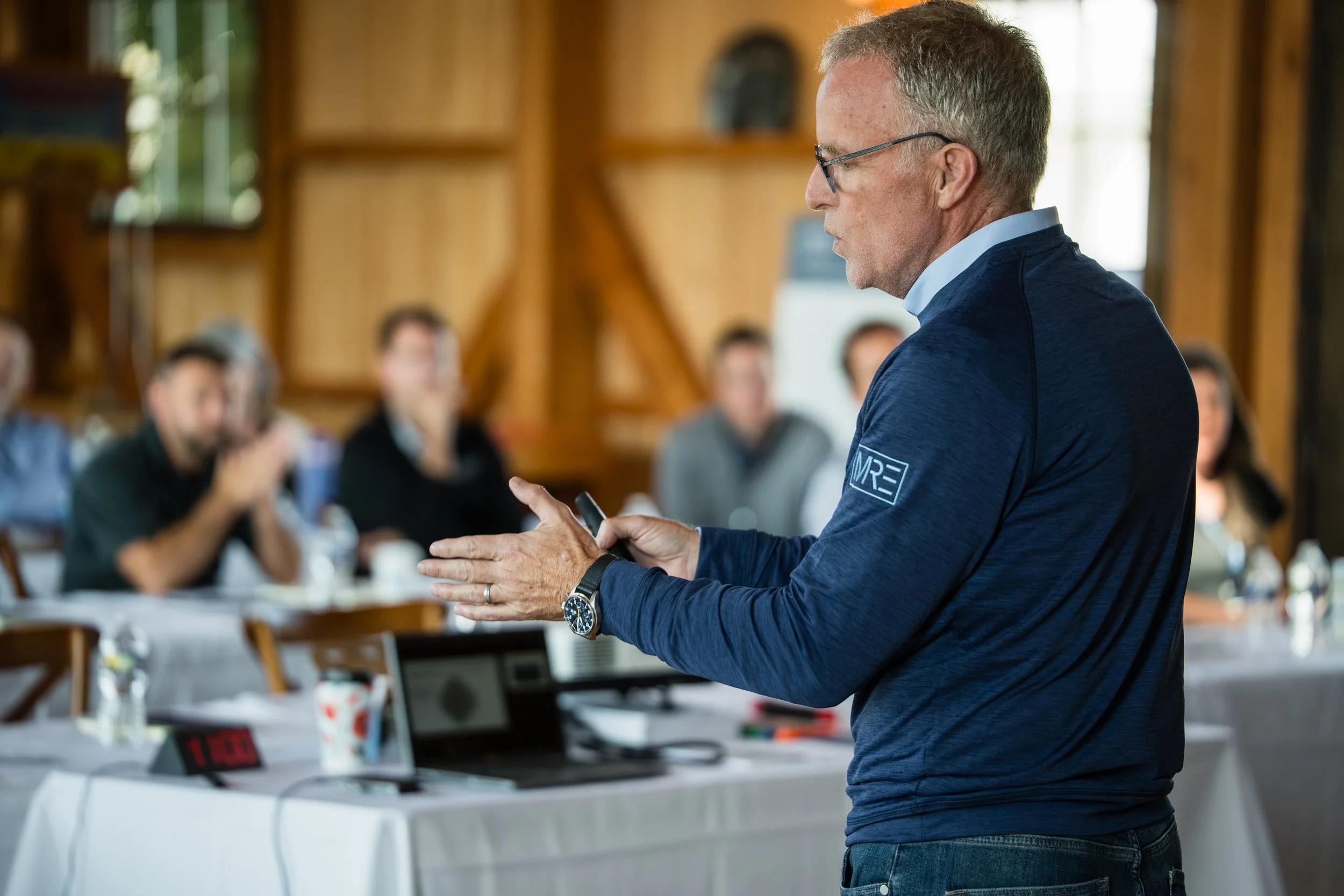
In September 2025, MRE brought portfolio executives to Northwest Point Farm in Centreville, Maryland, for its second annual Executive Summit. Williams led a CEO roundtable. Former Amazon executive Bill Carr, co-author of Working Backwards, also joined the program. The gathering put leaders from separate businesses in contact with one another, adding conversation and comparison to the written framework.
A discussion among chief executives has a particular usefulness. Each participant can recognize the problem of being responsible for a decision that has no obvious answer. Hearing how another leader handles it can make an abstract management idea less abstract. The summit gave MRE’s investment relationships a setting in which experience could circulate beyond a single boardroom.
In November 2025, MRE announced three Business Partner roles: Libby Barden for talent, Sean Creamer for finance, and Dave Paulus for sales. All brought Merkle experience. Their remit includes coaching portfolio executives and helping them apply the playbook. For Williams, this is a way to extend the availability of operating help beyond his own calendar.
Growth has to show up at work
MRE’s 2025 portfolio results supply a recent snapshot of the work: $679 million in pro forma revenue, 17 percent organic growth, and 24 percent total growth. Those are collective portfolio figures. They describe a group of businesses rather than Williams’s personal income or the investment office’s own sales. The distinction keeps the scale of the activity in view.
The next year brought concrete changes inside individual companies. DJ’s Landscape Management ranked No. 32 on the 2026 Lawn & Landscape Top 100, up from No. 52 in 2025. In July, Curated Events acquired Montana Party Rentals, extending its reach into the Mountain West. The portfolio’s growth is visible in places, teams, and services as well as percentages.
In September 2026, Total Fire Protection added Victory Fire Protection in Pottstown, Pennsylvania. The addition brought the platform to nine locations across five states and approximately 570 employees. Williams described the deal in terms of backing established operators and providing resources for expansion. It is a current example of the relationship between local experience and a larger business.
The recurring question in his career remains surprisingly ordinary: what must change so a company can do more, and who can help make that change? At 25, Williams answered by taking ownership of Merkle. Today he works alongside other leaders answering it inside their own businesses. Thirty years of experience can fill a book. Putting it to use still requires the next appointment.