The owner still answers the phone. The difficult quote still lands on the same desk. When a technician cannot make a job, the person who built the company climbs back into the working day. In Tony Tricozzi's account of industrial services businesses, these habits can look like a management problem. They can also explain why customers keep coming back. A founder's continued presence may be the place where a company's standards are being taught.
Tricozzi is looking closely at that distinction because he wants to take responsibility for a business himself. In May 2026, he announced that he had joined The Brydon Group as a CEO-in-Residence, seeking a services company to acquire and lead over the long term. His career has included Boston Consulting Group, Regrow Ag, and Kickpoint Ventures. The next step puts a different kind of consequence behind his interest in leadership.
He described the move through an unusually modest unit of distance: a seat. For more than 15 years, he had worked alongside the people running companies. Now he wanted to run one. A chair is a small thing to move across a room. In a business, the change can alter who gets the final question, who must live with the answer, and whose judgment becomes part of everyone else's working day.
What survives the founder?
In August, Tricozzi wrote about the industrial services owners he had been speaking with over the summer. Some were still handling complex estimates, accompanying technicians, and taking urgent customer calls. He resisted treating all that involvement as evidence of failure. The founder, in his telling, could be the person whose example had established the quality customers expected.
His interest was in the moment that example began to spread. He described a technician learning alongside an owner and eventually carrying the same expectations into independent work. The point concerns succession as much as delegation. A task can be reassigned quickly; judgment takes longer to pass along. Tricozzi's observation puts the attention on what the next person has learned, rather than simply on whether the founder has stopped doing the job.
An owner’s example can be valuable and limiting at the same time. If everyone waits for that person, the standard has only one custodian. If others understand the judgment behind it, the company has a way to keep learning. Tricozzi’s argument invites a buyer to distinguish between these situations before deciding what needs to change. That is a patient place to start a transaction.
That distinction makes an acquisition a more interesting undertaking than a change of signatures. A buyer can inherit equipment, contracts, and a customer list. The everyday understanding of what counts as a good job is harder to inventory. Reading Tricozzi's argument, the question becomes whether a new leader can make that understanding easier to teach without flattening the habits that earned the company's reputation.
There is a useful restraint in this view. The founder's instinct gets treated as something worth understanding before it gets reorganized. It leaves room for improvement while acknowledging that an established business has already solved many problems. Anyone arriving with a growth plan would do well to notice which solutions are written down and which ones still walk through the door every morning.
“Build a standard that does.”
Tony Tricozzi, on founder succession
From the advisory seat to the operating seat
At BCG, Tricozzi became a partner. His work included growth transformations and private equity due diligence across industrial, services, and consumer businesses. He later held operating roles in founder-led startups and small companies. The sequence matters to his present search: he has examined businesses as an adviser and then moved closer to the work of making decisions inside them.
His training began with engineering degrees at the University of Michigan, followed by an MBA at Northwestern University's Kellogg School of Management. He also worked in corporate development at Mondelēz International. These are different vantage points on how organizations fit together: the arrangement of work, the allocation of resources, and the choices involved in buying or building a business.
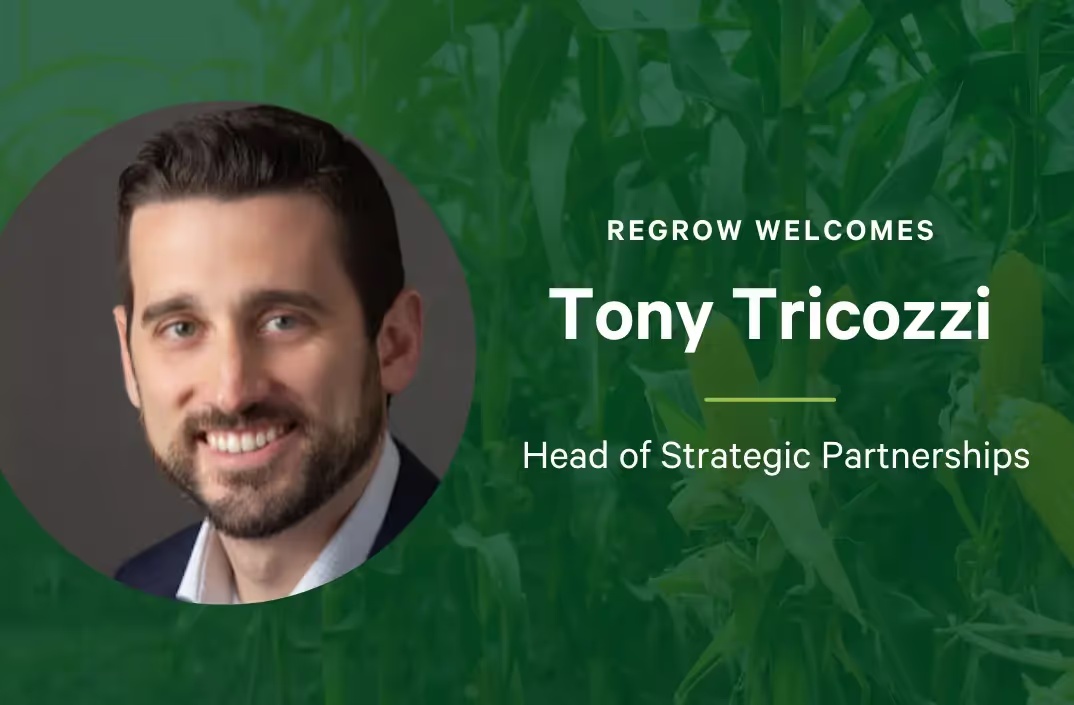
Regrow announced his arrival as Head of Strategic Partnerships in March 2023. His experience there grew out of a consulting focus on agriculture and sustainability. He subsequently worked at Kickpoint Ventures. By the time he announced his Brydon move, he was describing those operating experiences as preparation for leading a smaller business, where decisions are close enough to be felt in an employee's day.
The progression gives his chair metaphor some substance. Advice is a contribution; running a company requires an ongoing relationship with the consequences. A recommendation that looks sensible at a distance must survive schedules, customers, and the people expected to carry it out. His new ambition is to stay with that process. The intended time horizon is part of the job he is choosing.
Five ingredients, one crowded calendar
In September, Tricozzi laid out a five-part account of growth: cognizance, capability, capacity, conviction, and capital. The list emerged from conversations with services business owners. Money and people were often the opening answers. Further questions brought time, experience, and willingness to act into the discussion. A full calendar, he observed, can coexist with a company that has barely changed in size.
The five terms describe different obstacles. Cognizance means recognizing the need to grow deliberately. Capability concerns knowing how to add the next salesperson, crew, or offering. Capacity means having time to work on it. Conviction supplies the willingness to commit before the outcome is secure. Capital carries the expense while the new investment begins to contribute.
Putting time on the same list as money is revealing. It makes growth a problem of attention as well as financing. The owner whose week is already occupied has to find space for work whose benefit comes later. In that sense, the framework asks a prospective partner to explain what they can contribute to the operating week, as well as what they can contribute to the bank account.
The list also offers a way to read Tricozzi's career change. An acquisition search requires a financial transaction, but his public interests keep returning to what happens around it. Who helps the team learn? Who makes the next hire useful? Who has enough attention left to turn an intention into a routine? Those questions give a growth plan its working parts.
- 01CognizanceSee the need for deliberate growth.
- 02CapabilityKnow how to build the next step.
- 03CapacityMake time in the working week.
- 04ConvictionCommit before the outcome arrives.
- 05CapitalFund the investment while it develops.
The knowledge that never made it into the manual
At Reliable Plant 2026, Tricozzi found another version of the same issue. His June account of the conference focused on experienced maintenance people and the knowledge they carry. He described attending a session by Jeff Shiver about documenting work. The attraction of AI, in his account, was its potential to make that documentation less burdensome and help experience travel beyond the person who had accumulated it.
He also noticed hesitation. A tool can be available while the work of using it remains undone. Tricozzi put responsibility on leaders to create time and direct people toward useful applications. The technology belonged inside an operating practice: recording knowledge, organizing it into job plans, and helping another person perform the work with greater consistency.
That is a fairly unromantic setting for an AI discussion, which is part of its appeal. The drama is in a piece of know-how becoming usable by someone else. For a business built on experienced people's judgment, a document can be an important bridge between generations of employees. It can also be an unfinished promise if nobody has time to check it or use it.
Across his writing about founders, growth, and maintenance knowledge, a common problem comes into focus. A company needs to carry what it knows into its next stage. Tricozzi's interest in training and documentation suggests a leader paying attention to that transfer. The test of the idea would be ordinary and demanding: whether another person can do the work well when the original expert is elsewhere.
Ann Arbor, with Saturdays reserved
Tricozzi is based in Ann Arbor, a city that also appears in his education and family story. He and his wife met at the University of Michigan. In Brydon's account of his life outside work, the couple have three boys and spend time outdoors together. Running and soccer are among his interests. Golf gets a less triumphant description: a “mostly losing battle.”
In the fall, Michigan Wolverines football claims Saturdays. It is a small detail, but a useful one in a career story full of organizational titles. Engineering school, marriage, and a football allegiance all connect him to the same place. His professional moves do not tell the entire story of what he returns to, or what occupies the calendar once the working week ends.
His public ambition at Brydon is to find a business and build a culture in which people can do work they value. That aspiration connects the personal career decision to the companies he is studying. He wants the responsibility of leading; his writing pays close attention to the people whose experience makes leadership useful in the first place.
For now, the defining action is a search. Tricozzi has chosen the kind of seat he wants, and the kind of business he hopes to lead. His observations offer a way to understand what he is looking for: a company with something worth carrying forward, and room to help more people carry it. The chair may move in a moment. Learning what belongs to it takes longer.