Monday morning is a useful place to test a business idea. The presentation has ended. The charts have behaved themselves. Someone has to decide what the people doing the work will do differently. Arunkumar Sunderraj has a question for that moment: “what changes on Monday morning for the people responsible for execution?” It is an awkward question for a beautiful plan, which is precisely its value.
Sunderraj posed it in a discussion about private equity value creation. His concern was that a plan could specify initiatives in considerable detail while leaving the machinery of decisions untouched. Who has authority? What gets rewarded? How often does the team make a decision rather than report progress? In his reading, an unchanged operating routine can turn a growth plan into a sophisticated system for watching the same business.
That concern now has a personal consequence. After nearly a decade at McKinsey, Sunderraj joined The Brydon Group as a CEO-in-Residence. He is pursuing the acquisition and development of specialty property and casualty insurance businesses. The adviser is moving toward the operator’s chair, where Monday belongs to him too.
The dream job, and the door beyond it
“McKinsey was the dream,” he wrote when announcing the move. He credited the firm with shaping him professionally and personally. There was affection in the announcement, rather than the customary suggestion that a departing executive had suddenly discovered everything wrong with the place. He had valued the work. He also saw an opening he wanted to pursue.
His explanation centered on artificial intelligence and the changes it could bring to underwriting and claims. Brydon offered a way to buy and grow businesses with an operator at their center. Sunderraj joined its fifth cohort, thanking Alexander Mears, Steve Ressler, George Dutile, Allison Watson Pugh and Sarah Higgins for helping him make the transition. The choice of platform was as much about people as about the model.
There is a particular tension in leaving work one has wanted for years. The next role must offer something more specific than novelty. Sunderraj’s stated aim is to build a company, a team and a culture over time. That is a different relationship to an organization: the advice becomes a continuing obligation, with consequences that arrive after the meeting ends.
Before the boardroom, the software
His route into that obligation began with building technology. At Infosys and Bank of America, Sunderraj worked on software and product before his consulting chapter. He holds a master’s degree from Syracuse University; Brydon describes it as Data Science. A Syracuse alumni publication from spring 2015 records him as a 2014 graduate working as a technical solutions analyst at Bank of America Merrill Lynch in Princeton, New Jersey.
That small alumni entry offers a useful pause in a career now described in terms of chief executives and industry change. It puts him at the point where technical work meets a large financial institution. Later, at McKinsey, he advised insurance CEOs and CIOs on technology and AI, including transformations involving underwriting, claims and distribution. His work crossed the boundary between a system’s capabilities and an organization’s willingness to use them.
The sequence matters to the story. A software product has to work; a transformation has to survive contact with incentives, managers and existing habits. His subsequent writing keeps returning to those practical dependencies. The technical background gives one starting point. The years of organizational work supply another, often less tidy one.
- BuildInfosys · Bank of AmericaSoftware & product
- AdviseMcKinsey & CompanyInsurance & technology
- OperateThe Brydon GroupAcquisition & growth
The reader who started reluctantly
Years before the acquisition search, he set himself a modest personal target: one book a month during 2017. He wanted to overcome his reluctance to read. By January 2018, he reported finishing about 16 books and raised his target to two a month. He had been inspired by someone claiming to finish a book a day, an ambition he cheerfully declined to copy.
His list ranged from Kevin Hart’s memoir to books about business writing, experimentation and leadership. He used print, Kindle and audio, preferring paper for technical subjects so he could make notes. The detail is ordinary and revealing: a person working on organizational change had also found a manageable way to change one of his own habits.
The promotion that keeps an expert an expert
One clue to his view of organizations appears in his published work on talent. In 2020, he coauthored an article with Kyla Kelly and Chandni Sachdeva about managing people in team-based organizations. It examined alignment, motivation and craftsmanship, and warned that attaching individual rewards too tightly to targets could encourage cautious goals and discourage people from speaking up.
The following year, he coauthored a piece on craftsmanship with Bryan Hancock and María C. Helo. Its premise gave technical expertise room to grow without requiring every capable person to become a manager. A professional could deepen a craft, develop through apprenticeship and move toward work where that skill was needed. The organizational ladder would have to accommodate something besides more people reporting to you.
These were coauthored arguments, rather than a private leadership manifesto. Still, their subjects help explain what occupies Sunderraj’s attention. A company’s talent system can quietly determine what its technology achieves. If expertise earns recognition only through management, the business risks rewarding people for leaving the work they know best. The corner office is a poor substitute for an actual career path.
Learning to leave a little silence
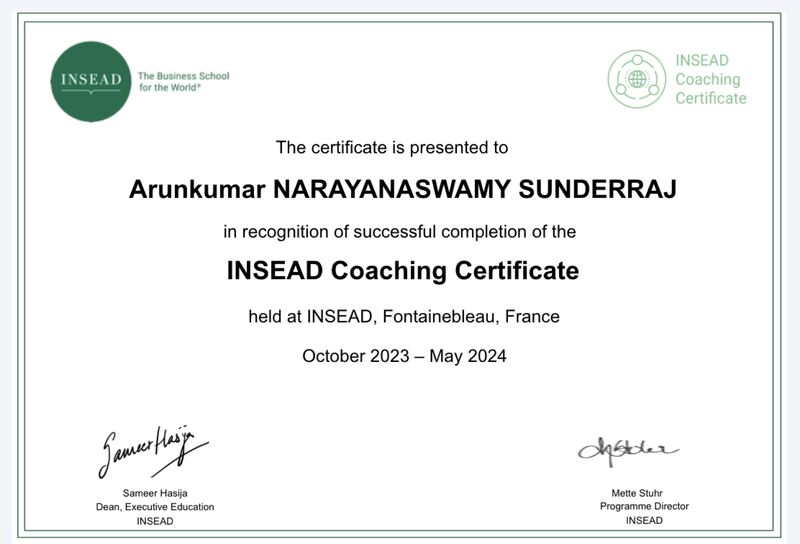
By October 2023, Sunderraj had another question. He described experience across more than 25 transformations and five continents, yet remained interested in how senior leaders actually change their assumptions and behavior. He enrolled in INSEAD’s executive coaching program with support from McKinsey sponsors. His certificate records the program’s dates as October 2023 to May 2024.

His reflections afterward contained an admission familiar to anyone paid to be helpful: his instinct as a consultant was to provide advice. Coaching taught him to delay that instinct. Deliberate questions, a pause and candid reflection could help a client recognize the problem more clearly. The adviser’s quickest answer might interrupt the discovery that made the answer useful.
He also described learning to attend to two activities at once: the task a group is completing and the relationships through which it completes it. Processes and deliverables attracted plenty of attention; collaboration often received less. He asked leaders to examine how much meeting time they spent giving advice versus asking questions. For someone moving toward ownership, that is a useful habit to carry through the door.
“Revelation > Salvation”Arunkumar Sunderraj’s shorthand for helping clients see a problem before offering advice
Capital has to learn, too
The same practical emphasis appears in a 2022 article he coauthored with Santiago Comella-Dorda and Marami Kar on agile funding. The argument addressed a familiar organizational mismatch: teams are asked to adapt while funding decisions remain locked around detailed projects. Resources can stay attached to yesterday’s plan even as the work reveals tomorrow’s priorities.
The article proposed funding persistent portfolios, allocating resources toward outcomes and reviewing performance while work was underway. It treated financial decisions as part of the operating model. A team’s freedom to respond means little if its budget cannot respond with it. Anyone who has tried to change direction inside a fixed annual plan will recognize the predicament.
Read beside his writing on talent, this adds a second piece to the picture. Skilled people need a workable route toward important problems. Money needs one as well. Moving either requires more than an encouraging statement about agility. It requires the company to decide what it will stop, what it will support and who can make that call.
The invoice gets a vote
In July 2026, Sunderraj brought that allocation question to AI in an essay on token economics. His focus was the business cost of using models, especially when document-heavy workflows repeatedly process the same material. A promising tool could be widely deployed while its consumption costs remained poorly understood by the people responsible for margins.
He argued for measuring cost per business outcome, assigning an executive owner to material workflows and connecting engineering with finance. The distinction is practical: more usage does not, by itself, tell a company what it has bought. The invoice records activity. Management still has to establish whether the activity is worth funding.
He made a related point in his discussion of scaling AI pilots. Governance, changed working practices and business ownership needed attention before expansion. A technically sound model could wait for months if nobody had settled the decision rights. In this account, the difficult part of AI includes the familiar office question of who is allowed to say yes.

Buying into the complicated middle
His acquisition interests put these ideas into a defined corner of insurance. He is looking at specialty and excess-and-surplus wholesale brokers, third-party claims administrators in complex commercial lines, and business-to-business technology and data platforms connecting managing general agents, insurers and brokers. These are businesses that sit within the industry’s working relationships.
The attraction, as Brydon described it, is the combination of domain knowledge with better data and decision-making. Sunderraj wants to improve fragmented workflows, support carrier relationships and build profitable growth. It is a plan with several moving parts: the quality of the business being acquired, the expertise of its team and the changes an incoming operator can make together with them.
His public discussion of value creation makes the test fairly concrete. A plan should alter decisions and everyday execution. His published work adds questions about developing expertise and directing resources. Those ideas now converge on an acquisition search, where he must choose the business in which to put them to work.
A croissant with windstorm exposure
There is room for a joke in this otherwise operational vocabulary. Announcing his planned session at Insurity’s October 2026 Excellence in AI & Insurance event in Fort Lauderdale, Sunderraj mentioned the brunch yacht cruise. He imagined himself calculating hull values and windstorm exposure between croissants. Some people see a boat. An insurance specialist apparently sees a placement opportunity with catering.
Outside work, Brydon describes him as a triathlete with ambitions connected to Kona. That offers another glimpse of a person prepared to pursue a demanding goal over time. The ambition is his; any comparison between endurance sport and business remains a metaphor, rather than an explanation of his career.
The professional chapter is still unfolding. What gives it interest is the accumulation behind it: building software, advising insurers, studying how people learn and change, then seeking a company to operate. Sunderraj has spent years asking how plans become behavior. His move to Brydon gives that question a longer appointment in the diary. Monday morning will keep coming.