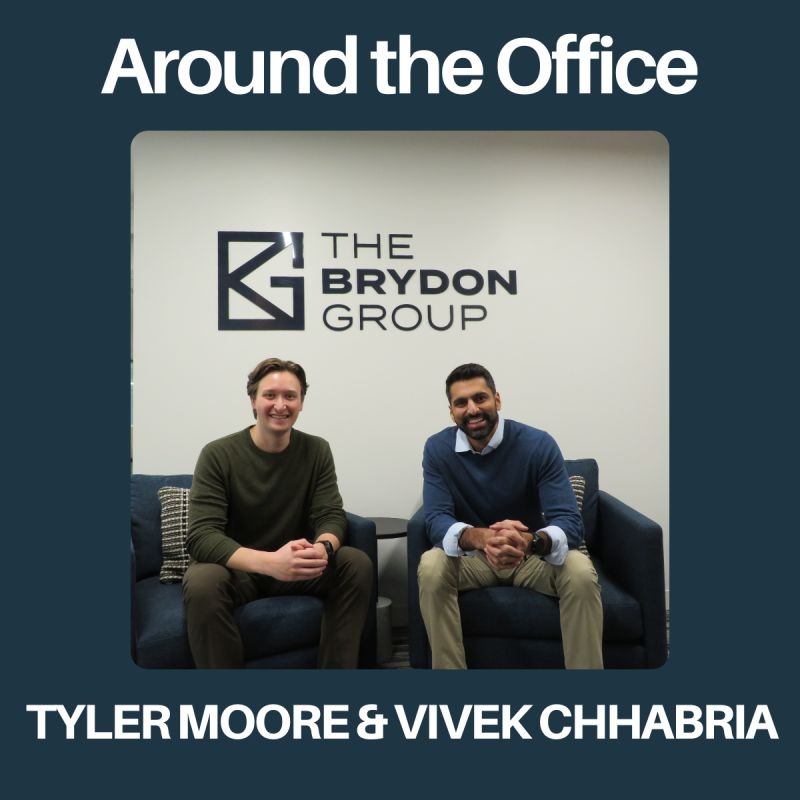
Before Vivek Chhabria and Tyler Moore began looking for businesses to buy, they had already shared cross-country races, awkward prom photographs and the logistics of moving into college dorms. That is an unusually long introduction to an investment partnership. Most prospective partners can exchange résumés. These two can remember what happened before there was anything impressive to put on one.
Chhabria is now a Chicago-based CEO-in-Residence at The Brydon Group. He and Moore are pursuing acquisitions in business-to-business services enabled by technology. The professional description is tidy. The decision behind it was less automatic. They had to weigh the appeal of working together against the possibility of putting an old friendship under new pressure.
That hesitation makes their story more interesting. Buying a business involves forecasts, negotiations and assumptions about what can improve. Choosing a partner involves another set of assumptions: how someone listens, how they behave under strain, whether a difficult conversation will remain a conversation. A friendship provides evidence collected over years, often without either person realizing there would eventually be an investment decision attached.
A partnership older than the pitch
When asked about teaming up, the pair gave an answer with a useful absence of swagger: “Honestly, we weren't immediately sure it was the right choice.” They ultimately chose the opportunity to build with someone they trusted and respected. The shared past helped make the future imaginable, even though it could hardly make it predictable.
Moore’s announcement of their partnership identified B2B tech-enabled services as the broader search area, with an initial interest in measurable risk and compliance. They wanted to meet owners considering succession or a growth partnership. Those words place the search in an existing business’s life: customers are already buying, employees are already working, and an owner is deciding what should happen next.
The distinction matters to the story. A buyer enters relationships that began without them. An acquisition partner must be able to examine a business together while recognizing that the seller has lived inside it. The two friends have chosen a path where knowing each other is useful, but learning about other people’s companies remains the central assignment.
Learning where the work gets stuck
Chhabria’s preparation includes electrical engineering at Ohio State and an MBA in Finance and Economics at Northwestern’s Kellogg School of Management. His career at McKinsey began as a Business Analyst in September 2016. His published coaching résumé traces the steps through Senior Business Analyst, Associate and Engagement Manager to Associate Partner in July 2024.
Brydon describes his McKinsey work as growth strategy, operational transformations and AI-enabled deployments for financial-services and industrial clients. This is experience with the workings of a business: the systems that connect a decision at the top to a task completed elsewhere. A strategy becomes consequential when someone has to carry it out.
Business Analyst
Operations article
ACC credential
CEO-in-Residence
In June 2022, he coauthored an article on bringing digital tools into operations management. Its argument linked technological change to management practices and the way employees do their jobs. The examples included automation in financial services and process improvements in a nonprofit. The proposed sequence began with understanding the problem and assessing existing systems before assembling a team and testing an initial approach.
That sequence is modest enough to sound obvious, which may be why it is worth remembering. A demonstration can show what software does. It takes a different kind of investigation to understand where software belongs. For an acquisition entrepreneur with an operations background, the question is especially relevant: what would change inside this particular business, and who would have to make the change work?
Buying into someone else’s history
Brydon’s stated acquisition criteria give the search a financial frame. Initial platform businesses typically target annual revenue of $5 million to $25 million and EBITDA of $1 million to $5 million. The firm also looks for recurring revenue, limited capital expenditure and low customer concentration. These are firm-level targets, rather than a description of a company Chhabria has acquired.
Target characteristics, not guaranteed outcomes or Chhabria’s personal results.
The institutional support is also explicit. Brydon works with CEOs through sourcing, transaction execution and operating a business. Its approach pairs committed capital with a deal team, advisers and operating resources. That structure helps explain the setting for Chhabria’s move: he is pursuing entrepreneurship within a firm that organizes support around the search and the eventual work of running a company.
The partners’ own explanation for choosing Brydon began with seller treatment. They wanted a firm that would handle business owners as they would want their families’ businesses handled. They also cited the partners’ experience building companies and the people around them. A family comparison brings a transaction down to a scale that financial terminology can obscure. Someone built this thing. Someone will be trusting a buyer with its next chapter.
The coach beside the consultant
Chhabria also holds the International Coaching Federation’s Associate Certified Coach credential, issued in March 2024. His Leland profile offers coaching to people navigating decisions and pursuing personal or professional milestones. It describes years of demanding consulting work and an approach that combines professional experience with empathy.
The coaching credential belongs in the story because acquisition work is full of decisions made by people, often at moments of change. It would be too easy to turn a qualification into a claim about every conversation he has. What it establishes is a separate, deliberate strand of his professional life: alongside advising organizations, he has trained to support individuals.
There is an earlier entrepreneurial effort, too. In August 2014, Chhabria listed a project called When I Grow Up, intended to help high-school students secure internships with Fortune 500 companies. He reported third place in the Ohio State business-plan competition and second place in the BOSS idea-pitch competition. The idea involved approaching recruitment leaders, making a proposal and trying to connect students with opportunities.
Seen beside his current work, the project adds an early example of building something around access and relationships. It does not explain the whole career. Few student ventures could bear that weight. It does show that the interest in entrepreneurship predates the current acquisition search by years.
A conference floor, with dancing robots
In 2025, Chhabria and Moore spent two days at the Energy Drone & Robotics Summit in Houston. They met service providers, software vendors and hardware developers working on infrastructure inspection and energy operations. The visit also supplied an unexpected bit of choreography: robots formed a conga line to the song Who Let the Dogs Out. Even an investor’s conference notes deserve an occasional dance break.
His takeaways concentrated on how the work would get done. He discussed collaboration between pilots and compliance specialists, the training needed for commercial assignments and tools for sharing mission information. He also described autonomous drone systems and developments in sensors and attachments. The interest was in the practical arrangements around a technology as well as the technology itself.
It is an instructive scene for this stage of his career. A search gives someone reasons to visit unfamiliar corners of industry and listen closely. The notes reveal an operations consultant’s questions in a different setting: where are the coordination problems, what skills are missing, and what helps separate a promising demonstration from a dependable service?
From the help desk to the decision table
A later conversation brought Chhabria and Moore into the managed-services world. ScalePad’s MSP Confidential lists them as guests on its May 9, 2026 episode, Fixers to Advisors, hosted by Luis Giraldo. The discussion’s stated subjects include practical AI use cases, pricing and preparing a business for a transaction.
Giraldo framed the problem around IT providers that want to be trusted advisers but remain the people customers call when something breaks. The episode also addressed advisory work in smaller firms and the choice between self-funded acquisition searches and a private-equity-backed route. Chhabria’s consulting background supplied experience in client relationships; Moore brought a perspective on AI use cases.
The appearance joins the threads already visible in his career. Consulting, technology and acquisition entrepreneurship meet around a business owner’s concrete decisions. The title itself suggests a change in the relationship with a customer: being invited into decisions earlier, when there is still time to influence them. For Chhabria, it is another setting in which operating knowledge can become a conversation about ownership and growth.
“Black coffee.”Vivek Chhabria, on his coffee order
Keeping a different kind of appointment
The everyday details make the professional transition easier to picture. Chhabria likes black coffee, including the diner variety his wife teases him about. He listens to business and endurance podcasts on long runs. In Brydon’s interview, he described the flexibility of sourcing work and being home for his daughter’s bedtime almost every night over the preceding year.
Those details give a calendar its other commitments. An acquisition search has calls to arrange and companies to understand. A family evening has its own repeat appointments. Chhabria’s account includes repeated readings of a children’s book and the ordinary disorder of a small child’s dinner. Neither belongs in a financial model. Both belong in a life.
His next chapter brings several histories together: engineering study, consulting work, coaching and a friendship old enough to include college move-ins. The company search will require fresh judgments. The partnership has a longer record behind it. Chhabria and Moore are entering other people’s business stories with one of their own already in progress.