In July 2023, Mariano Amador shared a designer’s work on a line of coffee for Búlali Artesanal. The designer, Kenneth Calderón, had illustrated and packaged the product. Amador’s response was a public expression of pride in the team and in Calderón’s contribution to growing Nacascolo Holdings’ businesses. It was a modest occasion for an executive’s attention: a coffee line, some illustrations, a finished piece of work.
Coffee packaging offers a useful entrance to his working life. A business can possess a promising product and still need help explaining itself. Someone has to decide how it looks, how it reaches a customer and how the organization behind it keeps moving. Amador’s public comments return to those questions across several very different products. The coffee bag belongs in the same story as a cleaning brand’s new identity and a beverage company’s expansion abroad.
There is something pleasantly concrete about beginning here. Investment language can float several feet above the ground. A bag of coffee must eventually sit on a shelf. The illustration has to survive contact with an actual shopper, who has probably come to buy groceries rather than admire the strategy.
The founder stays in the picture
Amador is based in San José, Costa Rica. He describes more than 20 years of experience building and operating businesses, including food and beverage. His education record includes Kellogg Executive Education in 2020. Today, Nacascolo’s leadership page lists him as Director Bienestar. Earlier coverage identified him as chief commercial officer and commercial director; a March 2026 interview called him CEO Wellness. The work documented across those titles concerns the commercial development of the group’s consumer brands.
One recommendation on his professional profile describes a strategic, creative approach to marketing goals. That is a colleague’s assessment, and it fits the kinds of assignments on which he has spoken publicly: positioning a product, expanding its audience and giving a growing brand a route into a larger market. His professional story is particularly visible at the point where a company’s identity has to become a workable commercial plan.
Nacascolo’s approach gives that work a particular setting. In 2021, the group described partnerships in which founders remained involved after their businesses joined the portfolio. Its executives supplied structure, planning and strategy, while founders continued to bring their knowledge of the companies they had created. Sustainability and innovation were among the criteria for a partnership.
Amador was part of the executive team alongside Frank Woodbridge and Rodrigo Volio. The arrangement matters to a story about growing brands: there are already people, products and decisions in place. The task begins with an existing business, with its own habits and loyalties. Growth must be negotiated in that company’s language as well as in the language of an investor.
Growth acquires an address
On June 16, 2022, Nacascolo opened a production center in Guachipelín, Escazú. The acquisition and adaptation required an initial investment of $3 million. Eight companies brought production, storage or administrative activities into the complex. Natural Bites, Nutri Greek, Aromas and Massa would make products there; other businesses used the location for storage and distribution.
Amador, then identified as commercial director, described Natural Bites, Nutri Greek and Aromas as strategically important businesses that allowed the group to grow through innovation. The new premises gave a physical setting to that ambition. The company paid for the center and its operating costs, with participating brands paying rent under the shared arrangement. For Nutri Greek, the move created the capacity to triple production.
The operating model also left room for geography. Companies with factories outside the metropolitan area could keep making products at their original sites and use the center for distribution. Individual business leaders worked through operating committees and annual plans. Expansion therefore involved a mixture of shared facilities and local independence. Putting businesses under one roof did not require every business to do everything in the same way.
That detail is easy to lose in a story about investment. A facility is an address, but it is also a collection of decisions about who makes what, where goods wait and how they reach the next stop. The appeal of the 2022 project lies in its specificity. A commercial ambition had acquired rooms, equipment, storage space and people responsible for using them.
A new label for an old chore
In April 2023, Amador spoke about another kind of change: Florex’s refreshed identity. The cleaning-products company had joined Nacascolo’s portfolio in October 2021. Its relaunch introduced a revised logo and the concept “Juntos cuidando lo nuestro,” linking an everyday household task with environmental care. Amador said the new image was intended to make the brand more competitive and bring it to a wider audience.
The company’s market research had identified interest in environmental questions among consumers aged 25 to 35. Its operating practices included recycled resin in packaging, solar energy at its plant and treatment of wastewater. At the time, Florex offered more than 80 products in 200 presentations and sold in Costa Rica, Panama and Guatemala.
This episode gives a different scale to Amador’s commercial work. A logo revision can look like a small matter from outside a business. Here it sat beside a question about the audience: how to make existing practices legible to more customers. The product’s environmental attributes were already part of the proposition. The renewed identity aimed to help people recognize them while choosing something for an entirely ordinary chore.
The people behind the next step
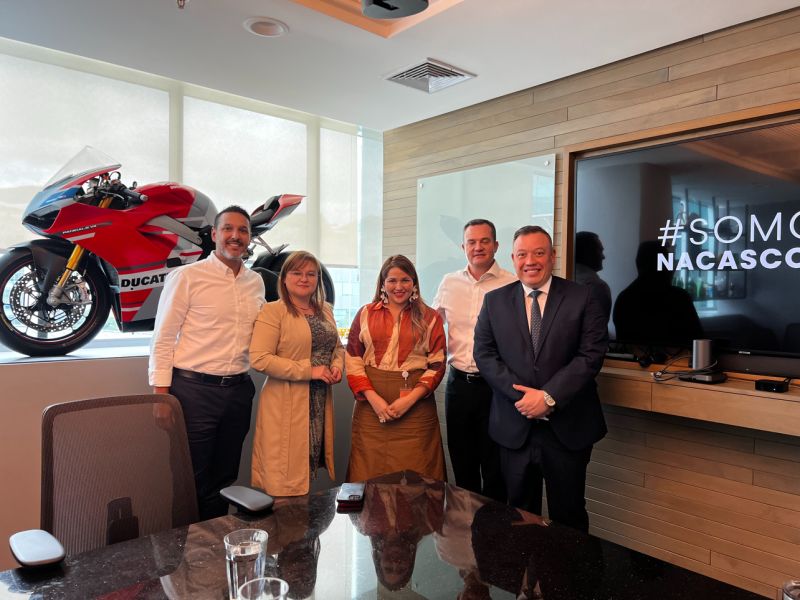
In July 2023, Woodbridge shared a photograph following a meeting with Costa Rica’s Ministry of Economy, Industry and Commerce. He thanked the Nacascolo team and partners for their work developing small and medium-sized enterprises and creating employment opportunities. Amador was named in the post and appears in the photograph. The meeting offers a glimpse of the institutional relationships surrounding the portfolio’s development.
The photograph has an agreeable interruption: a red Ducati beside the group. Nacascolo’s interests extend beyond consumer goods, and the motorcycle supplies a rather emphatic reminder. Even a meeting room can have a supporting cast. The scene brings the people and the breadth of the business into the same frame, without requiring a corporate diagram to make the point.
A further set of relationships became public in 2024. Mike Schall announced that he had joined Nacascolo USA as senior managing director. He described work with Mike McKeon and Francis Woodbridge to identify investment opportunities and bring the group’s brands into the US. His announcement acknowledged Amador among the Costa Rican colleagues who had placed their confidence in the effort.
Later that year, McKeon described a visit to the Costa Rican office with Schall. Amador replied enthusiastically about the chance for them to see the potential of the products, companies and country firsthand. Read together, the announcement and the visit show the human connections around the US effort: an appointment, a trip, a conversation across markets. International expansion has people attached to it well before it has a shelf attached to it.
A bottle makes the journey
Kombucha Culture joined Nacascolo’s portfolio in 2021. By October 2023, the company was reporting 85 percent year-on-year growth for the brand. Amador described a growth plan aimed at strengthening its position in Costa Rica. The figure belongs to the brand and that reporting period; it gives a dated view of the business as it developed within the group.
This is the same commercial problem seen through a different object. The coffee bag asks a customer to notice a design. A bottle asks a customer to choose a flavor, recognize a name and return to it. A growth plan has to hold those choices together with the company’s ability to supply the product. The reported progress in 2023 supplies one marker on that longer route.
By March 2026, Kombucha Culture had begun entering the US market, initially in California, while producing in Pérez Zeledón. Amador described an approach centered on specialized retail, with changes to packaging and communication for the new market. He also discussed the practical importance of distribution and how quickly products sell through stores.
His comments included a concise qualification about the brand’s Costa Rican identity: “el origen por sí solo no es suficiente.” Origin alone is insufficient. That is a useful limit to place on a good story about a product. A place can help explain a brand, but a customer still has to choose what is in front of them. The company was also considering US co-manufacturing as a possible way to scale in the medium term.
“el origen por sí solo no es suficiente.”
Mariano Amador, March 2026
Keeping the team in the sentence
Amador’s own response to the 2026 milestone emphasized the team. He presented the US entry as a step for a brand developed in Costa Rica and expressed a shared conviction that Latin American consumer brands could compete in larger markets. He was proud of what was being built. The language echoes his earlier response to the coffee packaging: different scale, similar attention to collective work.
Taken as a working portrait, these episodes form a coherent sequence. He has spoken about brand identity, the purpose of shared operations, domestic growth and the demands of selling abroad. Each episode puts a product beside the people and arrangements that help it travel further. The practical details give the story its texture: a designer receiving credit, a factory finding space, a cleaning brand meeting a new audience, colleagues visiting from another country.
The coffee bag remains a good place to leave him. It is small enough to hold and complicated enough to contain a business. Behind it sit design decisions, production decisions and relationships that a shopper will never need to inspect. Amador’s public working life makes some of those decisions visible. The distance between a good product and a bigger business is measured in quite a few such steps.