Consider the peculiar afterlife of a business deal. While it is alive, the transaction commands attention: lawyers negotiate, documents circulate, definitions acquire consequences. Then it closes. The files survive. The knowledge becomes harder to reach. A firm can possess the answer to tomorrow’s question and still spend tomorrow looking for it.
- Centari turns private deal documents into searchable, structured data.
- Its customers include transactional law firms and investment funds.
- The useful trick: preserve the terms, their context and the evidence behind them.
The archive has a memory problem
Centari has chosen this gap as its business. Founded in 2023 by attorney Kevin Walker and machine learning engineer Bryan Gilbert Davis, the company combines transactional expertise with software that makes deal history easier to interrogate. Walker previously practiced M&A law at Paul Hastings. The current leadership team includes CTO Junyuan Lau. The founding combination tells you something about the problem: knowing what a contract says and building a system that can extract it are different professions.
At Australian firm Gilbert + Tobin, an earlier deal-data initiative encountered a familiar obstacle. Busy lawyers struggled to record knowledge consistently. General AI and older contract tools also fell short on complex extraction. The firm chose a customized Centari-powered system, G+T Dealex. For 200 deal data points, knowledge leader Gareth Cantin reports that extraction moved from a full day to about an hour. That is a customer’s experience, rather than a universal speed guarantee. The firm’s account gives the number its context.
The lesson travels beyond law. A knowledge system that relies on people having spare time will compete poorly with work that has a deadline. Put capture inside the normal workflow, and the economics change. The next person can begin with a checked record instead of another request to the colleague who remembers.
A contract is a system of dependencies
A transactional document is an awkward customer for a machine. The sentence that matters may depend on a defined term elsewhere. Another provision can qualify it. An amendment can change it. Searching for a few words retrieves language; understanding the transaction requires following the connections.
Centari’s Deal Reasoning Engine uses multiple stages to trace definitions, conditional logic and related provisions. Data taxonomies are calibrated to the customer’s practice. The output is a private database whose points link back to source material. Lawyers can inspect and verify what the software extracts. The citation is doing practical work: it gives the reviewer somewhere to look when an answer appears suspiciously tidy.
“Generic AI products fall short when billions of dollars are on the line and precision is non-negotiable.”
Kevin Walker / September 2025 funding announcement
That is Walker’s positioning, not an independent accuracy verdict. Its commercial logic is nonetheless clear. Centari sells into work where a plausible summary can be less valuable than a defensible answer. A buyer can evaluate a specific extraction against a source document. An elegant paragraph alone offers a less demanding test.
The business lives after closing
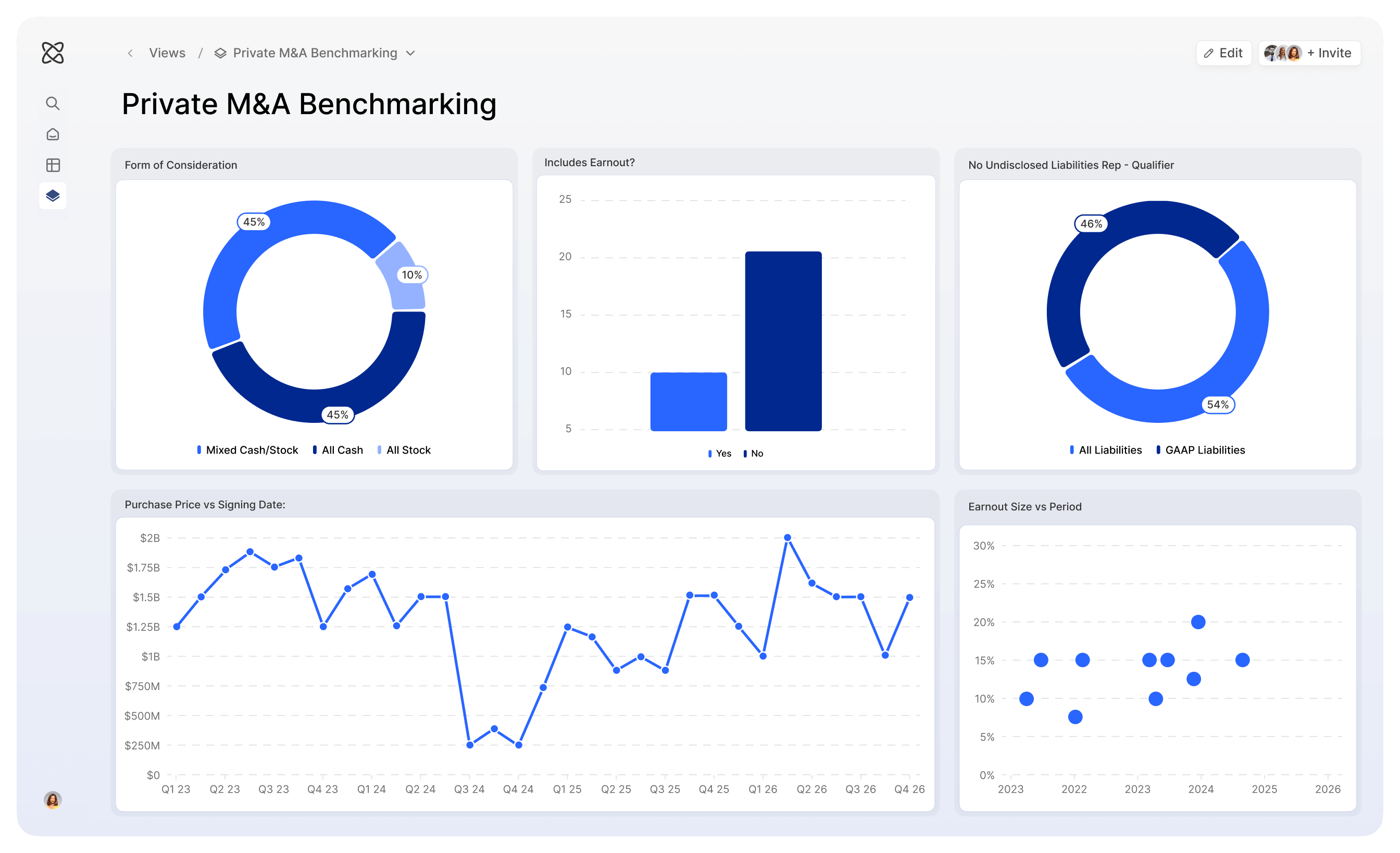
The product grows more interesting after the first extraction. Centari Intelligence lets users question their deal history. Views makes that data visible through charts and tables. Its August 2026 Precedent Intelligence release adds clause search, citation editing and comparison across documents. A lawyer can describe what a provision needs to accomplish, then inspect comparable language in context. The release announcement leaves the final choice with the lawyer.
Ropes & Gray announced adoption across its transactional practices in October 2025, including benefits for private funds. Fried Frank announced a strategic partnership the previous month. Centari also serves investment funds, where negotiation terms and portfolio obligations matter across legal, investor relations, finance and compliance. A past agreement can answer an operational question long after the signing celebration.
These are enterprise buyers. Centari’s sales process begins with a demo, and its proposition includes a database built to the organization’s specification. Its Microsoft Word add-in offers assisted drafting and comparison alongside precedent search, with a separate purchase required for full functionality. For a prospective customer, the sensible calculation includes the time spent checking data, configuring the system and maintaining it. Extraction speed alone cannot settle the purchase decision.
The capital behind that effort is more precise than some headlines suggest. In September 2025, Centari announced $14 million in cumulative funding, including an $8.4 million Series A led by Sentinel Global. It earmarked funding for research, development and hiring. Its published values favor ownership, difficult problems and results over process. The team mixes attorneys, financial professionals and engineers: a product organization built around the vocabulary of its customers.

A useful answer needs a boundary
In September 2026, Centari described ethical walls that follow matter permissions into search, conversational answers and visualizations. That matters because a chart derived from confidential documents can reveal information even when the documents themselves stay hidden. Its security page reports data isolation, no customer-data model training, regional hosting options, SOC 2 Type II and ISO 27001 credentials.
The approach has conditions. A database with few comparable transactions offers limited evidence. Inconsistent definitions make comparisons slippery. Old deals record what happened under old conditions; they do not automatically establish today’s market. Correct permissions and professional verification remain essential. Broader platforms such as Harvey and Legora address overlapping legal workflows. Draftwise also works with proprietary precedent and deal history. Centari’s emphasis is practice-calibrated extraction into a structured, citation-backed database. That is a buying proposition to test against the firm’s documents, rather than proof of an exclusive capability.
What can another organization copy? Choose the questions worth answering, agree on the data points, preserve the evidence and assign review. Make the record useful enough that people return to it. Centari’s wager is that experience becomes more valuable when the next team can actually find it. There is something pleasingly unsentimental about that ambition: yesterday’s deal still has work to do.