In 2006, Rick Nucci walked out of a JavaOne session and back to his hotel room with the sort of problem that makes a founder briefly forget the room has a bed. The speaker had been discussing databases small enough to run on memory sticks. Nucci started drawing. If business software was moving onto the internet, he reasoned, the old machinery for connecting applications would have to move too. An integration product designed for servers in the basement could not merely be hauled upstairs and relabeled cloud.
The sketch became a wager inside Boomi, the company Nucci had helped start six years earlier. There were already scores of integration vendors. Microsoft had arrived with BizTalk. Boomi was small, based near Philadelphia, and not burdened by the comforting illusion that the market owed it room. Nucci, engineering leader Mitchell Stewart, and colleague Dennis McCarty began working through a different architecture: design an integration online, deploy it with a click, and let the runtime maintain itself. The company committed to the new direction. Nucci later described the decision in appropriately nautical terms: they were burning the ships.
Dell acquired Boomi in 2010. Nucci stayed for roughly three more years, eventually running the business as general manager. Then he left to build another company with Stewart. The second venture, Guru, looked different from the first. Its family resemblance was unmistakable. Boomi moved data between systems. Guru would try to move knowledge from wherever a company had abandoned it to the exact moment an employee needed it.
The trouble with knowing things
Guru came from a frustration Nucci and Stewart had already lived. As Boomi grew, the company knew plenty, but useful answers were scattered among documents, conversations, and the memories of busy colleagues. A sales rep trying to answer a customer could search, interrupt somebody, or gamble on a file that might no longer be correct. Growth had created knowledge and made that knowledge harder to reach.
The founders did not rush the cure. Early customer development began with conversations and mockups. They showed prospects lists of problems and asked which ones hurt enough to solve. Pantheon became the first customer through Scott Crawford, a former Boomi colleague who understood the disorder firsthand. Nucci recalled joking about a disorganized Google Drive as a dumpster fire. Boomi itself became roughly customer number five, an old company purchasing relief for a pain that had helped inspire the new one.
There is a bracing footnote here. Nucci had already founded a company, made the cloud bet, sold to Dell, and managed inside a global corporation. None of that made finding product-market fit at Guru feel easy. He has said the search was equally hard both times. Experience supplied pattern recognition and old phone numbers. It did not supply customers by divine right.
“Customers are great at telling you their problems. I don't think they're always the best at telling you the solutions.”Rick Nucci
Guru first leaned into sales teams, where slow answers could be measured in missed revenue and painful onboarding. Its larger ambition was to make company knowledge meet people inside their work. By 2024, Nucci said the company had more than 2,500 paying customers, including Sonos, Etsy, and Spotify, and had raised more than $70 million. The numbers matter. The more revealing constant is the product instinct: do not make the employee undertake an archaeological expedition every time a customer asks a sensible question.
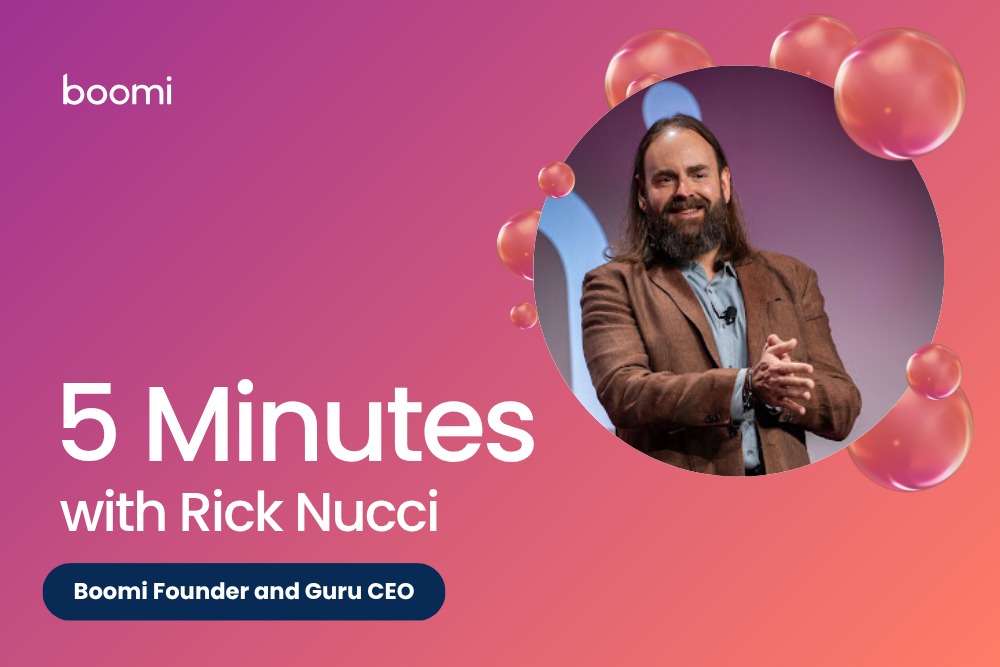
A Philadelphia address, by choice
Nucci grew up in rural Pennsylvania, where both parents owned businesses. Entrepreneurship looked less like a special calling than something adults occasionally did. His own first business was DJing weddings in high school for what felt like astonishing money. He studied logistics, materials, and supply chain management at Penn State, then found technology compelling enough to redirect his attention. Two years after college, at 24, he helped launch Boomi.
Both Boomi and Guru were built in the Philadelphia area. Nucci has never presented that as homespun decoration. It was an operating decision. He argued that the region had the engineers, salespeople, designers, and data scientists needed to make serious software, while admitting that Philadelphia was often poor at advertising itself. His solution was participation. He served as president and later chairman of Philly Startup Leaders, pushing for a city where investors, customers, and recruits could see a credible place to build.
Remaining outside Silicon Valley carried an obligation: the company could not use distance as cover. An investor once remembered seeing Nucci so often around the software circuit that he assumed the founder lived in San Francisco. Nucci also kept himself in front of customers. He had watched Michael Dell devote a striking share of his schedule to them and took the lesson seriously. Seniority, in this view, is no permission slip for abstraction.
Connect the applications
Boomi begins by tackling brittle, custom-built integration work.
Rebuild for the cloud
A technical insight becomes a company-wide bet on cloud-native integration.
Connect people to knowledge
Guru starts, validates the pain slowly, and launches around answers delivered in the flow of work.
Give agents trusted context
Guru and Boomi reunite around governed knowledge and live enterprise data.
The weight of the founder's voice
Nucci's public lessons are unusually interested in the ways a founder can become a problem. At Boomi, he learned that his words landed with more force than he intended. Direct feedback could sound harsher simply because it came from the founder. His response was not to retire into vagueness. He leaned into the framework of radical candor, trying to balance personal care with direct challenge.
He also learned not to let a startup swallow its maker's identity. Company results move up and down; a person stapled to that chart will follow every motion. Coaching, self-awareness, and the search for blind spots became, in his account, high-return investments. One of his own essays calls him a “Recovering Sensitive Founder,” a phrase with more use in it than the usual laminated leadership adjective.
When he left Dell in 2013, Nucci worked through a transition of about six months. He wanted his departure from Boomi to be a non-event. A successor had already been brought into the company and knew the product. The handoff was designed so that customers and employees would not have to orbit a founder's feelings. Boomi continued growing without him, which may be the least cinematic and most persuasive kind of legacy.
“If you don't give your team a narrative, they'll write their own.”Rick Nucci, on transparency at company town halls
At Guru, that idea became ritual. The company began town halls when it had roughly 14 or 15 employees sitting around a couch. The format grew, but three purposes remained: alignment, culture, and transparency. Good news and bad news both required context. Silence also produces a story; management simply loses the privilege of editing it.
An optimist asks for receipts
The arrival of generative AI has brought Nucci's two-company argument into a single frame. Models can reason across broad information, but they do not naturally know a firm's changing prices, permissions, products, or decisions. They can still answer as if they do. For an employee unfamiliar with the subject, a fluent mistake may be indistinguishable from the truth. At enterprise scale, one error acquires excellent distribution.
Intelligence is only as useful as the knowledge it can safely reach.
and company systems
knowledge
AI agents
Nucci's answer is a verified knowledge layer serving two constituencies: humans doing their jobs and agents acting on their behalf. In May 2026, that premise led him back onto a Boomi stage. Guru became a launch partner for Boomi Connect and tied its knowledge agents into Boomi's emerging connector and MCP ecosystem. Boomi supplied access to live enterprise data. Guru supplied governed organizational knowledge. The first company and the second had found a reason to speak again.
The reunion carried sentiment without surrendering to it. Nucci compared the return to coming home and then promptly declined excessive credit for what Boomi had become after he left. The useful founder's paradox is that the title lasts forever while control should not.
On jobs, Nucci rejects the easy apocalypse. He argues that AI amplifies the person using it, including that person's strengths and weaknesses. At Guru, he calls AI fluency a “mandatory gift”: people are expected to learn the tools, while the company says it will not turn their efficiency into an immediate argument for eliminating them. The bargain removes one quiet incentive to sabotage automation. Nobody learns generously while wondering whether the lesson is an audition for unemployment.
Learn the technology. Use it seriously. Keep human experts in the system. Take responsibility for what your agents produce. He compresses the last point into four words: “We are all managers now.”
This is optimism with chores attached. Models still need context. Access still needs security. Knowledge still goes stale. Someone must notice. The task is less photogenic than summoning an all-knowing machine, but Nucci has made a career from unglamorous connective tissue. Integration was once the thing that held up every software deployment. Internal search became the work required before the real work. AI now threatens to automate confusion at thrilling speed.
Across a quarter-century, Nucci's response has remained consistent: find the broken connection, listen closely to the people tripping over it, and rebuild the route. The tools have moved from servers to clouds to agents. The stubborn question has barely changed. Somewhere in the business, the right answer already exists. The interesting work is getting it to arrive on time.