The answer exists. This is both the comfort and the calamity of the modern company. It is somewhere inside the policy library, the sales deck, the support notes, the shared drive, or the PDF whose filename ends in “FINAL-v7.” A customer is waiting. An employee is searching. Now an artificial intelligence system is searching too, with no instinct for office folklore and no discreet colleague to ask which document is actually current. Colin Kennedy has built his career inside that gap: the small, costly distance between possessing information and being able to trust it.
Kennedy is the co-founder and chief operating officer of Shelf, the enterprise software company he built with Sedarius Tekara Perrotta and Tobias Jaeckel. Shelf diagnoses, organizes, governs, and retrieves the unruly material companies call knowledge. This was once considered a worthy but mildly beige branch of information technology. Generative AI has supplied the dramatic lighting. A machine that can produce an answer instantly can also repeat a stale policy with immaculate grammar. The neglected filing cabinet has become part of the AI stack.
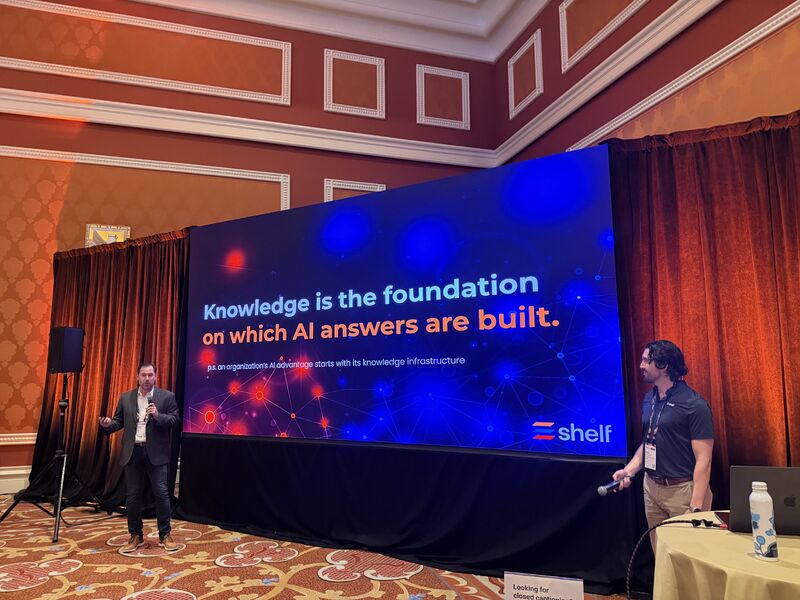
At Genesys Xperience in September 2026, Kennedy stood beside a screen bearing the line, “Knowledge is the foundation on which AI answers are built.” There is no mysticism in it. His current pitch is that most organizations have prepared content for human readers, who supply missing definitions and context without being asked. AI does not bring that quiet institutional memory. It needs relationships, permissions, meanings, and allowed actions made explicit. The difference between a beguiling demonstration and a dependable production system may be a carefully tended pile of documents.
The filing cabinet was always the plot
Kennedy arrived at this moment by an unfashionably straight road. He studied finance and philosophy at Boston College from 1998 to 2002, two subjects that make an intriguing pair for a future software operator. Finance asks what something is worth. Philosophy asks what it means and whether you can know it. Enterprise knowledge management, on a difficult Tuesday, asks both.
He also played on the Boston College men’s tennis team. The surviving record is agreeably specific: at the 2000 Northeast Intercollegiate Tournament, he finished 2-2 in singles and 1-1 in doubles. It would be too neat to turn four college matches into a management doctrine. Still, tennis does share one habit with operations: whatever happened on the previous point, another serve is coming.
By 2006, Kennedy had co-founded Neuron Global. The firm made customizable web software for networks and dispersed organizations, the sort of places where expertise exists in abundance and arrives at the wrong desk. In 2009, a launch announcement identified him as vice president of business development for a new portal serving 1nService, an international community of technology integrators. The product helped member companies search for expertise, share practices, and find collaborative opportunities. Different decade, same nuisance: the answer was present but insufficiently findable.
Neuron was not merely a prelude. It was where Kennedy and Perrotta spent years seeing what happened when organizations accumulated more material than any one person could understand. Kennedy’s public biography describes him as a two-time software entrepreneur; Perrotta worked on the knowledge side; Jaeckel brought engineering leadership. Shelf was the product-shaped conclusion to their consulting years.
- Finance, philosophy, and varsity tennis at Boston College.
- Co-founds Neuron Global to build knowledge-sharing software.
- Helps launch a search portal for the international 1nService network.
- Co-founds Shelf; the enterprise knowledge platform launches publicly.
- Shelf raises a $52.5 million Series B led by Tiger Global and Insight Partners.
- Kennedy carries the knowledge argument into the generative AI era through keynotes, webinars, essays, and customer work.
A large round for a small delay
Shelf first concentrated on contact centers, where the cost of uncertainty has a clock attached. A support agent cannot spend the afternoon contemplating which returns policy has moral authority. The company said its platform could reduce the average search for an answer from more than four minutes to less than 20 seconds, while lowering handling time and escalations. Those are company claims rather than commandments carved in stone, but they explain the market with admirable economy. At thousands of interactions a day, a few recovered minutes cease to be a convenience and become a budget.
Shelf’s published time-to-answer comparison
A directional rendering of figures published by Shelf in its 2021 Series B announcement.
The company’s 2021 financing made the scale of the wager plain. Tiger Global and Insight Partners led a $52.5 million Series B, joined by existing investors and software founders including Datto’s Austin McChord and Procore’s Tooey Courtemanche. Shelf reported fourfold growth over the preceding year, tenfold user growth, and three years without customer churn. It named customers including John Deere, DSW, HelloFresh, Equitable, and Glovo. The office filing cabinet had acquired global investors.
Kennedy’s operator instinct appears most clearly in how he describes the product. Shelf should perform its analysis without intruding on a worker’s flow, he has said, guiding rather than demanding another pilgrimage to another application. The point is not to admire the knowledge base. The point is to answer the question and get on with the job. Software is often happiest when users notice its powers. Operations software succeeds when the work simply stops snagging.
“Getting knowledge right is one of the few things that can actually lift multiple tides.”Colin Kennedy, in conversation with TTEC Digital
The trouble with fluent machines
Kennedy was writing about chatbots in 2019, well before ChatGPT made them acceptable dinner-table company. His argument then was that an AI follows paths through the information it receives; connect it to a useful knowledge base and it becomes more capable. The generative era has sharpened that point and complicated it. More capable models can make weak information sound more convincing. The answer may be beautifully composed and operationally wrong.
He calls the underlying condition “information atrophy.” Things degrade. A policy changes, a product retires, an acronym acquires a second meaning. No villain is required. Large stores of unstructured content age by default, and manual audits rarely keep pace. Kennedy’s proposed remedy joins automated diagnostics with what he calls the Voice of the Agent: feedback from the people who discover, during real work, that an answer is missing, muddled, or old. Analytics finds patterns; employees find the paper cuts.
This is where his public style becomes revealing. Professional recommendations from his Neuron years describe a patient teacher with enough fluency to explain both SEO fundamentals and advanced changes in Google’s algorithms. His more recent appearances have the same translation problem at a larger scale. He talks to data officers, knowledge managers, customer-service leaders, and AI teams, groups that may share a project without sharing a vocabulary. His recurring move is to return the room to the operational question: what information is needed, by whom, under which conditions, and how do we know it is still right?
“We can take analytics and diagnostics and combine that with the Voice of the Agent to continually set a flywheel of improvement around the content.”Colin Kennedy
The answer cannot be a one-time cleaning spree. Shelf’s present language emphasizes continuous quality assurance, contextual enrichment, access controls, content ownership, and remediation queues. These are not phrases likely to appear on a cinema marquee. They are, however, the difference between a model that can retrieve a paragraph and a system that knows whether that paragraph applies to this customer, in this country, under this policy, today.
Context is not garnish
Kennedy’s compact formulation is that winning enterprises will treat context as the foundation, not a feature. The distinction rebukes a familiar buying habit. Add a chatbot to the stack, connect it to a repository, and call the matter settled. But retrieval alone does not resolve two contradictory documents or explain that “account” means a customer to one department and a ledger entry to another. A model needs the institutional meanings that people have been carrying in their heads.
That creates a curious reversal. Generative AI was supposed to free companies from the drudgery of organizing information. Instead, it has made the discipline urgent. The better the interface becomes, the less visible the underlying disorder can be. Kennedy’s career offers a useful check on the excitement: he has watched the same problem survive portals, cloud software, enterprise search, chatbots, RAG, and agents. Each wave improves the route to the answer. None makes a wrong answer right.
In 2022 he delivered a KMWorld closing keynote about knowledge automation and the future of work. In 2024 he argued that knowledge management had become the backbone of successful generative AI. In 2025 he published on governance designed for machines that predict patterns rather than understand as humans do. By 2026, the stage message had been condensed to one line. The evolution is tidy because the conviction underneath it has hardly moved.
There is an appealing modesty to building the layer below the marvel. Kennedy’s work does not ask the machine to become wise. It asks the organization to become explicit: identify the current rule, name the owner, preserve the permission, define the term, retire the duplicate, and listen when the person using the answer says it is wrong. It is closer to editing than prophecy, and considerably more useful on a busy support floor.
The next chapter of enterprise AI will produce larger models, friendlier agents, and fresh demonstrations of synthetic eloquence. Kennedy’s bet is that the durable advantage belongs elsewhere - inside the private corpus of an organization, properly modeled, governed, and made usable. The files were never glamorous. They were merely important. Now the machines are reading them, and the cost of pretending otherwise has become impossible to misfile.
Follow the thread
Kennedy’s public work spans company essays, professional posts, webinars, and conference talks on the changing craft of enterprise knowledge.