Breaking
$52.5M Series B led by Tiger Global & Insight Partners 4 minutes → 20 seconds: Shelf's answer-time claim Zero churn across a three-year stretch Built KM systems for World Bank, Harvard, MIT & Stanford Gartner Cool Vendor 2025 $52.5M Series B led by Tiger Global & Insight Partners 4 minutes → 20 seconds: Shelf's answer-time claim Zero churn across a three-year stretch Built KM systems for World Bank, Harvard, MIT & Stanford Gartner Cool Vendor 2025
Person / Founder / Operator

Sedarius Perrotta

Co-founder & CEO, Shelf • Knowledge management lifer • New York

Twenty years chasing one stubborn question: how do you connect a question to its answer, fast? He started in the Peace Corps. He's ending up rewiring how enterprises trust their own data.

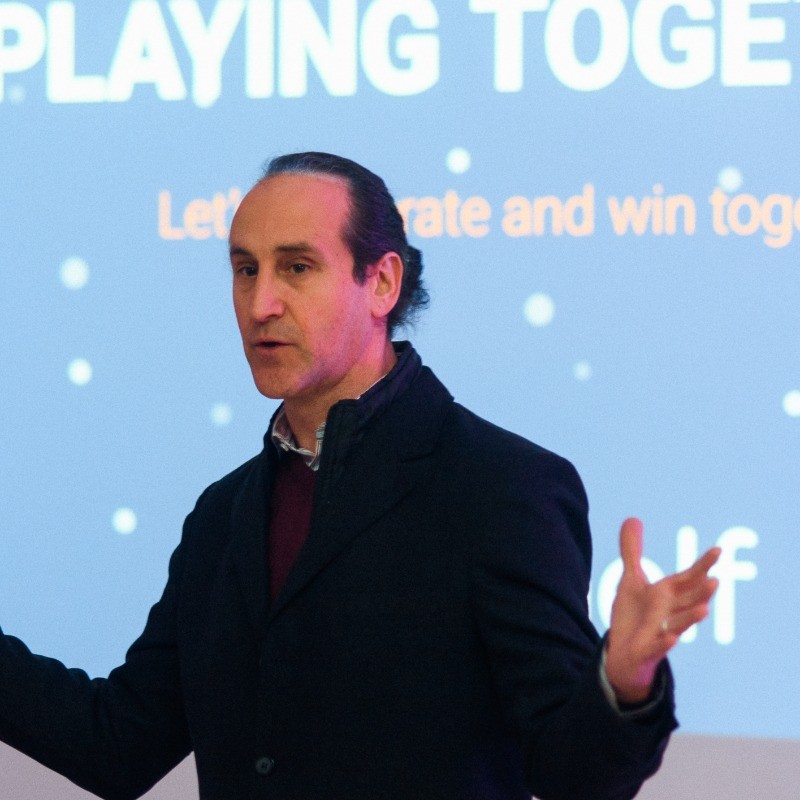
Sedarius Tekara Perrotta, co-founder and CEO of Shelf

The man who keeps the answers honest

Right now, somewhere, a customer-service rep is staring at a chat window with a clock running and a customer who wants a refund policy quoted correctly. The answer exists. It's buried in a 90-page PDF, a Slack thread from 2022, and a wiki nobody has touched since the last reorg. Sedarius Tekara Perrotta has built a company around the unglamorous, faintly maddening gap between that answer existing and that answer arriving.

Shelf, the New York company he co-founded and runs, sells knowledge management and AI data-quality software. The pitch is deceptively plain: clean the content, surface the right passage, and cut the time it takes a worker to find a trustworthy answer from minutes to seconds. The company says it can shrink an average rep's lookup from more than four minutes to under twenty. In an era where every enterprise is bolting a chatbot onto its help desk, that gap is suddenly worth a great deal of money.

Perrotta's contrarian line - the one he repeats on podcasts and conference stages - is that generative AI does not have a model problem. It has a data problem. Feed a brilliant model rotten, duplicated, outdated content and you get a confident, fluent, wrong answer. He has been saying this since before it was fashionable, which is the rare luxury of a man who picked his obsession early and refused to let it go.


By The Numbers

The receipts

$52.5M
Series B, 2021
$60.7M
Total raised
Growth in 12 months
0%
Churn over 3 years

Before the startup, the village

Most founder stories open in a dorm room or a garage. Perrotta's opens in the Peace Corps. In 2002 he was running workshops on financial literacy and entrepreneurship - teaching people, in effect, how to organize what they knew well enough to act on it. It's a strange first chapter for a software CEO, and also a suspiciously perfect one. The job was knowledge transfer before he had a word for it.

He'd come out of Georgetown with a degree in new and small business management, and later spent two semesters in MIT's New Enterprise Program. By 2007 he was at Neuron Global, an on-demand global intelligence firm with offices stretching from the Philippines to Washington to New York, where he ran products and eventually served as president.

It was at Neuron and then Shelf that the through-line hardened. He found himself running knowledge management projects for the kind of institutions that drown in documents: the World Bank, Harvard Business School, MIT, Stanford. These are organizations where the cost of not finding the right answer is measured in millions and reputations. He spent a decade applying machine learning and natural-language processing to their content piles - quietly, years before the rest of the world decided AI was interesting.

A product named Merlin

Around 2015, the consulting work became a company. Perrotta co-founded Shelf with Tobias Jaeckel, who runs technology, and Colin Kennedy. Inside the platform sits an engine they call MerlinAI - a name that tells you exactly how the founders think about the problem. Pulling the one correct paragraph out of a corporate content swamp can feel like sorcery. They decided to bottle it.

The early Shelf went after contact centers, the most acute version of the pain: thousands of agents, millions of queries, every second of handle time a line item. Perrotta wrote, often, in those years - for Fast Company, Forbes, CIOReview, eContent Magazine - making the case that knowledge management was about to matter more, not less. He mentored at the Founder Institute. He was, in the language of the trade, a thought leader before there was much of a market to lead.

The thesis in one line

Connect questions to answers as quickly and easily as possible. Everything else - the AI, the cleansing, the connectors - is in service of that sentence.


The promise of KM is straightforward; to connect questions to answers as quickly and easily as possible. — Sedarius Perrotta

Then everyone started caring about data

For most of Perrotta's career, "data quality" was a phrase that emptied conference rooms. Then generative AI arrived, enterprises pointed chatbots at their own documents, and the chatbots started confidently making things up. Suddenly the unglamorous problem he'd been working on for twenty years was the most expensive problem in the building.

Shelf's modern pitch leans into it. The platform watches enterprise content for the things that quietly poison AI: duplication, outdated passages, contradictions, content rot. It scores and monitors that content so retrieval-augmented generation and tools like Microsoft Copilot are fed something trustworthy. The old metaphor - garbage in, garbage out - became a product roadmap. On the Eye on AI podcast in 2025, Perrotta framed unstructured data as the fuel of AI systems: get the fuel wrong and the engine, however brilliant, sputters.

The market noticed. Shelf raised a $52.5M Series B in August 2021, led by Tiger Global and Insight Partners, with Base10 Partners, Connecticut Innovations and Contour Venture Partners, plus angel checks from the founders of Datto and Procore. Gartner Digital Markets rated it the highest knowledge management software; Gartner named it a Cool Vendor in 2025. The clients - John Deere, DSW, Equitable, Glovo, HireRight - are the kind that don't churn, and reportedly didn't, for three straight years.

His 2023 KMWorld keynote carried a title that doubles as a mission statement: "The Evolution of the Knowledge Manager in the Age of Generative AI." The knowledge manager, in his telling, doesn't disappear when the machines arrive. The job gets more important, because someone has to make sure the machines are reading the right book.


The Pitch, Visualized

Four minutes versus twenty seconds

Shelf's headline claim, drawn straight: the time it takes a customer-service rep to surface a trustworthy answer, before and after.

~4 min
Before
<20 sec
With Shelf

Why it adds up

Studies peg the time knowledge workers spend just hunting for information at roughly 19% of the work week - the better part of a full day. Perrotta built a company to claw that day back.

An 86% cut to answer time isn't a UX nicety at contact-center scale. It's the entire business case.


With the remote distributed workplace now mainstream and an unprecedented volume of company content available on a growing number of cloud solutions, the need to quickly access answers within that information has never been greater. — Sedarius Perrotta, on Shelf's Series B

The Texture

Details that don't fit the LinkedIn summary

The Peace Corps founder

His first "product" wasn't software. It was teaching financial literacy abroad - knowledge transfer before he had a market for it.

The patient obsessive

Most founders pivot. Perrotta picked one problem - findable, trustworthy knowledge - and has stayed on it for two decades.

The early skeptic

While the world fell in love with bigger models, he kept arguing the bottleneck was the data. The market eventually agreed.

The institution whisperer

World Bank, Harvard, MIT, Stanford - he cut his teeth on the most document-drowned organizations on earth.

Names matter

He called the engine MerlinAI. When your job is conjuring the right paragraph from chaos, the wizard metaphor writes itself.

Good company

Among Shelf's backers: the founders of Datto and Procore - operators who know the unsexy-infrastructure playbook cold.


Who's in the room

A founder is partly the company he keeps, and Perrotta's cap table reads like a who's-who of people who understand unsexy infrastructure. Tiger Global and Insight Partners led the Series B - two firms that have made a habit of writing large checks for software that sells to large companies. Around them sat Base10 Partners, Connecticut Innovations and Contour Venture Partners. The angel list is the tell: Austin McChord, who built Datto into a backup-and-recovery giant, and Tooey Courtemanche of Procore, who turned construction-management software into a public company. Both made fortunes on the kind of deeply embedded, low-glamour tooling that becomes impossible to rip out. They recognized the shape of the bet.

He didn't build Shelf alone, either. Tobias Jaeckel, the co-founder who runs technology, has been the engineering counterweight to Perrotta's product-and-vision role from the start, alongside co-founder Colin Kennedy. The division of labor is the classic one - a CEO who can stand on a keynote stage and explain why content rot matters, paired with a technologist who can make the retrieval actually work.

The customers tell their own story. Shelf's roster has included John Deere, DSW, Equitable, OPEX, the delivery company Glovo, and the background-check firm HireRight - operations-heavy businesses where a wrong answer at the front line is expensive and a slow answer is worse. These are not logos you win with a slick demo. You win them by surviving a procurement gauntlet and then, crucially, by not getting fired. The reported three years of zero churn is, in its quiet way, the most impressive line in the whole file.


The ambition, stated plainly

The destination Perrotta keeps describing is one where organizational knowledge is instantly findable and inherently trustworthy - where the answer arrives in seconds and you don't have to wonder whether it's stale. As AI eats more of the workflow, that goal quietly mutates from "nice search experience" into "the thing that decides whether your AI can be trusted at all."

It's a patient bet on an unsexy layer of the stack: the plumbing beneath the chatbots. The companies that win there rarely make magazine covers. They make the cover possible for everyone else. Perrotta seems entirely content with that.

Filed alongside

knowledge management ai data quality rag & genai unstructured data enterprise saas merlinai contact centers peace corps georgetown founder institute neuron global tiger global
Go Deeper

Links & sources

Spread The Word

Share this profile

LinkedIn X / Twitter Facebook Instagram