Company Profile • Consumer Hardware
The Garage Company That Won the Dashboard
Roger and Scotia Alves started Scosche in a garage with a car-audio how-to book. Four decades later, three generations of the family run the brand that put a magnet between your phone and your dashboard.
Most consumer-tech origin stories brag about a first product that changed the world. Scosche Industries has a quieter one: its first product was a book. In 1982, two years after Roger and Scotia Alves set up a car-audio consultancy in a Southern California garage, they published the Autosound Encyclopedia, a reference manual so thorough that the industry started calling it the bible of car stereo installation. It did not make anyone rich. It did something more useful. It made a small family shop the credible authority in a category that was about to explode.
Forty-five years later, that shop in Oxnard, California, is the top-selling phone mount brand in the United States and Canada. If you have ever slapped your iPhone onto a magnet stuck to your dashboard, there is a good chance the magnet said Scosche on the back. The company is still private, still family-owned, and still run by the people whose last name is on the paperwork - now across three generations.
What the company actually doesScosche makes the accessories that sit between your devices and your car. That means magnetic phone mounts, wireless car chargers, cables, power adapters, dash kits and wiring harnesses for stereo installs, Bluetooth speakers, and a handful of fitness and health gadgets. The catalog runs past 4,000 products. The company describes its purpose plainly, without much marketing gloss:
"To produce cutting-edge, innovative accessories at a competitive price, and to create products they will enjoy for life, with American ingenuity they appreciate."
- Scosche mission statementThe flagship is MagicMount, the magnetic mount family that launched in 2014. It is the product that turned Scosche from a respected car-audio name into a household mobile-accessory brand. Notably, Scosche was mounting phones with magnets years before Apple made "MagSafe" part of the vocabulary. When the magnetic accessory wave finally arrived on Apple's terms, Scosche was already there with tooling, patents and shelf space.
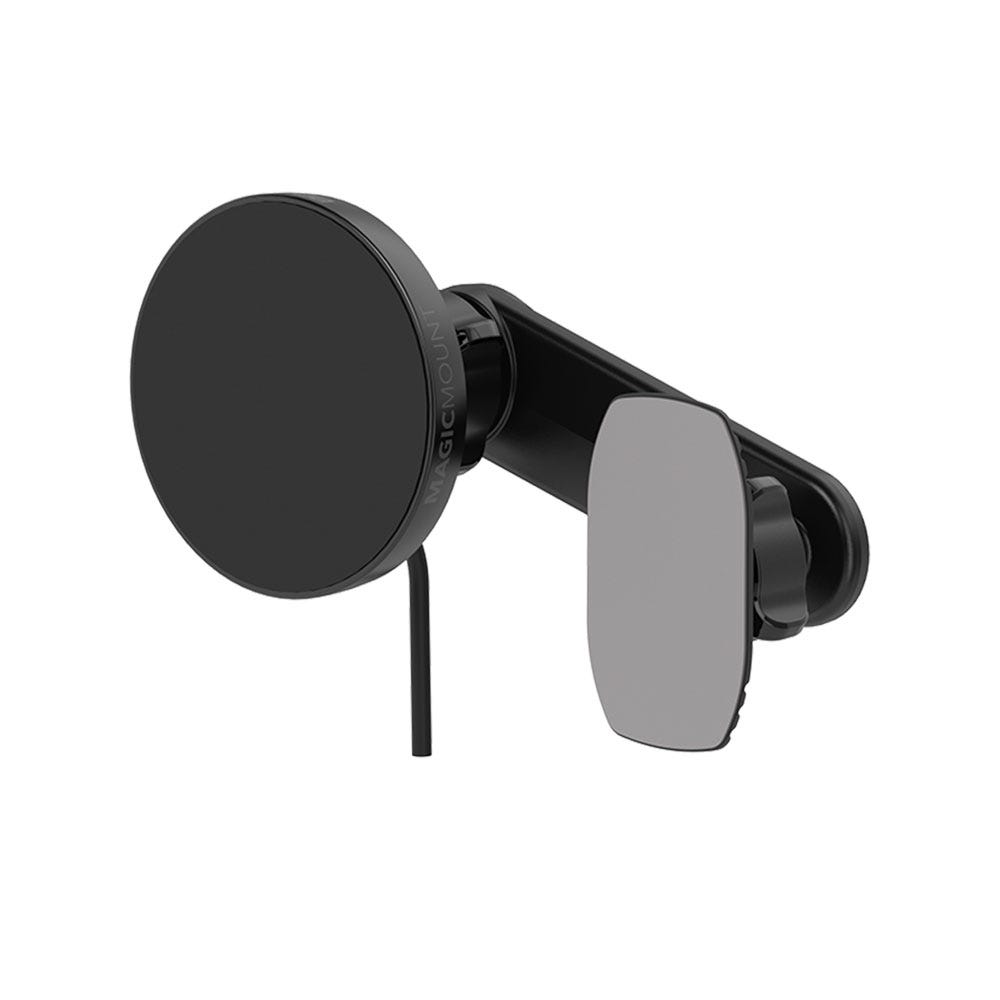
The customer base is wider than "people with phones," though that is most of it. Scosche sells to DIY and professional car-audio installers who need dash kits and harnesses, to drivers who want their phone visible and charged, to powersports and outdoor enthusiasts, and to fitness users who bought into products like the Rhythm+ armband heart rate monitor. The products move through big-box and specialty retail, distribution partners, and directly to consumers on scosche.com. In early 2025, Scosche added The Home Depot to its retail footprint, a signal that "phone mount" now lives in the same aisle as extension cords and work lights.
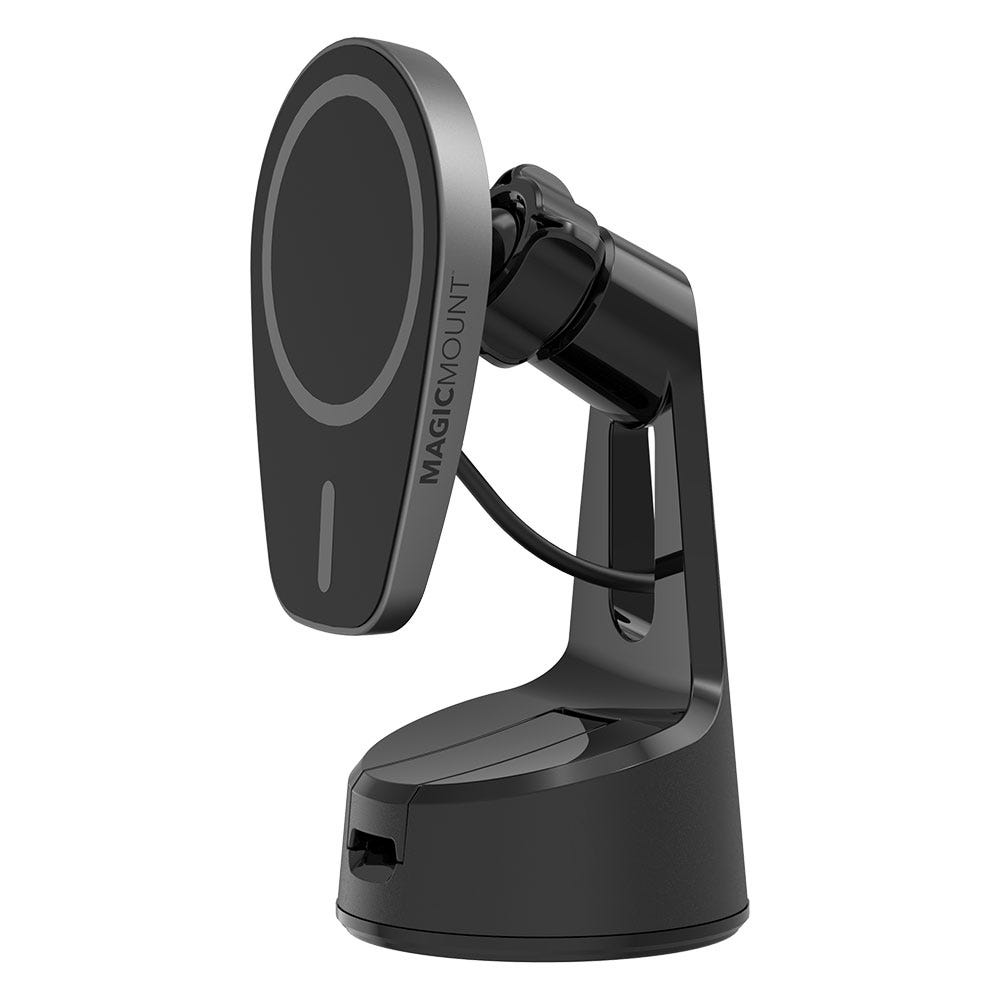
On paper it is unglamorous: hold a phone, charge a phone, do not block the airbag or the driver's view, survive the heat of a parked car and the vibration of a highway. In practice those constraints are why the category rewards engineering rather than branding. A mount that drops your phone at 70 miles per hour is worthless. A charger that cooks your battery is worse. Scosche's answer has been to chase standards early and hard.
The clearest example is wireless charging. In July 2025 the company launched the MagicMount Charge Pro 25W series, which it billed as the first Qi2.2-certified magnetic wireless charging car mounts. Qi2 aligns a ring of magnets with the ones inside MagSafe iPhones and Qi2 Android phones, so the coils line up even when you slap the phone on one-handed. Qi2.2 pushes the ceiling to 25 watts. Scosche got there first, using rare-earth magnets to keep the phone locked while it fast-charges.
How it is differentPlenty of companies make phone mounts - iOttie, Belkin, Anker, ESR, PopSockets, Mophie. What separates Scosche is less a single feature than a posture. It is a car company that happens to make phone accessories, not a phone-accessory company that discovered cars. That heritage shows up in the details: AMPS mounting patterns that bolt into ProClip vehicle-specific bases, integrated cable management on the Charge Elite line, and dash kits that go back to the 1984 patent for a General Motors multi-purpose dash kit - the product that helped create the retail DIY car-audio business in the first place.
Scosche's first product wasn't a gadget. It was the manual everyone else installed by.
- On the 1982 Autosound EncyclopediaA 45-year-old accessory company could easily coast. Scosche does not. Its 2025 CES haul included six award-winning products, and the two most interesting were not mounts at all. FoundIT is an item-locator that comes as a wallet card, a keychain tag, and a 42-watt car charger with a finder built in - so you can locate your keys and, in the Pro version, your parked car. Stranger still is isaac by PreEvnt, a Scosche subsidiary building a non-invasive blood glucose alert device and phone app that uses volatile organic compound detection. A car-audio family branching into diabetes tech is not an obvious move. It is the sound of a company refusing to let a mature category define its ceiling.
How it makes moneyScosche is a design-led manufacturer. It engineers products, has them built, and sells them across retail, distribution and direct-to-consumer channels, with the online store running on Adobe Commerce. Analysts peg annual revenue at roughly $24.5 million, with public estimates ranging from about $18 million to $34 million depending on the source. What is notable is what is missing from that story: there is no venture funding, no disclosed rounds, no outside valuation. This is a business that grew on product margins and retail relationships, not fundraising - a rarer thing in consumer hardware than it should be.
The name comes from Scotia Alves's nickname, "Scosche." She and Roger founded the company in 1980; Roger is still CEO. Their sons Kas and Vince joined in 1995 and 2000 and now serve as co-presidents. Grandson Ryder joined in 2018, making it a genuine three-generation shop. The company describes its own culture in the vocabulary of its customers - gearheads, drivers, surfers, racers - and runs an ambassador program of field testers who beat on products before they ship. It has also set sustainability goals that fit its engineering bent: carbon neutrality, plastic-free packaging, 100% renewable energy, and a design principle of universal compatibility so a mount bought today still works with next year's phone. That last one is clever positioning: it fights e-waste and keeps customers at the same time.
Where it fitsThe mobile-accessory market is crowded, low-margin at the bottom, and brutal on anyone who cannot ship fast or stand behind a warranty. Scosche's spot in it is the reliable, engineering-forward mid-market: not the cheapest mount on the rack, not a luxury brand, but the one a retail buyer trusts to be first to a new standard and to still be around next year. Being the #1 mount brand in the US and Canada, the #1 mobile-accessories brand in California, and the #1 FM transmitter brand in the US is the payoff of showing up for four decades and doing the unglamorous work well.
A short historyRoger and Scotia Alves start Scosche as a car-audio consultancy in Southern California.
The installation manual that became the "bible" of car audio.
A GM multi-purpose dash kit helps launch retail DIY car audio.
The magnetic mount family launches and becomes the flagship.
Grandson Ryder Alves comes into the family business.
Six products win CES awards; Scosche ships the first Qi2.2 25W car mounts.
The reader's takeaway is not complicated. You do not need a venture round to build a durable brand in hardware. You need to pick a narrow, boring category, learn it better than anyone, earn credibility early - even if the first product is a book nobody expects to sell - and then keep being first to the next standard while everyone else argues about branding. Scosche has done that from the same county in California since Reagan's first term. The magnet on your dashboard is the receipt.