The Swiss Company That Bet Everything on One Cup of Coffee
JURA quit irons, radios and toasters to make one thing - a machine that turns whole beans into a fresh cup on demand. It worked: a Swiss village factory is now a premium name in about 50 countries.
There is a village in the Swiss canton of Solothurn where roughly 900 people help sell coffee machines to about 50 countries. The village is Niederbuchsiten. The company is JURA Elektroapparate AG. And the strange, useful thing about its story is that JURA grew large by making its catalog small - dropping products one by one until only coffee was left.
JURA started in 1931 building radios and household electricals. For decades it was the kind of firm that made whatever the era wanted: irons, small appliances, the occasional coffee maker. It was known, of all things, for its clothes irons. Then in the 1980s it made a decision that reads like heresy for a manufacturer - it stopped trying to make everything, and pointed the whole business at a single question: how do you get an excellent, freshly ground cup of coffee out of a machine without a barista standing next to it?
The answer became a category. Today JURA is one of the names people reach for when they say "bean-to-cup," the machines that grind whole beans, tamp, brew and froth milk from one touch of a screen. The company sells to homes and to offices, hotels and restaurants, and it does it at the top of the market on purpose.
The name itself is a small tell about where the company comes from. JURA is named after the Jura mountain range that runs along the border of Switzerland and eastern France - the kind of detail a Swiss firm keeps because place and product are part of the same story. The company has stayed in Niederbuchsiten for its entire existence, and its leadership has stayed put too: CEO Emanuel Probst ran the business for roughly three decades, a tenure long enough to see the iron line closed, the coffee bet placed, and revenue grow more than tenfold.
01What JURA actually does
Strip away the marketing and JURA makes one product family really well: fully automatic coffee machines. You load whole beans and water, press a button, and the machine handles grinding, dosing, extraction and - on most models - milk. The pitch fits on a bumper sticker: freshly ground, not capsuled. That single line is a value proposition and a shot at capsule systems in the same breath.
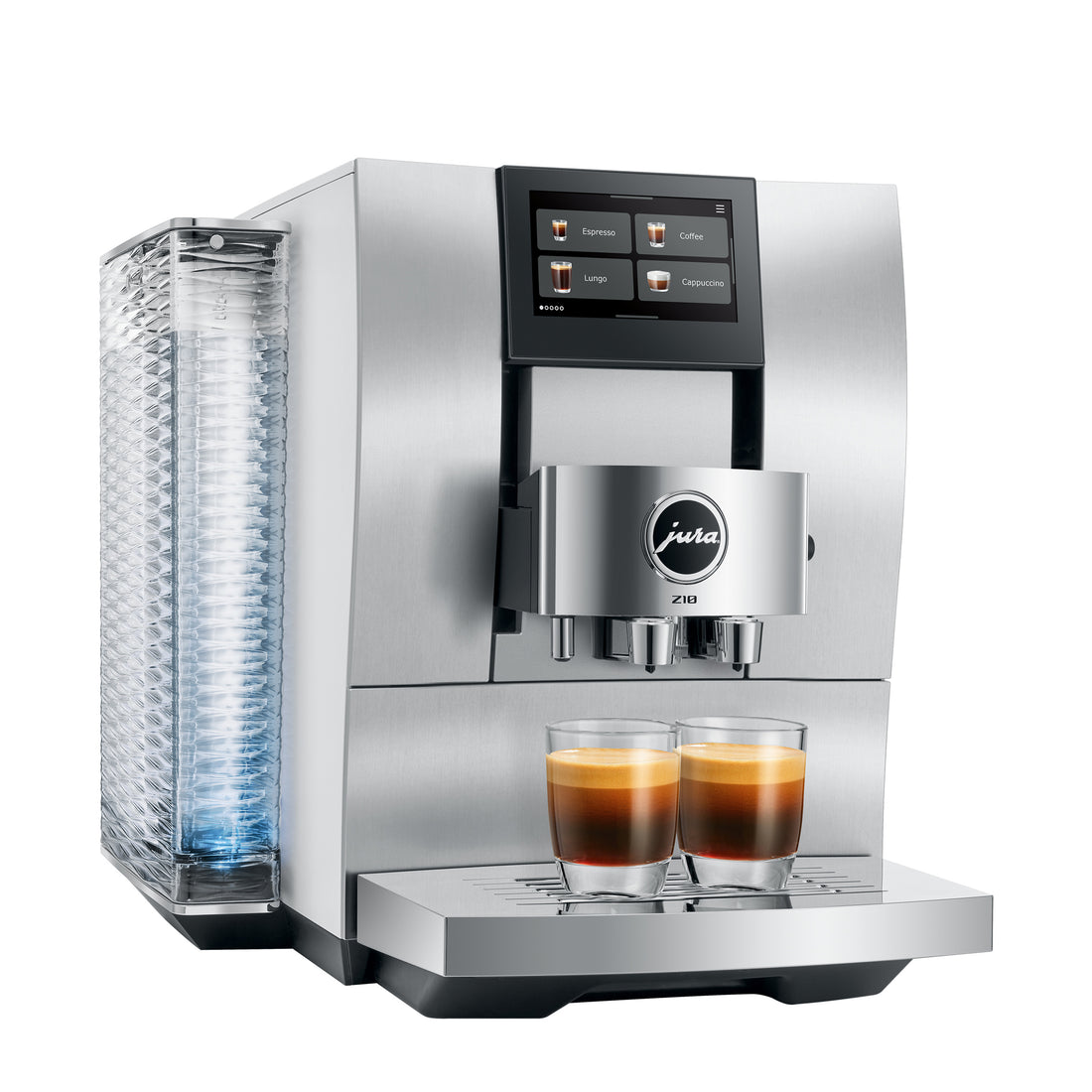
The range runs from compact home machines to heavy-duty professional units. The flagship home model, the Z10, offers roughly 32 hot and cold specialty drinks and can produce true cold brew through a Cold Extraction Process - cold coffee in seconds rather than the usual overnight wait. The GIGA line adds dual grinders and dual heating for higher output. The E8 and ENA 8 cover the more approachable end of the premium spectrum, with the same core idea in a smaller box.
What binds the range together is a set of house technologies. The Pulse Extraction Process pushes hot water through the coffee in short bursts, aimed at shorter drinks like ristretto and espresso where even extraction matters most. Newer grinders read the drink you selected and adjust the grind, and JURA's milk systems are built to rinse and clean themselves so the dairy side doesn't turn into a maintenance chore. None of this is glamorous on its own; together it is the difference between a machine people keep and one that ends up in a cupboard.
02Who buys it
Two audiences, one machine philosophy. On the consumer side, JURA sells to households that want café drinks at home and will pay for the convenience and the design. On the professional side, its WE, X and GIGA X machines land in offices, hotels, restaurants and food-service operations where the machine has to run all day and clean itself with minimal fuss. The company reaches both through roughly 5,000 outlets and a network of distribution subsidiaries, plus its own direct e-commerce. In the United States, that job belongs to JURA Inc., the subsidiary handling sales, marketing and after-sales support.
Where a JURA machine shows up
03The problem it solves
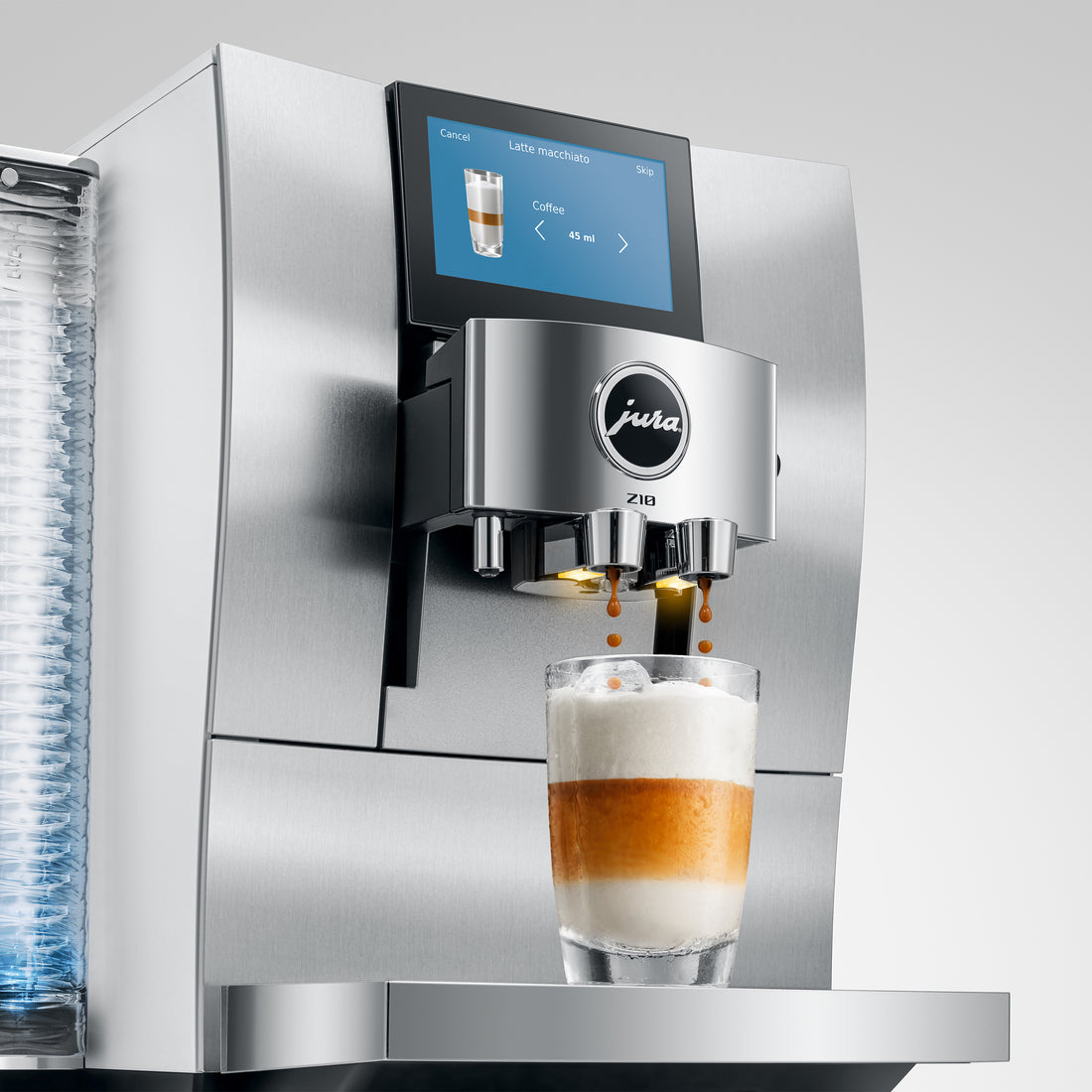
Good coffee has a labor problem. Doing it properly means grinding fresh, dosing right, extracting at the correct pressure and temperature, and steaming milk - a set of skills most people don't have at 6:45 a.m. Capsules solved the convenience side but handed you pre-ground, pre-portioned coffee sealed in plastic. JURA's whole reason for existing is to collapse the gap between those two worlds: the freshness and control of a real grind, delivered with the one-button ease of a pod machine.
That's where the engineering lives. Features like the Pulse Extraction Process (P.E.P.), meant to push water through the grounds in pulses for a more espresso-like result, and product-recognizing grinders that adjust to the drink, are attempts to make an automatic machine behave less like a vending unit and more like a competent barista.
04How it's different
Three choices set JURA apart, and none of them are about the coffee itself.
It's premium-only, on purpose. JURA doesn't make a budget machine. In a market obsessed with hitting price points, refusing the bottom of the market is both a bet and a moat - it protects the brand and keeps the margins that fund the design and engineering.
It rents the factory and owns the difference. Since the 1990s, JURA has outsourced the physical manufacturing of its machines - long associated with Swiss contract manufacturer Eugster/Frismag - while keeping design, engineering and brand in-house. It owns the parts that make it distinctive and rents the parts that don't.
It kept one face for two decades. Roger Federer has been JURA's brand ambassador for around 20 years, a partnership that has now outlasted his professional tennis career. Where most brands chase the next trend, JURA found a fit and let consistency compound.
05The business model
JURA's model is quietly durable. Sell a premium machine at a premium margin. Then keep selling - CLEARYL water filters, milk-system cleaning tablets, care kits and accessories that keep the machine hygienic and working. The hardware is the headline; the consumables and after-sales service are the annuity. Add a global network of retail partners and subsidiaries, and you get a company that isn't dependent on any single market or single sale.
Revenue growth under one CEO (illustrative)
Under CEO Emanuel Probst, turnover grew more than tenfold over roughly three decades. Shape is illustrative, not to scale.
06Expertise and where it fits
JURA sits in the premium tier of a crowded appliance market. Below and around it are De'Longhi, Philips/Saeco, Melitta, Miele and Siemens/Bosch in bean-to-cup, plus Nespresso and other capsule systems as the convenience alternative it positions against. What JURA brings to that fight is narrow, deep expertise: decades spent on the specific problem of turning whole beans into a good cup automatically, wrapped in Swiss design and a brand people recognize on a kitchen counter.
The company's own headquarters doubles as a pitch. Since 2006, "JURAworld of Coffee" in Niederbuchsiten has functioned as part museum, part showroom - the kind of destination you build when your product is a daily ritual rather than a spec sheet.
The United States is where JURA sees the most room to run. Americans have historically leaned on drip machines and capsules, which makes the premium bean-to-cup category younger and less settled there than in Europe. Probst has been blunt about the ambition, saying the company could double or even quadruple its US sales. The vehicle is JURA Inc., which handles sales, marketing, distribution and after-sales support, and which absorbed the US Capresso operations when JURA took full ownership in 2008. Selling a several-thousand-dollar coffee machine into a capsule-dominated market is a slow argument, but it is the same argument JURA has been making everywhere else for forty years.
07The short version
JURA's story is a case study in focus you can copy: pick one category, refuse the bottom of the market, keep the parts that make you different and outsource the rest, and hold your positioning long enough for it to mean something. It won't work for everyone - premium-only demands a market willing to pay up, and outsourced manufacturing means trusting a partner with your quality. But for a coffee-machine maker from a Swiss village, saying no to almost everything turned out to be the growth plan.