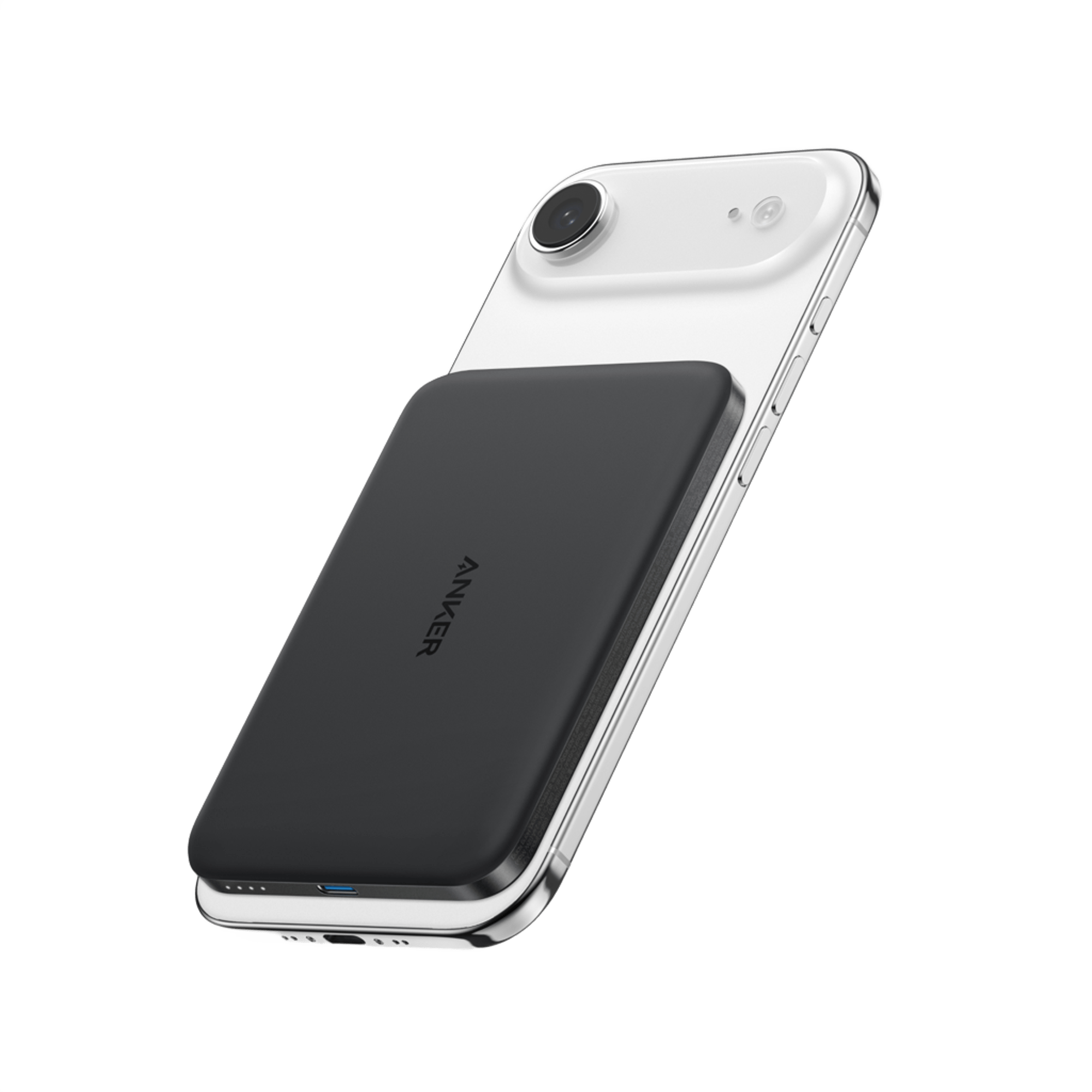
The Phone Charger That Won't Weigh You Down
There is a particular kind of product that makes you feel clever for owning it. Not because it's expensive - because it's right. The Anker Nano Power Bank (Model A1665) is that product. At 8.6mm thin and 122 grams, it slips into a pocket like a hotel key and charges your iPhone 16 like it means it. Nobody told this power bank it was supposed to be a brick.
Let's be direct about who this is for: if you carry an iPhone 12 or newer and you've ever ended a day at 8% battery in the middle of nowhere, this is your solution. It magnetically snaps to the back of your phone, charges at a full 15W via Qi2, and fits in a front jeans pocket with room to spare. Frequent flyers. Urban commuters. Conference attendees. The person who always has a dead phone at the airport. That is the audience, and Anker has served them precisely.
Anker was born in 2011 out of a very specific frustration. Steven Yang, then a software engineer at Google, kept buying battery products that didn't last - or wouldn't fit in his bag. He quit his job, rented a Shenzhen factory floor, and started shipping laptop batteries on Amazon. By 2014, Anker was the top-rated charging brand on the platform. Today, the company operates in 146 countries with roughly 3,000 employees and claims the title of world's number one mobile charging brand. The Nano Power Bank is not a startup bet. It is the matured thesis of a company that has spent 14 years solving the same problem: battery anxiety, in ever-smaller form factors.
The A1665 didn't happen overnight. It required graphene cooling technology - a material class better known in semiconductor research - to manage heat in a body so thin there is almost no airflow. Anker fitted dual NTC temperature-sensing chips and built ActiveShield 2.0 firmware that monitors heat in real time and scales charging speed to keep the unit below 104°F. In plain terms: it charges fast and stays cool. In a world where cheap power banks cook your battery or throttle themselves to uselessness within minutes, that's not a small thing.
The Qi2 certification deserves its own paragraph. Standard Qi wireless charging - the kind on most cheap power banks - tops out at 5-7.5W and requires precise alignment. Qi2 is the next-generation standard, co-developed with Apple's MagSafe technology, delivering 15W with alignment guaranteed by magnets. For iPhone 12 through 17 owners, this is the fastest wireless charging available from a third-party device. The A1665 is one of the first ultra-slim power banks to earn full Qi2 certification, not just claim MagSafe "compatibility."
There is also a small design detail that keeps coming up in reviews: the metal bar cable loop. The included USB-C cable feeds through a small metal ring at the top of the unit, creating a kind of handle. When you're charging via USB-C wired, the cable extends upward rather than dangling, and you can actually hold your phone with your fingers curled around the loop. It sounds minor. Every reviewer who mentions it says it changed how they use the device. These are the details that come from people who have thought hard about a problem for a decade and a half.
Eco-conscious buyers: 75% of the unit's exterior is made from post-consumer recycled (PCR) materials. Anker doesn't make a big press release about this - it's mentioned quietly in the spec sheet - which is arguably how you know it's genuine rather than marketing. The unit ships with a USB-C to USB-C cable and a 24-month warranty. At a retail price around $40-50, this is squarely in the "solid mid-market" zone - not Apple-priced, not disposable.
What works
- Genuinely the slimmest major-brand 5K power bank at 8.6mm
- Qi2 certification - not just MagSafe-compatible, actually certified
- Graphene cooling means sustained fast charging, not throttled fast charging
- Metal loop cable ergonomic trick is genuinely useful
- 75% recycled exterior with no performance sacrifice
- 24-month warranty beats most competitors
- Four colorways including Cosmic Orange
Trade-offs to know
- Wireless charging only for iPhone 12+ with MagSafe - older Android owners need the cable
- 5,000mAh won't carry a power-hungry Android through two days
- 20W wired limit - not 30W or 45W for laptops
- No built-in plug (unlike the PowerCore Fusion) - needs separate charger
- Baseus PicoGo is slightly thinner at 7.6mm for less money
A word on the competition. Baseus makes the PicoGo at 7.6mm - genuinely thinner - for roughly $35. The INIU SnapGo is lighter at 107.5g. Neither has Qi2 certification; both offer standard Qi at lower wattage. Belkin's BoostCharge Pro 5K actually beat the Anker in one head-to-head recharge test, charging a faded iPhone 16 Pro to 79%. Apple makes its own MagSafe Battery Pack, which costs more, charges slower at 15W only (no USB-C wired fast charging output), and has no recycled materials claim. The Anker hits a crossroads where certified quality, genuine thinness, and sensible pricing converge.
Men's Journal called it Best Travel Power Bank 2026. MacRumors called it "iPhone's Perfect Partner." Creative Bloq said it was "cool in almost every way." These aren't outlets that give standing ovations to charging accessories. When three different publications in three different categories all reach for the same superlative, the product has earned it.
The Nano Power Bank launched in Europe in June 2025 - Phantom Black, Aurora White, and Sand Brown. It reached the US market in fall 2025. Cosmic Orange arrived in March 2026 and immediately became the most photographed of the four variants on social media. If you are the kind of person who picks a product partly on how it looks, Cosmic Orange is the correct answer.
Bottom line: buy this if you own an iPhone 12 or newer and want the thinnest, fastest wireless charging power bank with serious thermal management and a warranty that suggests Anker expects it to last. Skip it if you need something that will run a laptop or power through three full phone charges on a single trip. The Nano Power Bank knows exactly what it is, and it does that one thing with style.


