An eight-hour timesheet is a wonderfully tidy document. Eight hours of actual work are less cooperative. They scatter across email, spreadsheets, meetings, applications, and the little administrative errands that somehow acquire an afternoon. Sapience Analytics has built a business around that difference: what an enterprise pays for, what its systems record, and what people actually spend their days doing.
- The job: connect digital work signals with workforce and financial data.
- The buyers: large enterprises managing employees, contractors, and technology spending.
- The new question: does AI create capacity the business can put to use?
There is a pleasing complication in its customer stories. Measurement does not always prescribe a longer day. In one bank, the company reports, it helped managers see that some teams were already working too much. The interesting part of the dashboard was what leadership decided to stop.
01 / The bank that shortened the day
Sapience describes a deployment covering 1,500 employees across two banking business units. Within three months, the bank recorded a 5% productivity increase. Its dashboards also revealed teams in Asia regularly working ten-hour days. Leadership introduced early-departure policies, reducing excessive daily work time by two hours.
The same exercise exposed manual workflows involving Outlook and Excel, prompting the purchase of an email solution. Five applications considered business-critical were used less than 5% of the time; retiring unused licenses produced further savings. These are company-reported results from an anonymous customer, rather than an independently audited experiment. Still, the sequence matters: observe the work, identify friction, change the policy or process.
That is Sapience’s commercial territory. A headcount system knows who works for you. A payroll system knows what they cost. SapienceIQ, its flagship SaaS platform launched in October 2025, tries to supply the missing account of how work moves through the organization.
02 / How a workday becomes data
The platform begins with collection. IQ Sync captures digital activity metadata; IQ Link connects it with enterprise systems, including HR, finance, customer relationship management, IT service management, and vendor management tools. Analytics then give those signals operational context: application usage, collaboration patterns, workload distribution, and capacity.
The current product story also includes Sapience Operational Business Logic, which applies classifications, business rules, and semantic context to the data. AskIQ lets users ask workforce questions in ordinary language against that structured foundation. The attraction is practical: a finance leader and an operations manager can approach the same underlying work from different questions.
Sapience says it does not capture keystrokes, screenshots, email content, chat messages, or meeting content. Customers can configure anonymization, aggregation, and role-based access. That distinction deserves precision. Activity metadata can still be sensitive, and authorized individual-level visibility is possible. The company’s privacy controls therefore matter as much as its collection exclusions.
03 / The invoice meets a second witness
Contractors make the measurement problem sharper. Procurement has invoices and timesheets; managers need evidence about delivery and available capacity. Sapience extends its analytics to contingent workers, checking reported hours against captured work activity and connecting that evidence with supplier oversight.
In a separate case, a top-ten U.S. commercial bank deployed Sapience to 4,000 external workers. The company reports $6.8 million in savings after leaders renegotiated vendor contracts, avoided unnecessary hiring, and removed unused software licenses. The bank subsequently expanded coverage to 6,800 users. A new policy required a minimum utilization threshold before managers could seek additional headcount.
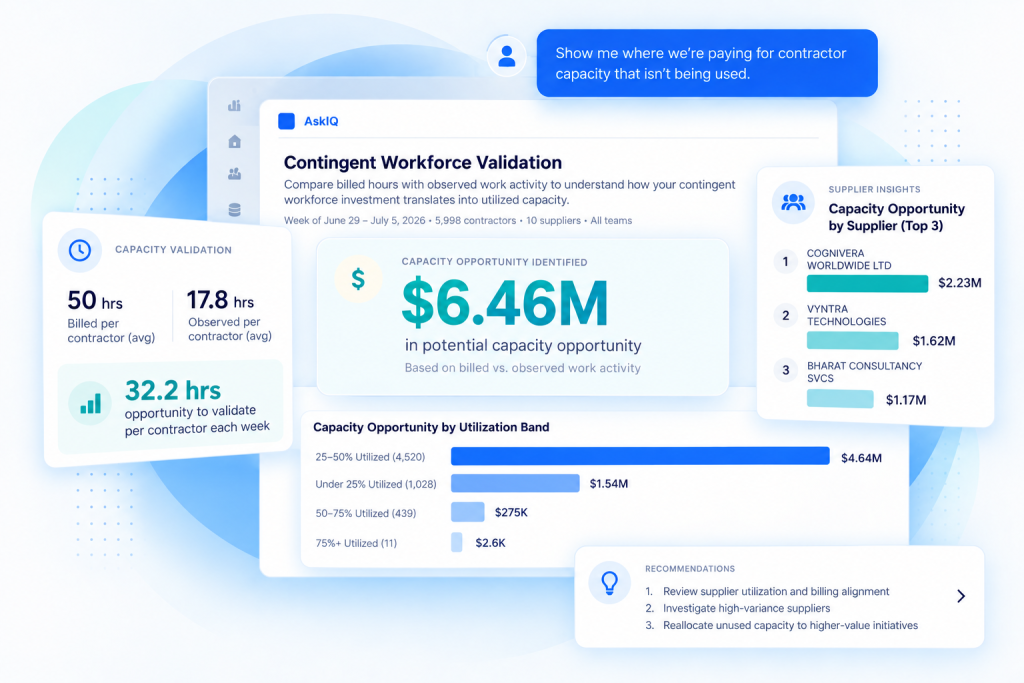
The useful lesson is a management rule, not a savings slogan: make the staffing request explain existing capacity. An apparent discrepancy should prompt investigation, with legitimate offline work and contractual terms considered. Computer activity alone cannot settle whether a consultant delivered valuable advice.
04 / A local beginning, an expensive lesson
Sapience began in Pune in 2009, founded by Shirish Deodhar, Madhukar Bhatia, Hemant Joshi, and Swati Deodhar. Bhatia’s account of the early business is refreshingly mundane: build the first version without external financing, sell nearby, and keep support costs manageable.
Customer feedback also exposed a deployment burden: installing and maintaining clients across thousands of machines created extra work for IT teams. The company simplified deployment, removal, and maintenance. It is an instructive correction for enterprise software founders. The product includes the effort required to keep it running.
“It is the feedbacks from customers, reaction from prospects during sales presentations and competitive landscape that shape the final product.”Madhukar Bhatia, co-founder
A $7.4 million Series B led by Orios Venture Partners in 2014 supported a U.S. sales push. Credit Suisse’s NEXT Investors made a majority investment in 2017; Kayne Anderson Growth Capital added an undisclosed growth investment in 2024. Today, the headquarters is in McKinney, Texas, with a development center in Pune.
05 / The hour AI supposedly saved
Its customers include banks, insurers, technology businesses, and healthcare organizations. HCL used the software before becoming a development and distribution partner in 2022. Partnerships with Trinium AI and SLKone followed in 2025, connecting workforce measurement with transformation work.
Sapience sits alongside HR and vendor systems, while competing for analytics budgets with tools such as ActivTrak. Its emphasis combines direct and external labor, enterprise integrations, and AI capacity measurement. The business is enterprise SaaS licensing with implementation and customer support. An older transparenSEE datasheet modeled an all-in fee at 0.3% of annual workforce spend; that illustrative scenario should not be mistaken for today’s universal tariff.
AI supplies its next test. SapienceIQ tracks usage and changes in work patterns, helping customers establish baselines and examine what happens after adoption. Opening a chatbot proves little. Saving time means more when output quality holds and the released capacity goes somewhere useful. For a manager considering Sapience, the sensible starting point is one decision worth improving, a defined workforce, and outcomes to check. Otherwise, the enterprise may acquire an exquisitely detailed account of yesterday and no better idea about tomorrow.