Ryan Wong remembers becoming a manager almost overnight. One day he was writing code; suddenly he was responsible for people, with little training and no useful playbook. He improvised. His view stopped at the edges of his department, and even there he could miss things. He knew that some capable colleagues were quiet. Knowing which ones deserved attention was another matter. A promotion had given him responsibility without giving him much more information.
Years later, as a founder and chief executive, he expected managers to have better help. His public account of that early experience carries an uncomfortable recognition: a company can own sophisticated HR systems while its supervisors continue making consequential decisions from fragments. For someone who spent his career building analytics software, that is a peculiarly irritating problem. The numbers exist. The person who needs them is still guessing.
Wong now leads Visier, the Vancouver company he co-founded in 2010. Its subject is the workforce: who joins, who leaves, where skills sit, how teams are organized and what those choices mean for a business. The story begins with an engineer, passes through a rented townhouse, and arrives at an argument about management. A chart can be beautifully drawn and still leave its reader wondering what to do on Monday.
01The engineer before the executive
Born and raised in Singapore, Wong eventually studied at the University of British Columbia, graduating in 1994 with an honours degree in computer science and mathematics. He still wrote code for pleasure when describing his career in 2022. The attraction was concentration: a task with its own logic, demanding his attention. Executive work, with its meetings and competing obligations, rarely offers so tidy a bargain.
His earlier work helped shape the business intelligence systems that companies used to understand themselves. Wong was the original author and chief software architect of the Crystal Enterprise Platform. He went through Crystal’s integration into Business Objects, then continued at SAP as vice president of engineering for SAP Business Objects. Before Visier, he had already worked on the machinery that turned corporate data into something a business could read.
That background matters because Visier’s founders came to HR with experience elsewhere in enterprise software. They had seen how much effort businesses devoted to measuring products and customers. In Wong’s own explanation of his interest in people analytics, employees were receiving less of that analytical attention, despite being central to the company. The question was almost embarrassingly straightforward. Why did an organization know so much about what it sold and so much less about the people doing the selling?
02A boardroom with a bedroom’s past
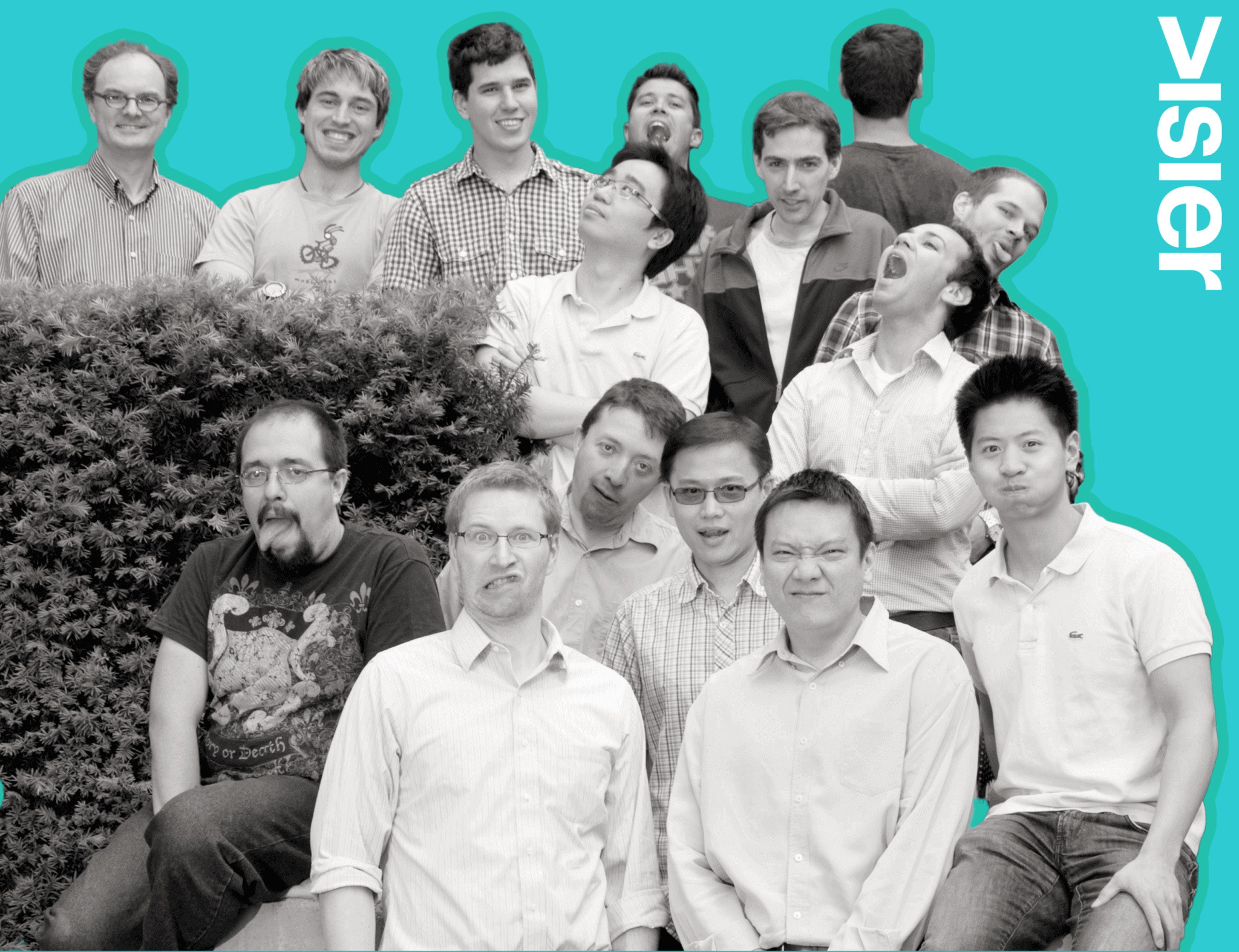
Visier began in a Vancouver townhouse. At its busiest, 13 employees worked there. Servers occupied the kitchen counter; tables had been made from old doors. An upstairs bedroom served as the boardroom. The surroundings had a useful way of reducing corporate grandeur to its constituent parts: a meeting was still a meeting if the room had once accommodated a bed.
John Schwarz, Wong’s co-founder and later chairman, brought his own business intelligence experience. The early team developed and demonstrated working software in weekly cycles. Wong remembered the first customer payment with particular pleasure. Its size would later seem modest. At the time, somebody had paid them. For a young software company, that is a more persuasive form of applause than a compliment after a demonstration.
They initially called the project workforce analytics. Much of the work they wanted to address was being handled through reporting functions and spreadsheets. Their wager was that a particular business problem deserved software designed around it. Starting with HR narrowed the problem enough to build an application people could actually use. It also meant the founders had to explain why anyone should buy it.
03The useful question comes before the chart
By 2021, Wong was describing Visier’s approach as a set of applications built for particular needs, with quicker access to useful answers and less implementation work. He wanted HR teams, managers and executives to use people data in decisions across an employee’s time at a company. The appeal was practical. A manager worried about departures needed help understanding retention, rather than another assignment to construct an analytical system.
The company’s June 2021 Series E brought $125 million in funding and a valuation of $1 billion. Wong discussed using the investment for product development, international expansion, hiring and potential acquisitions. Those are tangible ambitions behind an unusually theatrical label. The word unicorn describes a valuation; it provides remarkably little instruction for running the next staff meeting.
Series E financing
On May 6, 2020, he had succeeded Schwarz as CEO after serving as founding chief technology officer and then president. Schwarz stayed on as chairman. The transition put the engineer in charge of the whole enterprise, including the less programmable matters of customers, growth and people. The ambition also widened: analytics could reach business functions beyond the original HR application.
It is tempting to read that sequence as a clean ascent from technical work to leadership. Wong’s account of his first management role makes the transition look less orderly. Knowing how to build a system does not automatically teach someone how to recognize a colleague’s contribution. A business intelligence career gives the problem a particular sting: the expert in visibility once found his own team difficult to see.
04A report cannot chair the meeting
In December 2021, Visier and Deloitte announced a research and discussion series about a more people-focused approach to management. Wong argued that leaders needed to change their relationship with employees, their learning habits and their understanding of how teams affected business outcomes. He also emphasized that data alone would be insufficient. That admission is useful coming from someone whose business sells access to it.
A dataset can reveal a pattern. A leader still has to decide whether the pattern deserves intervention, whether the evidence is sufficient and whether the proposed response makes sense for the people involved. Wong’s stated ambition gives analytics a demanding job: helping leaders understand the effects of employees on a business and the effects of that business on employees. The second half prevents the exercise from ending at a cost column.
In Singapore in July 2025, he spoke about the growing demands on chief human resources officers. “I do not want your job,” he said. He described the need to show empathy while answering the business’s demands, and the pressure on HR to move beyond compliance and reporting. There is a trace of executive courtesy in the line, but the substance is serious. Providing a report does not guarantee that anybody reads it.
“Too many decisions are still made on gut feeling.”
Ryan Wong, Singapore interview, July 2025
His argument in another Singapore interview that month was that analytics should help people discover problems they had not thought to investigate. That is a different kind of usefulness from confirming a manager’s preferred explanation. It requires curiosity, and some tolerance for being wrong. A dashboard becomes less comfortable company when it interrupts the story its owner was hoping to tell.
05The quiet employee in the data
Wong’s writing has returned to pay transparency, compensation and the habit of confusing visible activity with useful work. His Fast Company articles include a critique of productivity theater. Taken together with his memory of quiet contributors, those subjects expose a recurring concern: organizations can mistake what is easy to observe for what actually matters. A busy-looking employee offers an immediately legible performance. A valuable contribution may need closer examination.
The distinction has practical consequences for the product he leads. Visier’s fiscal-year announcement in February 2024 described the launch of Vee, its generative AI assistant, alongside an expanded platform offering for builders. It also reported growth through embedded analytics partners, including Paychex and Betterworks. The company was seeking more ways to place its analytical capabilities inside the software and routines businesses already used.
Wong also shared a view of the Vancouver office after its renovation in 2024: recording space, training rooms and meeting rooms with writable walls. There was a lunchroom with table tennis and foosball, which he said became competitive. The details offer a small glimpse of the workplace behind the workforce software. Even a company devoted to measuring business outcomes leaves room for an argument over a foosball table.
06Singapore, again
Visier opened an AI lab in Singapore in March 2025, supported by the Singapore Economic Development Board. The lab’s remit included generative and agentic AI, with work on Vee and the company’s AI Agent Platform. Visier also announced a plan to double the workforce in the lab and its APAC regional office over two years. That was a hiring intention, with the work of delivering it still ahead.
For Wong, the location gives the business story a geographical return. In a CNA conversation about running billion-dollar companies, he argued that Singapore had creative people but a culture inclined to avoid risk. He wanted more willingness to take chances. The observation sits alongside his own move from an established software career into a new company. He knew the advantages of large organizations; he had also chosen the uncertainty of building one.
At Outsmart 2026 in Palm Springs, his message again concerned what happened after an insight arrived. He urged people analytics teams to concentrate on business impact and to participate in discussions about workforce transformation. The technology had changed considerably since the townhouse. The demand on the user was familiar: make the information count in an actual decision.
The company’s 2026 customer awards made that demand concrete. Newell Brands was recognized after connecting workforce systems and using the results to address attrition. Eaton was recognized for work that brought workforce data to more than 11,000 managers. These were customer achievements celebrated by Visier, rather than promises that every purchaser would obtain the same result. They showed the kind of organizational use Wong was asking his audience to pursue.
In September 2026, Visier announced a connector for Microsoft Viva Glint, bringing employee survey information into its wider workforce platform. Its organization design product also received a 2026 Top HR Product designation from HR Executive. Both developments belong to the same continuing effort: connect information that would otherwise remain separate, then help somebody use it to make a choice.
The most revealing detail in Wong’s story remains the inexperienced manager trying to understand his own department. It supplies a human reason for all the software that followed. A quiet employee, a partial view, a decision that must be made anyway: these are ordinary situations with serious consequences. Wong has spent years arguing that companies can give the person making that decision a better view. The next test comes when that person closes the dashboard and speaks to the team.
Continue the conversation
Interviews, writing and further reading.
- Visier
- Ryan Wong on LinkedIn
- Visier on YouTube (company channel)
- Nasdaq video interview
- CNA: the founder’s journey
- Engineering years and UBC
- The townhouse recollections
- CEO appointment, May 2020
- Wong’s professional biography
- Why he chose people analytics
- His first management experience
- UNLEASH: the 2021 funding round
- Management and judgment, 2021
- People Matters: the CHRO’s changing job
- HRM Asia: asking better questions
- Ryan Wong’s Fast Company writing
- Vee and the 2024 product developments
- A tour of the Vancouver office
- Singapore AI lab announcement
- Outsmart 2026 recap
- The 2026 customer awards
- Microsoft Viva Glint integration
- Organization design recognition