An operating room can be empty for perfectly sensible reasons. A surgeon has reserved a block but has too few cases to fill it. A procedure finishes early. The next patient needs equipment that is elsewhere. Individually, these decisions look reasonable. Collectively, they can leave a hospital with both unused rooms and people waiting for surgery. Opmed.ai has built a business around that awkward coexistence.
- Predict how long procedures will take, then build schedules around the dependencies.
- Coordinate rooms, staff, equipment, and recovery capacity.
- Sell to hospitals and health systems, with named work at Mayo Clinic, Geisinger, and AtlantiCare.
The company’s proposition is to recover useful capacity from resources a hospital already owns. Its software estimates case durations, spots underused surgical blocks, and proposes arrangements that respect staffing and equipment constraints. Operations leaders get choices they can act on. A waiting list gets a possible opening. The humble calendar acquires rather serious responsibilities.
01 / The physicist in the scheduling office
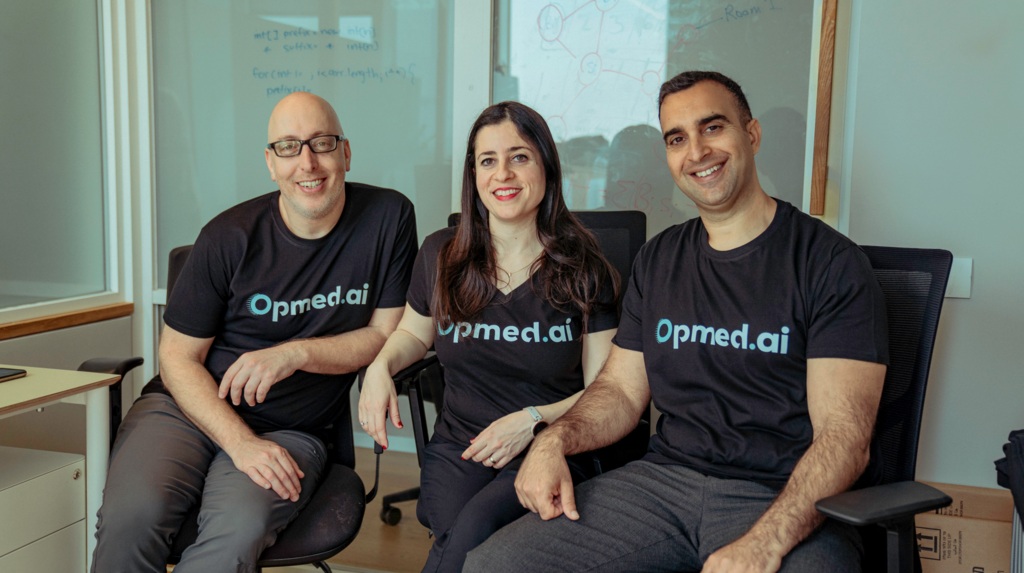
The intellectual route to that calendar runs through a physics laboratory. Co-founder and chief scientist Baruch Barzel studies complex networks at Bar-Ilan University. In his account of Opmed’s origins, future CEO Mor Brokman Meltzer brought him a proposition: apply the tools used to understand infrastructure networks to hospitals. Avi Paz, the third co-founder and CTO, supplies the software and technology leadership.
“There’s no more crucial infrastructure than hospitals.”
Mor Brokman Meltzer, as recalled by Baruch Barzel
Network science matters because a schedule is full of dependencies. A free room means little without the right nurse, anesthesiologist, surgeon, and equipment. Two attractive assignments may require the same person. A well-packed surgical day may send too many patients into recovery together. Opmed models these relationships, combining duration predictions with optimization under local constraints. The recovery unit belongs in the calculation.
Consider an illustrative scheduling problem: three rooms each have a short unused interval. Those intervals may be useless to a patient needing one longer procedure. Rearranging existing cases could gather the spare time into a usable opening, provided staff and recovery beds remain available. That is the distinction between counting empty minutes and making them useful.
Conceptual workflow, not measured performance.
02 / A better estimate buys a better question
The most legible evidence concerns prediction. In an earlier company-published Mayo Clinic cardiac-surgery case study, Opmed reported reducing mean absolute duration-prediction error from 60 minutes per case to 34. Mean absolute error measures the average size of a miss, regardless of whether a prediction is early or late. Smaller misses give schedulers a firmer basis for planning.
How far did the estimate miss?
A newer collaboration, reported in June 2026 after presentation at ACC.26, used a separate validation cohort of 643 cardiovascular procedures. The best-performing model combined structured clinical information with physician notes. Reported mean absolute error fell from 1.13 hours to 0.564 hours, roughly half. This is a separate study; its figures should not be blended with the earlier case study.
Neither result means every operation suddenly finishes sooner. Nor does a reduction in prediction error automatically become cash. A hospital must turn better information into a feasible schedule, complete additional cases or reduce avoidable expense, and measure the result. An accurate forecast left unopened is still an expensive form of stationery.
03 / The calendar has to survive the hospital
Geisinger makes the coordination problem concrete. Its October 2024 announcement described using Opmed across 10 hospital campuses, including daily case and block optimization, staff allocation, and balancing workload between sites. Moving capacity across a network raises questions a single-room calendar cannot answer: which facility can take the case, with which resources, and under which constraints?
AtlantiCare’s January 2026 selection extended the announced scope to more than 50 operating rooms and procedural spaces. Reporting described deployment over its Oracle Cerner electronic health record. For buyers, this is a practical detail. Recommendations need operational data and a place in the working day. A persuasive demonstration has to become something a scheduler can use.
Opmed now presents its platform through three verbs: forecast, allocate, adjust. Its offerings cover surgical services, procedural services, and rehabilitation, alongside custom workflow configuration. Users can plan staffing, assess block allocation, anticipate resource pressure, and respond to delays or cancellations. Rehabilitation brings its own coordination puzzle: matching patients, therapists, disciplines, and available treatment time.
The market already contains capable alternatives, including LeanTaaS’s iQueue for Operating Rooms, as well as existing EHR workflows and manual planning. Opmed emphasizes network science, configurable constraints, and coordinated resource decisions. Those are reasons to examine the product. They do not establish superiority over a rival. A buyer should compare results against its own baseline and workflow.
04 / The expensive lesson was focus
Opmed’s business is enterprise healthcare software, sold through conversations and demonstrations. It raised $15 million in Series A funding in May 2024 from investors including NFX and Grove Ventures. Hospitals evaluating the economics need to separate additional revenue opportunities from expense reductions, then compare both with the commercial agreement and implementation effort.
The founder’s history supplies a useful discipline. In a June 2026 Grove interview, Brokman Meltzer described an earlier startup that served too many industries. Opmed began with a repeated hospital problem. Grove’s Renana Ashkenazi initially doubted the ambition; working hospital deployments and progress toward US customers changed her assessment. Focus made the proposition easier to test.
There is something readers can copy here: choose one operational decision, measure its current error, and test whether a better plan survives real constraints. The inference is straightforward. Poor data, inflexible staffing, or recovery bottlenecks can limit what scheduling gains deliver. Hospitals need room to act on recommendations. The reward, when the pieces agree, is a patient getting a usable opening in the hospital that was already there.