Sanjay Prasad was one year old when his family crossed an ocean. In 1962, they traveled by ship to the United States, a journey that took a month. He had been born in New Delhi. Before there were degrees, professional initials, a company, or a board to chair, there was a family making a consequential decision and spending weeks getting somewhere else.
That opening gives his biography an unusual sense of scale. A month is a long time to spend between an old address and a new one. An infant could hardly have directed the expedition. Yet the voyage belongs to the story of the adult who would eventually establish an independent working life in the Washington area, then begin building a company of his own.
Today, Prasad is founder and CEO of SurgiQuality and chairman of its board. His route there runs through university study, a long professional career, authorship, investor presentations, and the ordinary business of persuading people to listen. The interesting part is how much starting again requires of someone who has already spent decades establishing himself.
An experienced person brings knowledge to a new venture. He also brings habits, a network, and a particular vocabulary. Entrepreneurship asks which of those will travel. Prasad’s public account of his working life gives that question some texture: introductions made in person, ideas explained aloud, money committed, and a willingness to ask other people for help.
An education with several addresses
Prasad graduated magna cum laude in biochemistry from the University of Maryland. He earned his MD at the University of Maryland School of Medicine. Further training took him to a Johns Hopkins-affiliated hospital, Georgetown University Hospital, and the University of Pittsburgh Medical Center. At Pittsburgh, he completed three fellowships.
The sequence matters as biography even before one considers what he studied. It was a succession of institutions and successive rounds of learning, rather than one credential followed by a swift departure into commerce. Maryland, Georgetown, and Pittsburgh recur in accounts of his background. His later professional life would bring him back to the Washington area.
He founded Metropolitan NeuroEar Group there and served on the clinical faculty at George Washington University. Publications in professional journals and contributions to reference texts accompanied the work. Those are different forms of explanation: a classroom, a published argument, a conversation with a colleague. Each asks the expert to make knowledge legible to someone else.
There is a useful distinction between acquiring expertise and learning to describe its value. A degree records an accomplishment. It cannot introduce its holder to every person he hopes to work with. Prasad’s career makes that second task visible. The résumé was substantial; the introductions still had to be made.
The door-to-door years
Prasad began independently. In his own retrospective account, he describes introducing himself to colleagues in person, giving informal educational talks, publishing around a demanding schedule, and following up carefully with people who sent work his way. He stayed for conversations and learned names. This was the practical work of becoming known.
His recollection is affectionate toward those early methods. He says he would repeat them. The point is worth keeping: building a company later did not require him to dismiss the relationships that helped establish his first career. Personal contact had mattered, and he continued to regard it as useful.
The modest scale of these actions gives the story its human proportions. A founder’s biography can move so quickly from credentials to capital that the years of introductions disappear. Here, they are part of the account. The eventual executive once needed to make himself familiar, one encounter at a time.
“I would still go door-to-door.”
Sanjay Prasad / on beginning independently
A founder writes his own cheque
The venture began in 2014 with SurgiPrice, Inc., alongside SurgiQuality and SurgiConnect. That date places the business well before its later investor materials and pitch appearances. By August 2020, Prasad was presenting SurgiPrice at a Connectpreneur event. The public record shows an idea being carried into rooms where other founders and investors were listening.
A November 2020 company presentation listed a $2 million investment from Prasad himself. It also listed $410,000 from other investors in his profession. These were historical fundraising figures, attached to that presentation. For the personal story, the revealing number is the founder’s contribution: he had committed his own capital to the venture he was describing.
An investment changes the weight of an argument. It joins a belief to an exposure. The figure tells us something concrete about Prasad’s commitment without telling us everything about his finances or the business’s eventual fortunes. Two million dollars belonged to this particular entrepreneurial decision. It deserves to be read at that scale.
The same presentation named colleagues with responsibilities across operations, marketing, and engineering. His new project required skills distributed among several people. After years of independent work, he was presenting a venture whose organization chart had multiple disciplines on it. Being the founder meant having to explain the idea well enough for others to work on it.
That is one of the less glamorous changes in a second act. Experience can help a person recognize a problem, but a company needs people who can turn a proposed answer into daily work. Prasad’s investor appearances document that transition from a personal conviction to an enterprise asking for attention, resources, and collaborators.
Founder capital recorded in a November 2020 presentation.
Historical investment figureSeven point seven in Menlo Park
On July 25, 2024, SurgiQuality took part in Unicorn Pitches in Silicon Valley, held in Menlo Park. The event’s published results gave the company an average score of 7.70 and recorded it as the winner. Other entrants included machineMD, EarthGrid, and Ambient Scientific. For once, the founder’s argument came with a scoreboard.
The number is precise, and its meaning is limited to the competition. It records how that pitch was received in that setting. It does not settle every question a customer or investor might ask. Still, it is a concrete moment in the company’s public life: Prasad had taken a venture developed over years before a new audience and earned its vote.
The judging roster included investors, an entrepreneur, and a capital markets attorney. The room had its own standards and its own language. A professional explaining an idea to peers can rely on shared context. A founder presenting to such a mixed audience has to establish the context, explain the business, and make the reason for listening apparent.
Prasad later thanked the event’s network for the opportunity to pitch. The gratitude fits the mechanics of his career. Opportunities arrive through people, and the person asking for one has to show up prepared. The door-to-door introductions of an earlier period and the investor presentation belong to different settings, but both require him to explain himself to someone new.
SurgiQuality’s winning average score
A public voice, a private household
By 2021, Prasad had also become an author. His handbook received a review that July, and interviews about his work appeared across several programs. In August, he was a guest on Slice of Healthcare. In September, he spoke with Jonathan Westover on the Human Capital Leadership podcast. In October, he joined David E. Williams for a HealthBiz conversation.
These appearances made him available in another format. A presentation has a planned destination. An interview makes room for another person’s questions. The repeated appearances put Prasad’s biography, his motivation, and his business into conversations hosted by people outside his immediate professional circle. He was doing the work of explaining again, this time with a microphone.
His public biography also has a domestic scale. A 2021 book review described his life in the Washington area with his wife, Deepika, and their four adult children. That detail places the author and executive in a household. The children were already adults when the book arrived; the venture belonged to a life with substantial history behind it.
A second act is often told as though the first one vanishes when a new company appears. Prasad’s dates resist that tidy edit. The business began years before the book and those interviews. Family life, an established career, and a new venture occupied overlapping years. The story is less a sudden reinvention than the gradual addition of another demanding responsibility.
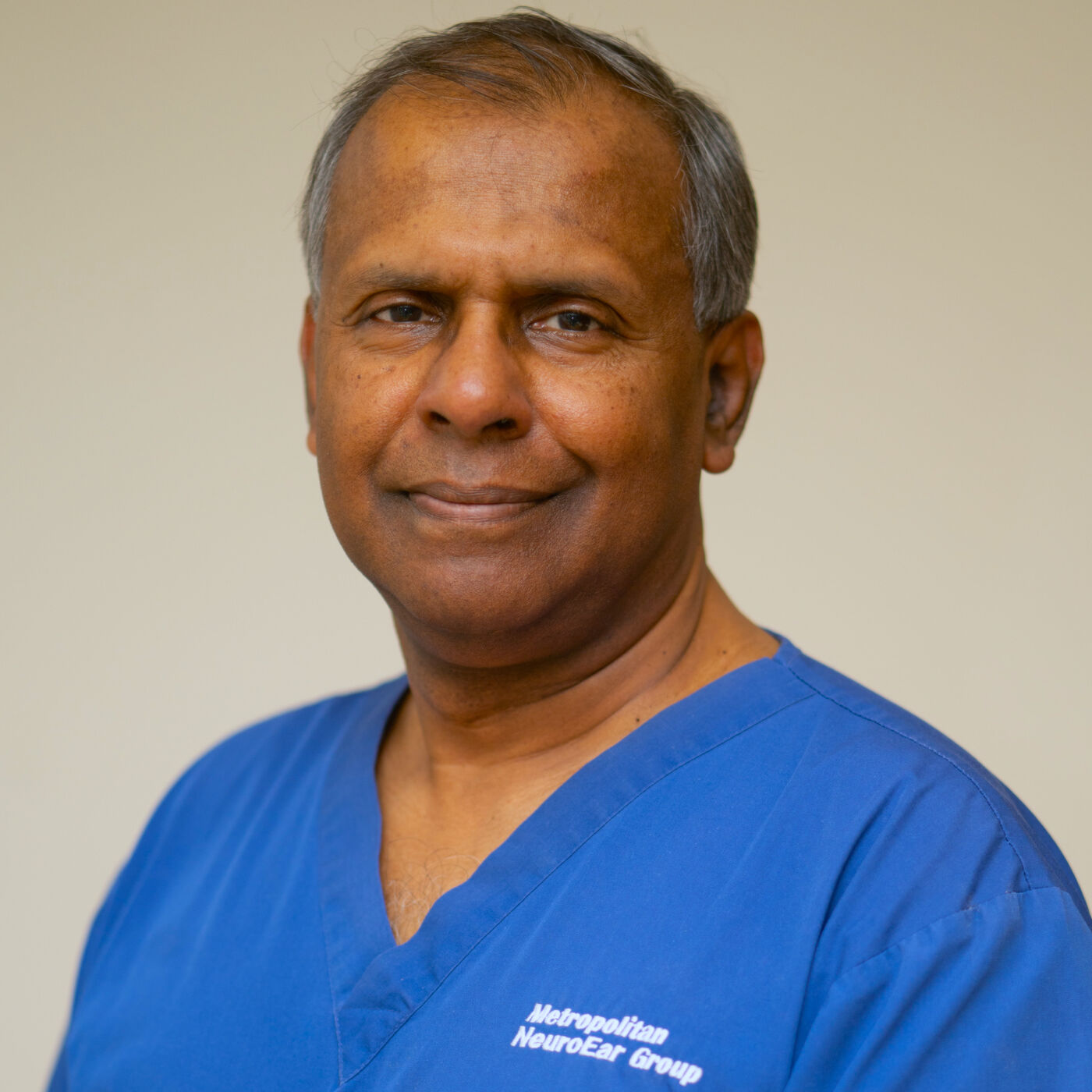
A different room, another introduction. Photograph accompanying Prasad’s Highway to Health appearance.
Still taking the call
Prasad now works with a leadership team that includes co-founder Marshall Besch in data operations and Tonya Hughes in client relations. Besch also serves on the board, alongside Prasad and Thomas Young. The arrangement makes clear that the company has separate jobs to do. The founder’s idea must pass through other people’s expertise to become an operating business.
He continues to offer half-hour conversations with people exploring the company. That small detail is more revealing than a grand statement about accessibility. Thirty minutes has a place on a calendar. It is a practical invitation to ask, explain, and find out whether two people have useful work to do together.
In his conversation with John Shufeldt, Prasad encouraged aspiring entrepreneurs to choose work they cared about intensely. He also welcomed guidance. “Our ears are wide open,” he said. The phrase leaves room for someone else to know something useful. For a person with so much formal training, it is a sensible way to enter another field.
The childhood voyage and the current invitation to talk sit far apart in time. Between them are institutions, introductions, a household, personal capital, and presentations to strangers. Prasad has accumulated experience without treating every subsequent question as already answered. His second act remains a working proposition, carried into the next conversation by someone who has spent a long time learning how to begin.
“Our ears are wide open.”
Sanjay Prasad / in conversation with John Shufeldt
Continue the conversation
Follow Prasad’s work, explore the competition results, or listen to a longer conversation.