Sanjay Dastoor helped start a skateboard company without having skateboarded. For someone entering the skateboard business, this was an unusual omission. For an engineer trying to get across Stanford, it was incidental. He and his collaborators had a journey to improve. The board happened to be a promising way of doing it.
“I’d never skateboarded before,” he recalled in 2018. Boosted had begun as something the founders wanted for themselves: a way to cross a spread-out campus, connect buildings and parking lots, and make the trip to a train less cumbersome. Before it was a company, it was a complaint about getting somewhere.
That distinction helps explain the career that followed. Dastoor would go from selling electric longboards at Boosted to co-founding Skip, which rented scooters for short city trips. The wheels changed. So did the customers, the responsibilities and the people entitled to have an opinion. A rider could love the machine while a city withheld permission to use it.
A skateboard without a skateboarder
Dastoor trained in mechanical engineering at Berkeley and Stanford, earning a bachelor’s degree at the former and a master’s at the latter. He also worked at NASA’s Jet Propulsion Laboratory and SRI International. His early professional direction was robotics, a field in which making something move is an occupation rather than a diversion.
At Stanford, he received a Bio-X Bowes Fellowship in 2006. His research concerned artificial actuators and manufacturing methods for robotics. Advisors included Mark Cutkosky and Scott Delp. His lab profile listed an interest in devices whose mechanical response could be varied. Long before the electric board, he was occupied with the relationship between materials, motion and control.
The people around him mattered. John Ulmen, a labmate, was working with compact motors and batteries and saw a use for them on a longboard. Matthew Tran, an engineering classmate, brought an interest in motorcycles and snowboarding. Their eventual collaboration made sense of ingredients that had arrived from different directions.
There is a pleasing modesty to that beginning. A university supplies ambitious research questions, expensive equipment and people who understand it. It also supplies inconvenient distances between buildings. The future of transportation could wait a moment. Someone still had to get across campus.
The board leaves the lab
Boosted joined Y Combinator’s summer 2012 batch. Dastoor and his co-founders also participated in StartX. A project that had fitted around other commitments was becoming a business, and the intended audience was growing beyond people who happened to encounter its creators.
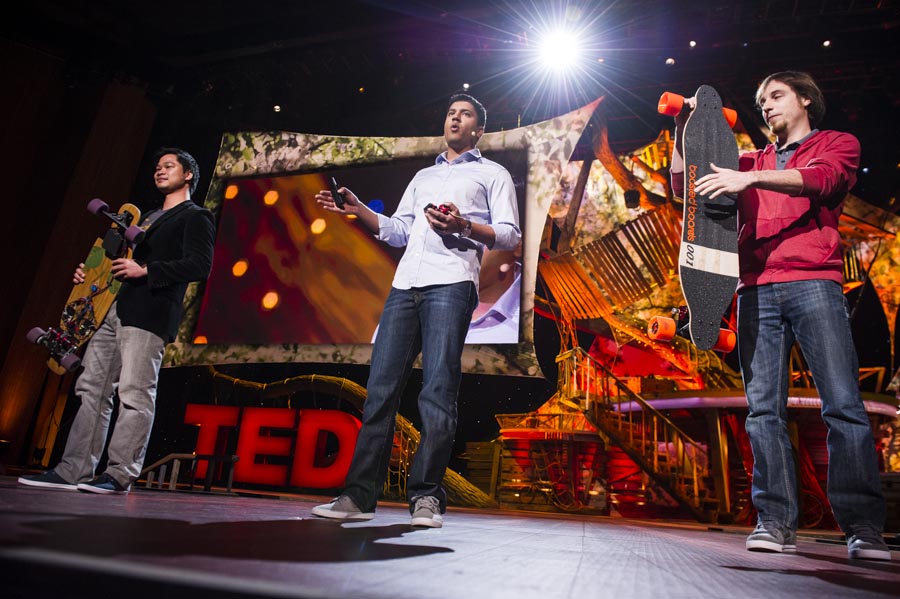
At TED2013, Dastoor stood onstage with his colleagues and showed what the idea had become. The pitch was unusually portable. Here was an electric vehicle that could be carried by hand, charged from an ordinary outlet and used for a short commute. Ulmen and Tran joined the demonstration, boards conspicuously present.
The attraction lay partly in scale. The battery offered about six miles of range in that early presentation. An audience accustomed to thinking of electric vehicles as cars was being asked to consider a machine that could accompany its owner indoors. Parking, for once, could mean putting something away.
Dastoor’s contact with prospective riders could be equally direct. Justin Veenema, visiting San Francisco, posted in a Facebook group seeking a test ride after failing to find a board in stores. His offer was lunch in exchange for borrowing someone’s equipment.
Veenema later described Dastoor answering personally and delivering a loaner to his hotel at 10:30 at night. They talked about the product and its future. A CEO arriving with demonstration equipment is a rather literal form of customer acquisition. In this case, the customer had not yet acquired anything.
Related technology. A different business to run.
The scooter skeptic
After Boosted, Dastoor did not immediately regard scooters as the obvious next chapter. Tran was interested in sharing them. Dastoor thought people would prefer bicycles or skateboards. This is an enjoyable detail in the biography of a scooter-company co-founder: the proposition first had to survive his own doubts.
He later conceded the point with economy: “He was totally right.” Skip brought Dastoor and Tran together with Mike Wadhera. Founded in 2017, the company went through Y Combinator’s winter 2018 batch. The earlier accelerator experience had not exhausted the usefulness of returning with a different business.
That business offered access to a vehicle rather than ownership. With Boosted, the rider bought the board and took it home. With Skip, riders found and unlocked a scooter using an app, then ended the rental when they arrived. The company retained the machine and the continuing job of keeping it available.
The convenience had an administrative consequence. A privately owned board could go under its owner’s desk. A shared scooter waited in public space for someone else. The next person to encounter it might be a customer, a pedestrian or an official. All three had a legitimate interest in what happened next.
The people who never unlock a scooter
Dastoor favored talking to cities before launching. Washington, D.C., already had a process for dockless bike sharing, and Skip worked with its transportation department on permission for scooters. Although based in San Francisco, the company began elsewhere rather than treating its home city as a place where deployment could precede discussion.
He could also be amused by the politics of curb space. Asked how many car parking spaces Portland should remove for scooters, he answered, “All of them?” Then came the laugh and the qualification. Cars had useful jobs. The point was a wider choice of vehicles, appropriate to different journeys.
“All of them?”
Dastoor, asked how many car parking spaces should make way for scooters, before laughing and qualifying his answer.
His stated preferences included more protected bike lanes and less dependence on infrastructure built around cars. They were compatible with a fairly practical view of driving: a trip through the Columbia River Gorge or a delivery might suit a car perfectly well. Sitting in traffic for a short downtown trip suggested room for another option.
In August 2018, San Francisco selected Skip and Scoot for its one-year scooter pilot. Twelve companies had applied. The city emphasized public space, accountability and access in explaining its choice. For Dastoor, cooperation with officials had produced something tangible: a place in the program.
The award came with obligations. Before permits were issued, the city required revised community engagement plans. Even the successful applicants had more work to do. Winning an application was the beginning of a relationship with a city that expected to keep asking questions.
Designing for tomorrow morning
At Skip, the hardware also had to account for the person who would repair it. In August 2019, the company introduced the S3, designed in-house for shared use. Its modular construction allowed components to be serviced individually. Swappable batteries offered a way to recharge without transporting the entire scooter every time.
These decisions give Dastoor’s engineering instincts a visible shape. The rider experiences a journey. The operator experiences an object that must make many journeys, with inspection, charging and repair between them. A design can make those jobs easier or leave the operations team to compensate.
Buy the board Keep the board
Ride Recharge Repair
The distinction reaches beyond specifications. Skip employed technicians at a San Francisco repair facility. They were part of the service even when a customer never saw them. A fleet is a collection of working machines, and keeping them working is employment, space, equipment and scheduling.
Dastoor’s career had brought him from the technical possibility of a small electric vehicle to the repeated labor required to operate one commercially. The workbench was still there. Around it had accumulated a warehouse, an application, a maintenance routine and a municipal agreement.
Permission has an expiry date
San Francisco did not renew Skip’s place in the next permit round in 2019. The company announced 34 layoffs and the closure of its local maintenance facility. Headquarters remained open, and operations continued in Washington, D.C. For the repair team, however, a regulatory decision had become a change of employment.
The reversal gives the earlier permit its proper weight. Skip had been selected for a pilot, a program designed to be evaluated and followed by another decision. Experience in the city had not guaranteed continued access. For a founder, the relationship required renewal on terms the company could not set alone.
The later Helbiz arrangement also deserves precision. Beginning in January 2021, Helbiz leased Skip’s Washington, D.C., operating license for a year and rights to use the app for nine months. It supplied its own scooters and operations. The arrangement did not include buying or leasing the rest of Skip’s assets.
Skip Transport filed for Chapter 7 in August 2021. That was the company’s bankruptcy. The useful ideas in its vehicles and operating approach belong alongside the ending, but they cannot make the ending disappear. Dastoor’s two-company story includes products people wanted and businesses exposed to constraints that enthusiasm could not settle.
Still a place for a soldering iron
A smaller detail provides a way back to the person. Asked about an underappreciated tool in 2020, Dastoor chose a butane soldering iron. It was portable, heated quickly and had proved useful for repairing customers’ boards. His preferred object came with a job attached.
He had also been experimenting with cellular connectivity on his own Boosted and thinking about greater involvement in local government. The combination fits the questions his companies had raised: how to make physical equipment work, and how to participate in the systems around it.
By June 2022, he was discussing an early hardware project with former Boosted and Skip colleagues. The next product was still exploratory. The attraction of making physical things had survived both companies. The first board had begun with somewhere he wanted to go. Years later, the pleasure of building something usable remained a reason to start.
More from the workbench and the street
Watch, listen, or follow the conversation.
Watch: A skateboard, with a boost · TED2013 ↗The Boosted and Skip conversation · 2022 ↗Prototypes, batteries and favorite tools · 2020 ↗New Wheels in Town · 2018 ↗Stanford research profile ↗LinkedIn ↗Twitter / X ↗Facebook ↗Wellfound profile ↗