In 2017, Samyr Qureshi and four other young men were living in one house, working without salaries and eating a dish they called “Knackeroni.” The ingredients were vegetable pasta, ground turkey and a generous application of sriracha. It was an early-company meal with the early-company virtues: cheap, repeatable and unlikely to require a reservation. The business they were trying to build was less accommodating.
Knack connected college students who needed tutoring with peers who could provide it. The premise had appeal. The arithmetic did not. Acquiring students cost too much relative to what those students would spend. They left too readily. Basic operations consumed about $4,500 a month, Qureshi later recalled. A shared kitchen could reduce expenses; it could do little about the economics of selling tutoring one student at a time.
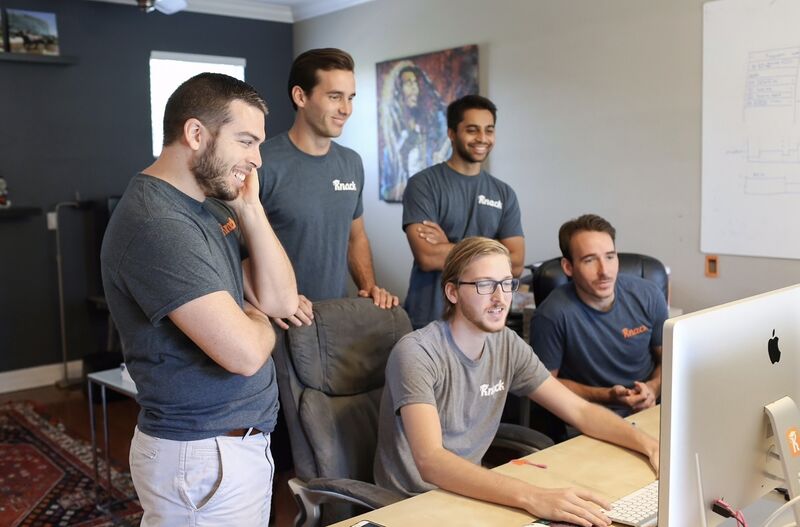
The photograph from those early days shows five people gathered around a desktop computer, several wearing Knack shirts. There is a sofa, a whiteboard and enough concentrated attention to suggest that the screen matters. Qureshi stands behind the seated group, arms folded, smiling. Looking at it now, the tempting thing is to call the outcome inevitable. The pasta budget suggests otherwise.
What makes his story interesting is the decision that followed. Qureshi and his colleagues kept the peer-learning idea, while changing the customer responsible for the bill. Universities would become partners and pay for support. Students could receive tutoring without buying each session themselves. The change required a different product, a different sales approach and a willingness to hear an uncomfortable answer.
A tutor before a founder
Qureshi was born in Abu Dhabi and grew up in the Tampa Bay area after moving to the United States with his mother and sister. He describes himself as Pakistani-American. Learning a new curriculum alongside a new culture was difficult. His mother tutored him, giving him the individual attention that would later sit at the center of his business.
The subsequent educational record looks almost impatient. Through early college enrollment at St. Petersburg College, he earned an associate of arts degree in 2011 while still in high school. He served as student body president at the college and became a tutor himself. Help had changed his own experience; he was now in a position to offer it to somebody else.
He remembered enrolling early partly because high school bored him. College offered flexibility, independence and a new mix of classmates. He also remembered an English professor, Ned Johnson, who pushed students to write creatively and sometimes dressed as Mark Twain in a white suit. Qureshi won Johnson’s annual writing competition. Before the pitch decks, there was an audience that expected him to put a thought into words.
At the University of Florida, he completed a bachelor’s degree in criminology and law in 2014. His childhood ambitions had included becoming an attorney and a rock star. Neither ambition quite predicted university procurement meetings. Still, writing, persuasion and music would all have their uses. His route into technology passed through work at Nielsen, Apple and Gartner, where he became an emerging-technology account executive.
A guitar lesson, then a campus
Another part of Knack’s origin involved a guitar. A more experienced friend helped Qureshi learn to play. He admired the friend’s style, and the friend understood the level at which he was starting. Learning at home felt natural. That experience gave him a practical example of instruction between peers: someone close enough to remember the difficulty, skilled enough to help with it.
The sharing economy was also attracting his attention. He had studied people and social systems, then worked around emerging technology. He was interested in how a digital service could establish trust between people and arrange a meeting in the physical world. A college campus supplied a concentrated setting for testing that idea. Students already shared courses, professors and places to meet.
He left Gartner and co-founded Knack in 2015 with Dennis Hansen, David Stoker and Shawn Doyle. Hansen brought the venture into the University of Florida’s Gator Hatchery incubator. The team had assumptions to test, rather than a finished formula. An early Startup Weekend appearance went poorly. In 2016, Knack won the university’s Big Idea business-plan competition and its $25,000 prize, then moved to Tampa.
The award supplied money and an encouraging verdict. It did not supply a working business model. That distinction would become expensive to ignore. The useful part of the early proposition was precise: a student who had succeeded in the same course could help another student taking it. Turning that familiarity into a dependable service required finding tutors, organizing sessions and giving somebody a reason to fund the arrangement.
St. Petersburg College
University of Florida
UF Big Idea competition
The student stayed. The payer changed.
Qureshi’s account of the pivot includes a student-government leader at a large state university. Knack had spread across more than 100 campuses through grassroots promotion when the leader asked about subsidizing the service. The campus, they felt, was failing to reach enough students. Someone inside a university was describing both a problem and a possible budget for solving it.
The request changed the question. Instead of asking only whether an individual student would buy a tutoring session, Knack could ask whether an institution would fund a network of student tutors. A university already had an interest in students completing courses and staying enrolled. High-achieving students could earn money helping classmates. The student seeking help could arrive without first making a purchasing decision.
By 2019, the company was moving from its student-paid model toward university partnerships. Qureshi has described hundreds of customer conversations during the broader transition. Listening sounds pleasantly inexpensive until it leads to rebuilding a product and teaching a team to sell it differently. Knack had to learn institutional buying, which comes with calendars, committees and budgets. The campus was familiar; the route to a signed agreement was new.
The model also preserved a local kind of expertise. Knack’s tutors could be classmates who knew the course and its professor, with sessions online or in person. Technology handled connections and coordination. The learning still involved one person explaining something to another. For Qureshi, whose own examples included his mother and a guitarist friend, that arrangement had a recognizable shape.
The chief executive and the coffee machine
Asked what he did at Knack in 2019, Qureshi answered, “Everything… except software development.” His description of a day included sales meetings, marketing copy, employee onboarding, quarterly objectives, individual conversations and replenishing the coffee machine. It is a respectable range for one job title. The coffee, at least, offered a reasonably short implementation cycle.
His fundraising experience was similarly varied. Over the years, Knack’s supporters included Precursor Ventures, New Markets Venture Partners, Jeff Vinik, ETS, Lumina Foundation and Arizona State University Enterprise Partners. The mix matters: venture investors, an individual business leader, education organizations and a university-associated investor all found reasons to back the company. Qureshi described thousands of meetings across the fundraising journey.
Recognition arrived alongside the work. He joined the education category of Forbes’ 2020 30 Under 30 class, received Tampa Bay Tech’s Emerging Tech Leader of the Year award in 2020 and became a University of Florida 40 Gators Under 40 honoree in 2021. In 2026, the Tampa Bay Business Journal included him in its 40 Under 40 class. These are dated milestones, rather than a substitute for the operational story.
There were smaller signs of scale, too. By 2024, a payroll-compliance interview described employees in seven states. Remote hiring meant registrations and recurring administrative work as well as access to talent. The founder who had started with a campus marketplace was now responsible for an organization spread across state lines. Growing a tutoring company involved rather more paperwork than finding someone who understood the homework.
A decade, then a different seat
In October 2025, Knack announced a Series B and a change at the top. Qureshi moved from chief executive to executive chairman. Megan Dusenbery, whose experience included 15 years at Kaplan Test Prep, became CEO. After a decade leading the business, he was giving daily executive responsibility to a successor while retaining a role in its direction.
At that point, he described a global team of 32 full-time employees and tens of thousands of student tutors across partner campuses in the United States. He also described established product-market fit, multiyear partnerships and clearer operating playbooks. These were his reasons for judging that the company could enter another phase. The choice followed the funding round; it was part of deciding how to use the next chapter.
His question was “What role creates the most value for the company and our mission?” The answer, for him, was supporting Dusenbery, refining strategy and opening doors to partners. A founder can remain closely attached to an idea without keeping every responsibility that once came with it. Qureshi’s explanation made the handover a decision about useful work, rather than an ending written around a title.
He was candid about the market he had chosen. Selling education technology meant seasonal cycles, constrained budgets, bureaucracy and staff turnover. He joked that he would hesitate to recommend it even to an enemy. Having spent years learning those conditions, he still saw enough purpose in the work to stay involved. An institution may take a long time to say yes; a student’s difficulty with a course arrives on its own schedule.
“What role creates the most value for the company and our mission?”Samyr Qureshi, on becoming executive chairman in 2025
The music continues
Qureshi’s present working life extends beyond Knack. He lists advisory roles at MagicSchool AI and Atomic, and a venture-partner role at Deep Acre. His personal site also describes small investments in founders, including education ventures such as Primer and Mentava. The person who spent years looking for backers now occupies some of the seats on the other side of the conversation.
His interest in useful connections between digital services and physical life remains visible. Knack began with those connections on a campus. Advisory work gives him other settings in which to consider customers, partnerships and routes to market. The experience he brings includes a business that needed to change who paid before its original learning idea could travel further.
Music has survived the career changes. He calls himself a songwriter, links to an artist page on Spotify and has spoken about writing and playing with vintage analog equipment. Earlier profiles mention live music and time outdoors with his dog, Koda. These details are small, but they keep the picture of a founder from becoming nothing more than a sequence of financing announcements.
The most revealing continuity is his movement between learner and teacher. His mother helped him. He tutored. A friend helped with guitar. He built a company around students helping students, and now advises other founders. The early house and its economical pasta belong in that sequence as well. Knack advanced when its founders accepted that they had something left to learn. Qureshi’s next role gives him another way to pass the lesson along.