When Qapita opened its new Hyderabad office, the person chosen to inaugurate it was Sai Tanmaiyee, a recent intern who had become a full-time employee. Ravi Ravulaparthi described the choice as a spontaneous team decision. In a business devoted to employee ownership, the youngest employee got the ceremonial job. For once, seniority could sit down and wait its turn.
Ravi paired the occasion with a photograph of an earlier office: four seats, against the new space's 125. The numbers made a tidy growth story. His accompanying remarks were more revealing. He thanked customers, called investors his co-pilots, and described Hyderabad as his original home and Singapore as his adopted one. Behind the expanding floor plan was a founder taking stock of the people who had helped him get there.
That scene offers a useful way into Ravi's career. He spent years working on other people's transactions before starting a company concerned with who owns what. Along the way, he has returned to a related question: who gets to participate? Founders, certainly. Investors, inevitably. Employees, too - including the colleague who has only just exchanged an internship for a permanent desk.
A banker changes sides of the table
Ravi arrived at entrepreneurship with a substantial professional life already behind him. An engineering graduate of IIT Madras, he earned an MBA at IIM Bangalore, where his public profile lists attendance from 2001 to 2003. His career began with the Tata Group and continued through investment banking roles at Macquarie and BNP Paribas. Before Qapita, he worked at Rippledot, the Singapore-based financial advisory firm.
His work covered capital raising, mergers and acquisitions, debt financing, corporate strategy and principal investments. Those are different ways of arranging a company's future: bringing money in, changing its owners, or deciding what it should become. Across roughly 17 years in investment banking and corporate development in Asia Pacific, he acquired a close view of the machinery behind business announcements.
He also became an angel investor and an adviser to entrepreneurs on transactions and strategy. This matters to the chronology. Qapita did not begin with a founder encountering ownership records for the first time. Ravi had worked alongside people raising money and had seen gaps in the way their ownership was recorded. The problem belonged to a world he already knew.
A transaction has an announcement date. Keeping the records useful is a continuing job. Every new investor, employee grant and subsequent financing adds another entry that somebody must understand. The adviser can help close a deal; a software company has to remain useful on the ordinary Tuesday that follows. Becoming a founder meant taking responsibility for those Tuesdays.
Three friends, three kinds of experience
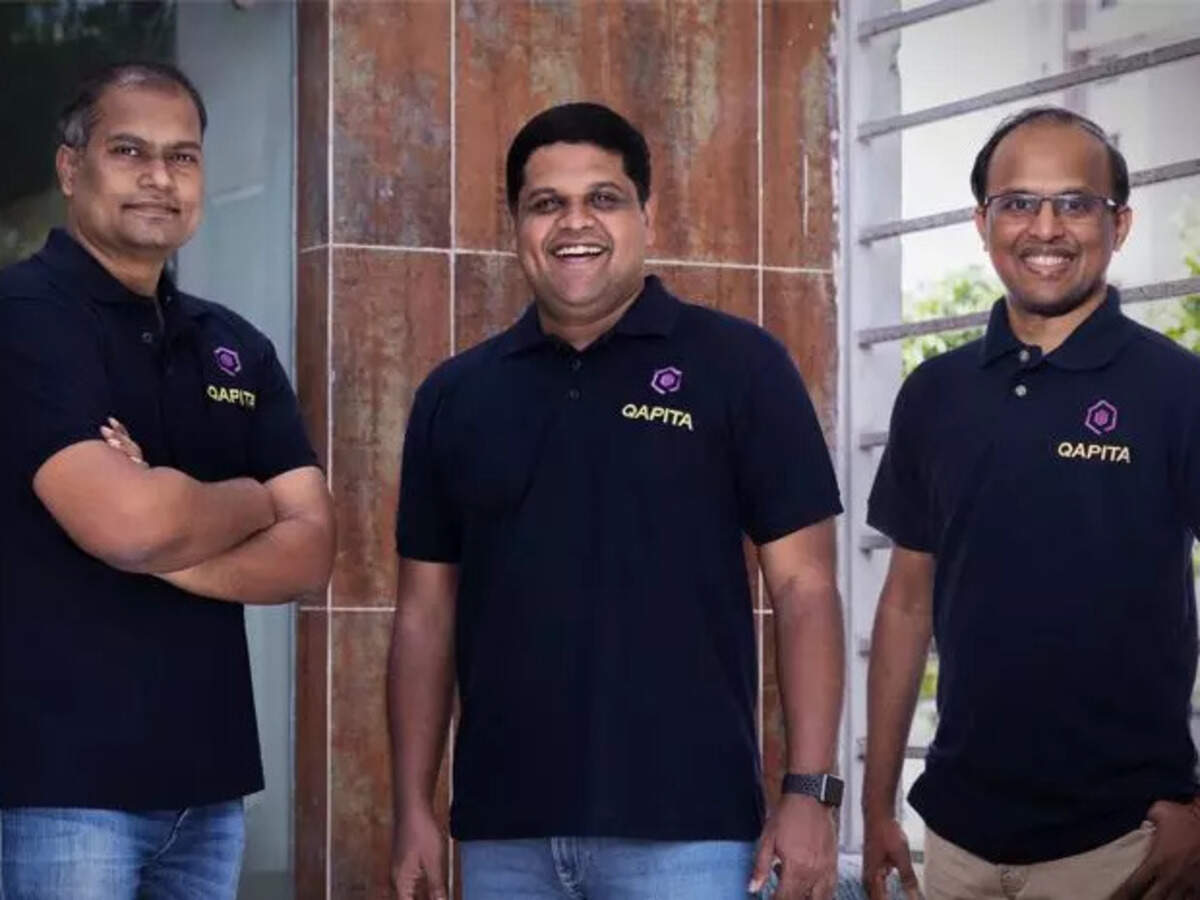
Qapita was founded in 2019 by Ravi, Lakshman Gupta and Vamsee Mohan. Ravi became CEO, Lakshman COO and Vamsee CTO. Their company describes the combination as a banker, investor and technologist. The three had known one another for a couple of decades, followed one another's careers and become friends before becoming business partners.
That history gives the founding story its particular texture. The team brought different professional skills to an old relationship. Ownership software requires several kinds of understanding at once: how companies finance themselves, how investors think, and how to build systems that people can actually use. Their respective backgrounds placed those concerns around the same table.
The initial work was concrete. Qapita helped companies manage capitalisation tables - the records showing their ownership - and employee stock option plans. It also set out to digitise share and option issuance. These subjects rarely compete successfully with a product launch for attention. Yet a company promising employees a stake in its future needs a dependable account of what it has promised.
Cap tables · Stock plans · Transactions
In September 2020, Qapita announced a $1.8 million seed round led by Vulcan Capital. A $15 million Series A followed in October 2021, led by East Ventures and Vulcan Capital. The financing gave the founders room to expand their software and liquidity ambitions. It also turned a familiar professional frustration into a company with customers, investors and its own obligations.
The promise inside the paperwork
At TechSparks in 2021, Ravi discussed private markets alongside Endiya Partners' Sateesh Andra. His emphasis was on the value of organised information. Private companies have less readily available information than their public counterparts; making ownership data usable could help people participate with greater confidence.
“Organising data is beneficial for people to invest into this sector.”Ravi Ravulaparthi, TechSparks 2021
The sentence is modest, which suits the subject. A capitalisation table cannot manufacture a successful company. It can make the company's ownership easier to understand. For Ravi, that administrative foundation connects to a wider ambition: helping founders, investors and employees participate in the value a business creates.
There is a human story tucked inside the vocabulary. An employee stock option is a contractual opportunity tied to the company's future, rather than a salary payment already received. Records and communication matter because the person receiving it has decisions to make. Software becomes useful when it makes those arrangements easier to administer and explain.
In July 2022, Qapita acquired ESOP Direct in an all-cash transaction. The announced combined business would serve more than 1,200 companies across India and Southeast Asia and cover more than 130,000 employee owners. For Ravi, the acquisition extended the work beyond a startup's early financing rounds to businesses at later stages, including listed companies.
The acquisition also joined technology with a practice built around equity compensation. A young software company can gain breadth by bringing experienced specialists into its orbit. Here, that breadth matched the original problem: ownership continues to require attention as companies grow, acquire staff, raise capital and eventually enter public markets.
Four chairs, two homes
The Hyderabad office comparison, shared in September 2024, makes the expansion less abstract. Four seats is a room you can count at a glance. A 125-seat space requires a different kind of coordination. Ravi credited the customers whose trust made that growth possible and the investors who helped support it. The photograph was about more than furniture.
Seats in the first office and the new office.
Office capacity, not an employee count.
He described Hyderabad as Qapita's engineering nerve center. The city has a personal place in his account, too. His phrase about an original home and an adopted home connects the company's geography to his own. Singapore provided the starting base; Hyderabad was part of the team's working life and Ravi's sense of belonging.
Sai Tanmaiyee's part in the opening adds a small, specific detail to that map. Ravi did not merely say that people mattered. He shared an occasion on which a junior colleague had been given the visible role. The anecdote does not need to prove an entire culture to be worth keeping. It shows one choice the team made, and one Ravi wanted others to notice.
Learning before the ending is written
Two months later, Ravi took the stage at the Singapore FinTech Festival's Founders Peak. His talk was called “7 Stories, 7 Lessons: From the Diary of a Mid-Career Professional Turned Founder.” Friends had encouraged him to speak about experiences particular to him. He described the prospect as both exciting and nerve-racking.
He had learned from other entrepreneurs' journeys, but noticed that many accounts were written after success, scale or an exit. He wanted to share his own while Qapita was still being built. That decision gives the talk its interest. An unfinished account leaves room for uncertainty; it cannot quietly rearrange every earlier decision into a step toward the known ending.
His lessons included rediscovering how to learn, involving the people who support a founder, and preparing for unexpected opportunities. Co-founders and employees should share responsibility for the direction of the business. Family belongs in the account as well, because the demands of building a company reach beyond the office.
“I am a work-in-progress… and so are you...”Ravi Ravulaparthi, reflecting on his Founders Peak talk
For someone with years of financial experience, an engineering education and an MBA, the invitation to become a learner again has weight. Experience helps identify a problem. Running a company brings new ones. His account allows the two to coexist: a founder can arrive well prepared and still have much to learn.
A new partner, a longer journey
On October 8, 2025, Qapita announced a $26.5 million Series B led by Charles Schwab, with Citi and MassMutual Ventures participating. Alongside the investment came a product collaboration: Schwab Private Issuer Equity Services, powered by Qapita, aimed at US private companies managing ownership and employee stock plans.
The collaboration carried the original idea into another market and another stage of a company's life. It was designed to support the transition to a public listing, reducing the need to change equity-management providers during an already demanding process. Ravi's ambition had grown from keeping records useful to keeping them useful across that longer journey.
His public conversations continued into 2026. In January, he appeared on the Trading Places podcast with Dave McClure and Aman Verjee to discuss Qapita, private markets and liquidity. He has also joined Brendan Marshall in The Catapult Code, a series of conversations with founders and investors about the decisions between starting a company and reaching the headline-making outcome.
That interest returns to the same unfinished territory as his own founder diary. The large funding announcement is easy to date. A friendship built over decades, a new skill learned, or a junior employee invited to open an office is harder to compress into a financial milestone. Ravi's story makes room for both. The ownership records may contain the percentages; the people explain why anyone wanted a share in the first place.