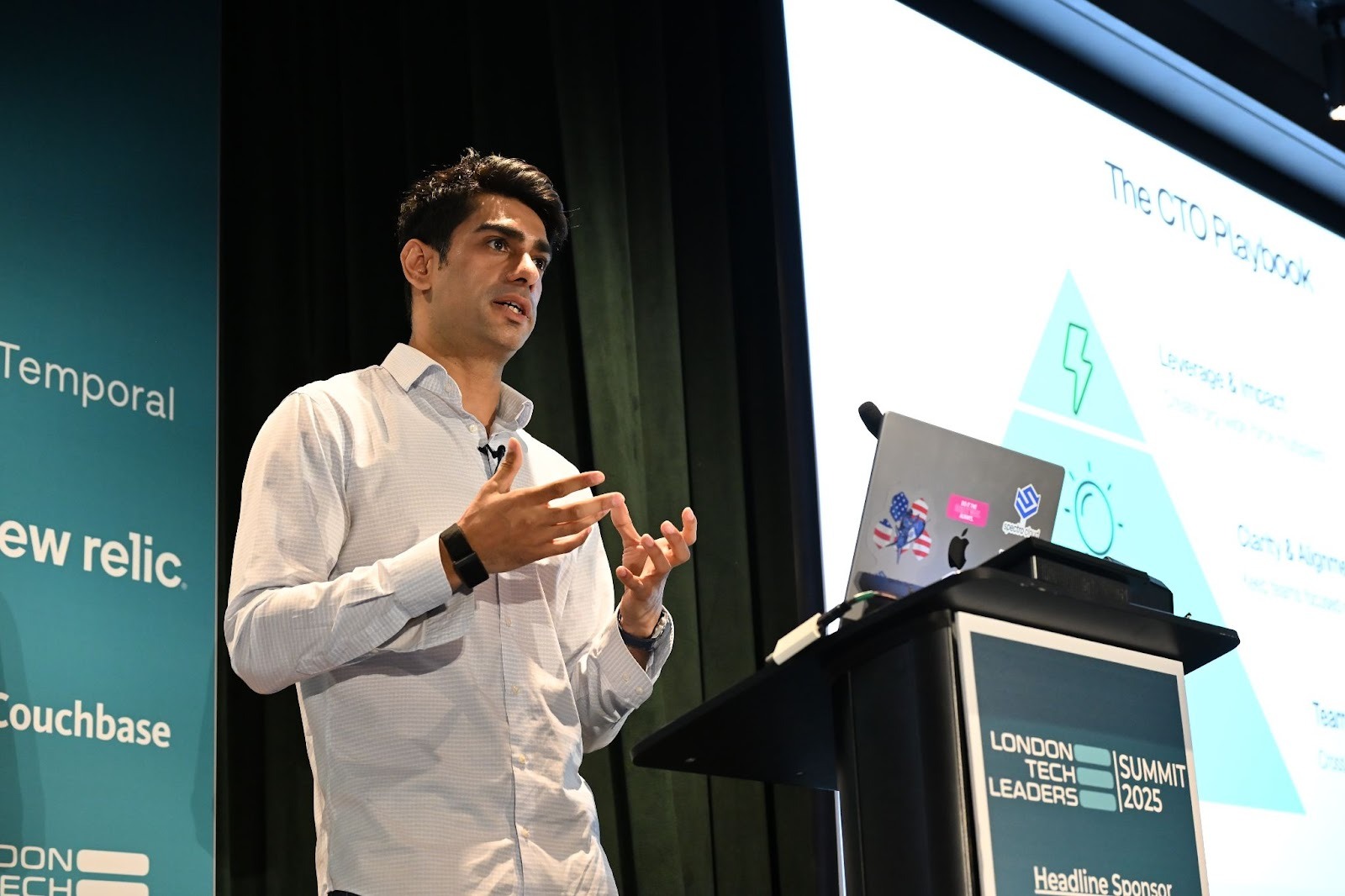
When Saad Malik stood on a London stage in October 2025, he noticed that his subject had changed. For years, the engineer and co-founder had spoken about Kubernetes, containers and infrastructure, the load-bearing nouns of his career. This time he was talking about leadership. The change made sense. Spectro Cloud, which began in 2019 with three founders, laptops and IKEA desks, had become a global company. Malik had gone from writing code to guiding engineering, product and operations. His central technical problem was no longer merely how to make computers coordinate. It was how to make people coordinate without requiring him in every loop.
This is the private comedy of the competent founder. The habits that make a young company possible can make a larger one unbearable. In the beginning, answering everything is useful. Later, it is a queue. Personal heroics become organizational latency. The engineer must design himself out of the critical path, which is a rather sophisticated way of discovering that indispensability is not always a compliment.
A startup apprenticeship in doing everything
Malik's working life began in the Bay Area infrastructure world. He studied computer science at San Jose State University and spent eight years as a software engineer at Cisco Systems. In 2013 he moved to CliQr Technologies, the multi-cloud management startup where small-team life erased the polite boundaries between departments. He wrote code, sold, supported customers and gave demonstrations. Whatever needed doing acquired the same owner: whoever was awake and capable.
CliQr was acquired by Cisco in 2016. Malik returned as a director of engineering, now able to see what happened when a compact startup idea entered a huge organization. The lesson was not simply that small teams can make consequential technology. It was that infrastructure remained stubbornly difficult across environments. Applications wanted to travel. The operating machinery beneath them remained a collection of local dialects.
In 2019, Malik co-founded Spectro Cloud with Tenry Fu and Gautam Joshi. The three had worked together before. Their premise was precise: Kubernetes had made applications more portable, but enterprises still needed a consistent way to manage the whole stack across public clouds, private data centers, bare metal and edge locations. They called the platform Palette. The company did not set out to invent another distribution. It set out to make many distributions, in many places, governable as one estate.
There was a pleasing symmetry to Malik's task. Kubernetes exists to reconcile declared intent with unruly reality. A CTO at a growing company does much the same. Spectro Cloud added people across engineering, product, marketing, sales and support. Informal decisions stopped traveling reliably. Malik began building playbooks and measurable goals, from code quality and security to customer satisfaction. He treated process as infrastructure: explicit enough to be repeated, flexible enough to survive contact with the world.
When the builder becomes the operating system
Malik calls the shift becoming a force multiplier. The phrase is common in management, but his account gives it teeth. A leader's job is to create systems, tools and frameworks through which other people can make good decisions. The pleasure of personally solving a hard problem gives way to the less visible pleasure of watching a team solve ten. It requires relinquishing a certain kind of applause.
His formulation of focus follows the same practical instinct. Focus, he has written, is not simply doing less. It is doing the right things in the right order. Spectro Cloud's sequence began with lifecycle management for Kubernetes infrastructure, then widened to bare metal and edge deployments, virtual machines and application management. More recently, it has moved into AI workloads, GPU clusters, model serving and inference economics. The grand idea behind the sequence is what Malik calls a “world computer,” a unified fabric linking applications and infrastructure across environments. The daily work is less cinematic: upgrades, policies, access controls, quotas and the occasional network that disappears at an inconvenient moment.
The company grew through that widening brief. A $75 million Series C arrived in 2024. In July 2026, Spectro Cloud announced more than $100 million in Series D financing, led again by Growth Equity at Goldman Sachs Alternatives, with strategic participation from AMD Ventures, Ericsson, LG Technology Ventures and Maximus. The capital was assigned to production AI infrastructure, a field with lavish hardware and rather mundane operational anxieties. GPUs are expensive. Models change quickly. Regulated organizations care where data travels. Someone must decide which requests may leave the building and who pays for the tokens.
AI meets the Tuesday-morning test
Malik's introduction to the recent AI wave was characteristically hands-on. When ChatGPT appeared, he built a quick AWS Lambda function and tried its code generation. Colleagues across Spectro Cloud began experimenting too: developers with coding assistants, support teams with triage bots, commercial teams with automated summaries. The enthusiasm produced a familiar infrastructure pattern. Every group had found a tool; nobody yet had a shared operating model.
His response was organizational before it was architectural. Spectro Cloud formed a cross-functional AI task force that included HR, sales and marketing as well as engineers. It developed guidelines for models, data sharing and security, including rules suited to government work. The move revealed Malik's mature CTO instinct. Technology adoption becomes real when the boring questions acquire owners.
By 2026, his writing had turned toward AI agents as production workloads and inference as a governed utility. Agents consume context, call tools, retry failures and burn tokens with an appetite no chat box prepared finance teams to expect. Malik's argument is that they should receive the same disciplines mature operators apply elsewhere: isolation, observation, quotas, policy and a record of cost. Local models can handle suitable work; frontier models can remain available behind controlled egress. The cleverness sits in routing each request without turning the whole arrangement into a casino.
This is also where Spectro Cloud's older work becomes newly relevant. The same platform ideas used to manage fleets of Kubernetes clusters can be applied to GPUs and inference services spread across data centers, clouds and edge sites. The nouns have changed. The need for consistent operations has not. Malik has spent a career arriving just after a technology's glamorous debut, when it needs governance, recovery and a maintenance schedule.
A useful AI model may run in a hospital, dental clinic, farm, shop or disconnected field site. At that point reliability and security are product features, not back-office concerns.
Starships, drones and dependable futures
The official biographies leave two small windows open. Malik is a hardcore Trekkie, and he builds autonomous drone-tracking software. Another conference biography adds LEGO spaceships with his children. These details rescue him from the gray cardigan of enterprise infrastructure. They also make a peculiar kind of sense. Science fiction supplies the world computer; engineering supplies the rollback plan.
There is plenty of frontier in his work. Spectro Cloud operates where cloud infrastructure reaches factory floors, restaurant back rooms, farms, defense environments and devices running NVIDIA Jetson. Yet Malik speaks about that frontier as an operator. In a 2025 edge AI talk, he described the dream plainly: package a model, place it in a container and deploy it to a device. Then he acknowledged the joke. It still sounds easy, he said, but it is not.
His conclusion was equally measured: edge AI can become reliable and scalable when security, consistency and cloud-native infrastructure are treated as fundamentals. This may be the most characteristic Malik position. He likes a speculative destination and distrusts a magical journey. The future deserves a control plane.
The founder with three laptops has become the executive who spends less time producing code and more time talking with customers, partners, investors and teams about what comes next. Yet the underlying craft is recognizable. He is still decomposing a large system, deciding which responsibility belongs where, and trying to remove single points of failure. One of those points used to be himself.
That makes his career less a departure from engineering than an expansion of it. The product is now partly organizational. The interfaces are conversations. The documentation is a playbook. The tests arrive as decisions made while he is elsewhere. A company that can pass them has learned the lesson its CTO spent years learning: resilience begins when no single machine, model or person has to carry the whole world.