The American açaí business began, in Ryan Black’s telling, with a contradiction. The fruit was already ordinary in Brazil and nearly unthinkable in California. On a trip to celebrate the turn of the millennium, the former football player found bowls of deep-purple açaí near the beach. A few days later, on the remote island of Fernando de Noronha, he asked a vendor how many people lived there and how many bowls he sold. The answers were roughly the same: 300 and 300. Everyone, it seemed, wanted one.
Black did not “discover” açaí. People in the Amazon had eaten it for generations, and Brazilian athletes had already helped popularize bowls in cities such as Rio. His discovery was commercial and logistical. If a frozen pulp could reach an island an hour from the mainland, perhaps it could reach his island too: the United States, where the category barely existed and the name defeated the uninitiated tongue.
He returned home with an idea, then left again to play one more football season in Europe. The delay is revealing. Careers rarely change with the cinematic neatness we assign them later. One identity was ending while another had not begun. Black had captained the University of Colorado team, led the NCAA in tackles in 1996 and briefly joined the Minnesota Vikings. He jokes that NFL meant “not for long.” Europe gave him more time on the field and a useful taste of living across borders. Açaí gave him somewhere to put the competitive restlessness that remained.
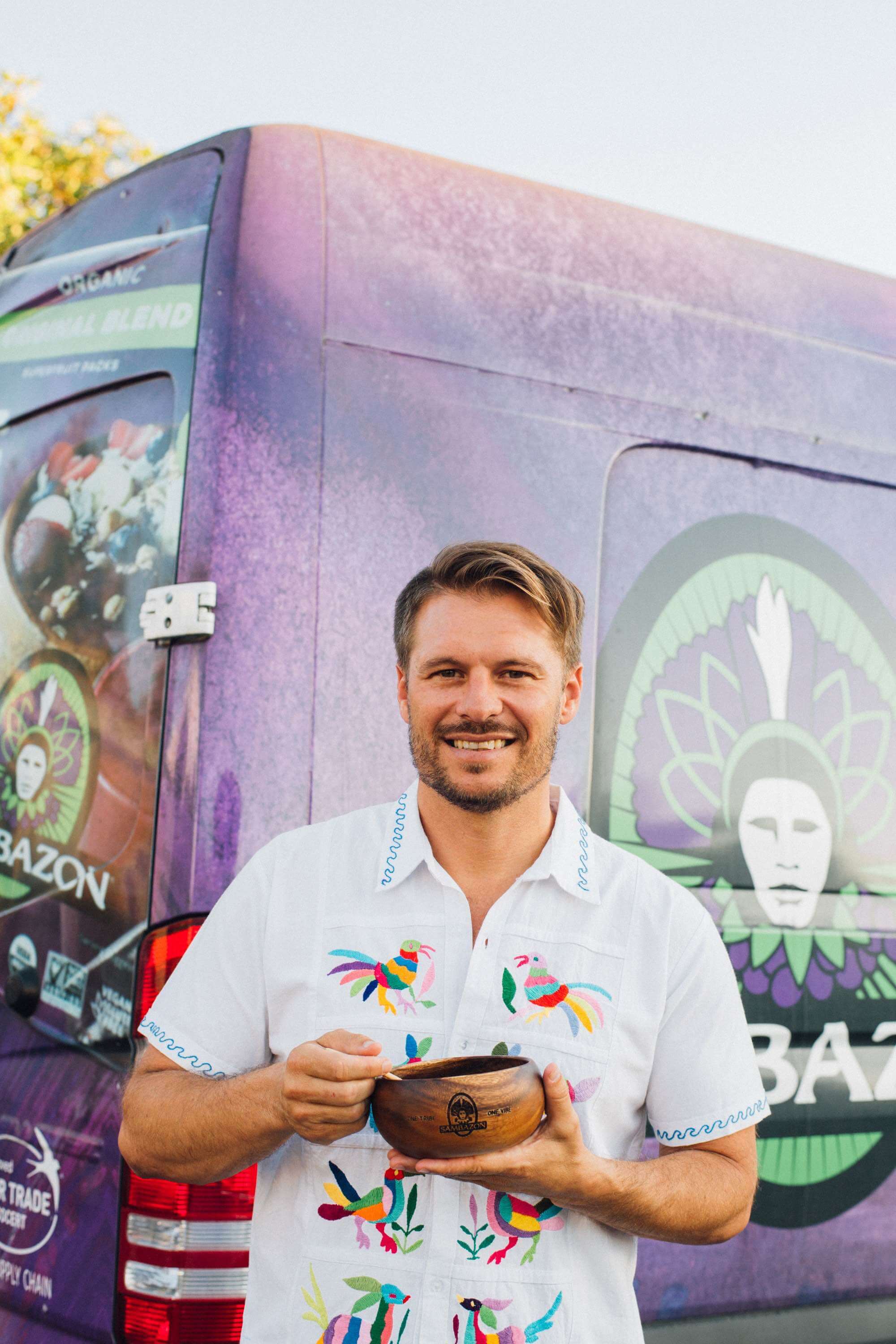
The phone book phase
Black founded SAMBAZON in 2000 with his brother Jeremy, Edmund “Skanda” Nichols and Travis Baumgardner. The name was a compact constitution: Sustainable Management of the Brazilian Amazon. They wanted a business that could make money, support the people at the beginning of the supply chain and reward keeping the forest standing. Today this gets filed under impact or purpose. At the time, it meant choosing the difficult version of nearly every early decision.
The founders first imagined shops. A friend offered more practical advice: sell the picks to the miners. Supply existing juice bars before opening a network of their own. Black and the team drove through Southern California, then Florida, Hawaii, New York and anywhere else they could locate likely buyers. Their discovery engine was a map and the local phone book. Their media strategy was a sample.
“The rest is a 20-year, overnight success story.”Ryan Black on SAMBAZON’s path into nearly 50 countries, 2022
Mother’s Market began carrying frozen packs in 2003. Whole Foods stores in Southern California followed in 2004. Bottled smoothies were less obedient. Early co-packing attempts did not work cleanly, and short shelf lives collided with a distribution system the young company did not possess. In 2006, SAMBAZON found an aseptic bottler in Southern California. A product that could last roughly 100 to 150 days opened larger supermarket doors. This was category creation by refrigerator math.
The familiar founder myth celebrates appetite for risk. Black’s version is more useful because it celebrates appetite for repetition. A strange product must be explained once, then explained again to a buyer, a distributor, a shopper and perhaps the shopper’s skeptical roommate. Before the word becomes culture, someone must patiently pronounce it at a folding table.
Purpose has paperwork
The front of SAMBAZON was education. The back was standards. Wild-harvested açaí moved through middlemen without the chain of custody a global food business required. Existing certifiers had no template for applying organic and Fair Trade rules to this particular crop. The company helped bring certifying organizations to Brazil and worked on standards for harvesting and cultivation. It built processing capacity near the fruit and froze pulp quickly enough to travel.
This is where the company’s ideals became harder to counterfeit. A mission printed on packaging may vanish at the first ugly quarter. A mission expressed through supplier relationships, certification, factories, audits and pricing is inconvenient to remove. It also has to withstand scrutiny. SAMBAZON publishes impact reports, and its current Palm-to-Palm app records more detail about origin, handling and quality while allowing communication with harvesters in remote areas.
Numbers give the rhetoric friction. In 2024, the company reported working with 827 individual harvesters across 256 communities and making more than 1,700 training and audit visits. It says lifetime investment in harvesting communities has passed $1 million. The point is not that a spreadsheet makes virtue automatic. It is that without names, visits, audits and dollars, “doing good” remains suspiciously weightless.
Black traces the philosophy to more than college idealism. At 26, early in the venture, he secured a meeting with Amazonas governor Amazonino Mendes. The governor appeared in white hair, white beard and an all-white suit. Black remembers a resemblance to Colonel Sanders and the nerves of waiting outside an Oval Office. Mendes described two earlier economic booms in the region, rubber and free-zone manufacturing. He suggested that a third might come from organic, exotic fruit, provided sustainability sat inside the model. The conversation gave a young founder’s instinct the dignity of a framework.
From player to coach
Sport supplied Black with a durable vocabulary for work. Persistence is getting knocked down and returning to the play. Leadership is accepting responsibility for more than your assignment. Balance is knowing when to leave the office and find a wave. In a recent interview, he described the first substantial outside investment as the moment his position changed. A board appeared. Other people’s money arrived. The founders were no longer merely teammates improvising together. Black had to become the coach.
His leadership principles are unfashionably physical: take the heat for your people, stay in the trenches, show up early, remain humble and keep scanning the horizon while specialists work. The football metaphors could feel ornamental if his career had not already tested both sides of them. He knew the public clarity of a scoreboard. He also knew disappointment, physical limits and the anticlimax of a professional stint that ended quickly. Business offered no final whistle and, in his view, no fixed ceiling on improvement.
“Leave things better than you found them.”The advice Black says stayed with him from his mother
That sentence is almost offensively modest for a corporate mission, which is precisely its charm. Black has proposed it as the basis of a movement he might call “Plus One.” No demand for sainthood, merely a requirement that the thing in your custody improves. It is a janitor’s philosophy and a chief executive’s burden. It applies equally to a balance sheet, a supplier relationship, a patch of forest and the mood of a room.
Surfing remains the useful counterweight. In 2008, he told Inc. that he owned four boards for different conditions, tracked swells online and rode goofy-foot, right foot forward. His favorite wave was a left break near Roti in Indonesia. “At the end of the day, it’s you against the ocean,” he said. The ocean, unlike a board meeting, cannot be persuaded by a deck. It has no interest in quarterly storytelling. One suspects this is part of the appeal.
The category catches up
By 2022, SAMBAZON was described as a business with more than $100 million in sales. Its mix had changed as the category matured: frozen packs, ready-to-eat bowls, sorbet, drinks, food service and branded shops. In 2024, Black was talking publicly about retail and franchise expansion. The first franchised bowl shop opened in Brooklyn in 2025. The old plan to build places where people could walk in and order a bowl had returned, now supported by the wholesale engine the founders built first.
In June 2026, Black received EY’s Pacific Southwest Entrepreneur of the Year award. SAMBAZON said its products were in more than 30,000 retail doors nationwide, with a growing shop footprint. Awards make tidy punctuation, but Black redirected the credit to employees, partners and grower families. It was the coach speaking after a long season.
He now lives in Austin with his wife, son and two Rhodesian Ridgebacks. His official biography lists travel, music, surf adventures and “yet to be famous Amazonian fruits” among his interests. The last item is funny and perhaps dangerous. One unfamiliar berry already required 26 years of his life. Curiosity, however, has never been famous for respecting the calendar.
The easy lesson from SAMBAZON is to follow a passion. The better lesson is to interrogate it. Can it survive customs, temperature, certification, supermarket shelves, investor terms and the change from founder-as-player to founder-as-coach? Can the story remain true when the phone book becomes an app and the sample table becomes 30,000 doors? Black’s wager was never only that Americans would like açaí. It was that the machinery carrying it could preserve the reason he cared in the first place.